
Pain

Physiotherapy care for knee osteoarthritis
INMOTION 31 Dec, 2021

Physiotherapy care for knee osteoarthritis


What are the experiences of physiotherapists delivering care for people with knee osteoarthritis, and how do these experiences align with the national Clinical Care Standard? Q&A with Rana Hinman and Samantha Teo.


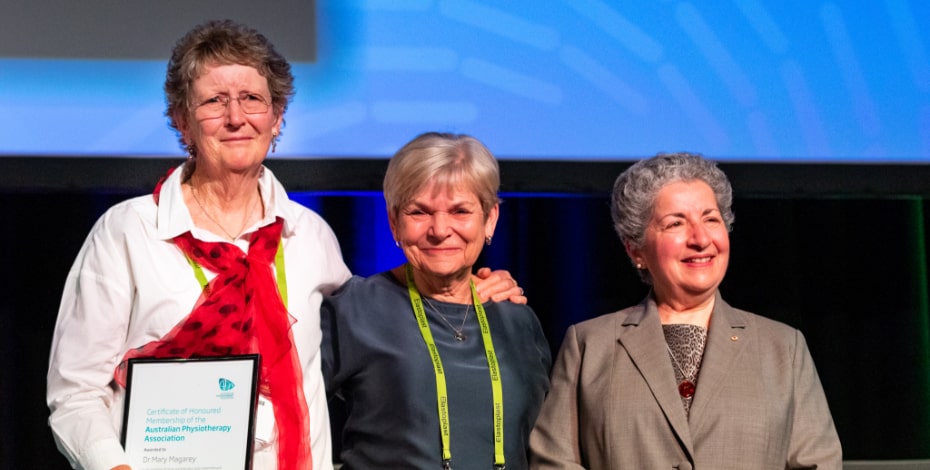
Professor Roberta Shepherd is an APA Honoured Member and an Honorary Professor at Sydney University. She is a pioneer in neurological and paediatric physiotherapy, working throughout her career as an educator and researcher. 

Talk about tricks will be a real treat
INMOTION 31 Dec, 2021

Talk about tricks will be a real treat


Using virtual reality, Tasha Stanton investigates how perceptions of reality can impact recovery from chronic pain.


With the presentation title ‘Perceptual trickery to shape our experiences’, clinical pain neuroscientist Associate Professor Tasha Stanton is sure to hold attention at the November APA Victorian Branch Breakfast.


The clinically trained physiotherapist studies the role that the brain plays in pain, exploring how information from myriad sources can shape a person’s perception of their body and environment.

Acute low back pain
INMOTION 31 Dec, 2021

Acute low back pain


Jon Ford presents a case in which treatment informed by a hypothesis of a nociplastic-dominant pain type was highly effective.


Low-back-pain (LBP) is a common and costly problem in the western world (Hurwitz et al 2018).


Clinical guidelines recommend the identification of red flags and radiculopathy, and in the absence of such features, management of LBP as a ‘non-specific’ condition (Oliveira et al 2018, Foster et al 2018).

Preferences for exercise programs to prevent low back pain
INMOTION 31 Dec, 2021

Preferences for exercise programs to prevent low back pain


People who have experienced low back pain are open to using exercise to reduce their risk of recurrence, but they tend to prefer exercise programs that differ from those programs that are known to be effective. Q&A with Giovanni Ferreira.


Your recent study published in the Journal of Physiotherapy investigated the use of exercise to prevent low back pain from reoccurring. Isn’t it already established that exercise does reduce the risk of recurrence?

Improved MRI imaging for back pain not a cure
INMOTION 31 Dec, 2021

Photobiomodulation therapy for low back pain


This systematic review found that current evidence does not support the use of photobiomodulation therapy to decrease pain and disability in people with non-specific low back pain. Q&A with Shaiane Silva Tomazoni.


There have been several systematic reviews about photobiomodulation therapy (PBMT) for low back pain. Why did you decide that this topic needed to be re-visited?

Spinal manipulation for low back pain
INMOTION 31 Dec, 2021

Spinal manipulation for low back pain


In this randomised trial, no clinically important differences were observed between directed manipulation and generic manipulation in people with chronic low back pain. Q&A with Leonardo Oliveira Pena Costa. 


Your trial compared two different approaches to spinal manipulation for chronic low back pain. Before your trial was conducted, what did the evidence say about the effects of spinal manipulation in chronic low back pain?

Subacromial impingement: is it time we finally abandoned the term?
INMOTION 31 Dec, 2021

Subacromial impingement: is it time we finally abandoned the term?

The past 15 years have seen tremendous change in the musculoskeletal (MSK) medicine landscape. At the centre of this has been a reconceptualisation of how we understand various common non-traumatic clinical conditions, including non-specific low back pain, osteoarthritis and tendinopathy, to name a few.

The pleasure and pain of lifelong learning
INMOTION 31 Dec, 2021

The pleasure and pain of lifelong learning


When Dianne Wilson finished her PhD earlier this year, she dedicated the achievement to her parents, Shirley and Bob, who are aged in their early 90s. They are the people who inspired the newly named APA Honoured Member to follow her academic dreams, at a time when many girls were discouraged from pursuing a career if they wanted a family life as well.  

Chronic pain and pacing: cause or consequence?
INMOTION 31 Dec, 2021

Chronic pain and pacing: cause or consequence?


Tim Austin presents a case of a patient with a complex pain condition who displayed numerous significant presenting signs and symptoms across the biopsychosocial spectrum. 


Pacing is universally considered to be a key aspect in the management of chronic pain conditions, in part due to its supposed intuitive logic (Stanos & Chang 2019). Many patients readily identify their own ‘boom/bust’ approach to performing physical activities or functional tasks.

Complex regional pain syndrome: allodynia, fear avoidance and neglect-like symptoms
INMOTION 31 Dec, 2021

Complex regional pain syndrome: allodynia, fear avoidance and neglect-like symptoms


Anne Daly outlines a complicated presentation of complex regional pain syndrome following a work injury. 


This case study will present the complex case of Mr A, a 47-year-old man injured at work and referred for management of lower limb complex regional pain syndrome (CRPS), almost six months after his original injury.