
Research

A man stares at a woman on the screen of a tablet as if conducting a telehealth appointment.
INMOTION 01 Feb, 2024

Telehealth-delivered pelvic floor training after gyneacological cancer surgery feasible

Pelvic floor muscle training (PFMT) delivered by telehealth may be a feasible intervention for urinary incontinence and/or faecal incontinence after gynaecological cancer surgery, say Australian researchers in a paper published in Supportive Care in Cancer in 2023.

A physiotherapist helps an older woman with arm exercises.
INMOTION 01 Feb, 2024

Charting a course through Parkinson’s disease

Early career researcher Cassandra Wong has received a Seeding Grant to investigate how Parkinson’s disease patients access physiotherapy services and why.

Parkinson’s disease (PD) is a progressive neurological condition that affects almost 200,000 people in Australia, around 80 per cent aged 65 and over. 

Symptoms such as tremors, slow movements and/or rigidity appear when the brain is unable to make enough dopamine to control movement.

Woman dancing holding colourful veils.
INMOTION 01 Feb, 2024

Dancing to prevent falls

Dance has been shown to be good for both the minds and bodies of people as they age. Nancy Low Choy Memorial Gerontology/Neurology Seeding Grant recipient Heidi Gilchrist outlines that carefully structured dance classes may also help prevent falls.

Regular physical activity is a necessity for people as they get older, not just for fitness but also to prevent falls. 

A woman is patting her lower back and wincing as if in pain.
INMOTION 01 Feb, 2024

Interpreting clinical relevance in chronic low back pain trials

A group of physiotherapists in the Netherlands, Italy and Germany investigated how authors of randomised controlled trials interpret the clinical relevance of the effects of physiotherapy interventions compared with no intervention on pain intensity, physical function and time to recovery in people with chronic low back pain. Corresponding author Tiziano Innocenti agrees to answer some questions about the study.

What specific questions did your study seek to answer? 

A young man holds up an iPad as if to teach a group of students.
INMOTION 01 Feb, 2024

Near-peer led simulation for physiotherapy students

A group of physiotherapists in Melbourne recently conducted a mixed-methods study to investigate the student experience of near-peer-led simulation in physiotherapy education. Senior author Associate Professor Selina Parry answers some questions about the study and its findings.

How established is simulation as part of the clinical training of physiotherapy students?

A group of young health professionals discuss a topic.
INMOTION 01 Feb, 2024

Clinical supervision in public health

A group of physiotherapists in Melbourne has tackled the issue of clinical supervision for physiotherapists practising in the public health system. Corresponding author David Snowdon answers some questions about their randomised trial.

Specifically, what questions did your study seek to answer?

A yellow flag points to the right of a blue image.
INMOTION 01 Feb, 2024

Check out this eye-catching research

Mark Elkins summarises the research published in the January issue of the Journal before the authors of several papers answer some questions about their research.

There’s a lot going on in the upcoming issue of Journal of Physiotherapy, from research on a wide range of topics to broader considerations of how we analyse and judge the results.

Reducing pain and itching of burn scars

A group of physiotherapists in Brazil have collaborated on a review of the evidence on physiotherapy interventions for burn scars. 

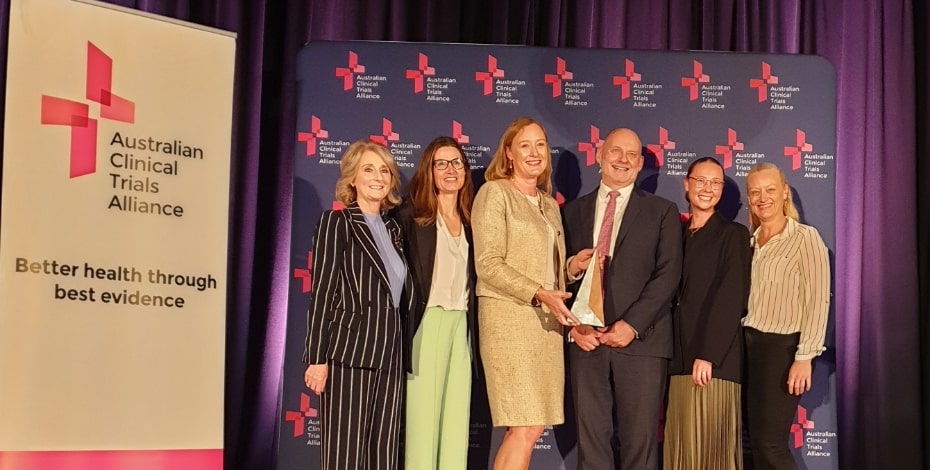
The TEAM Trial team accept the 2023 Australian Clinical Trials Alliance Trial of the Year Award (photo supplied). From left to right: Lisa Higgins and Tessa Broadley (TEAM Management Committee), Professor Carol Hodgson, Professor Steve Webb (Chair of ACTA), and Michelle Paton (TEAM physiotherapist at Monash Health).
INMOTION 01 Feb, 2024

TEAM ICU trial shows usual care is enough

A trial of early active mobilisation in critically ill patients has won a prestigious research award. Professor Carol Hodgson discusses the trial and its surprising result.

About 40 per cent of patients in intensive care units (ICU) develop ICU-acquired weakness—a musculoskeletal condition that results in generalised muscle weakness due to a combination of inflammation, protein catabolism, the effects of drugs given to ICU patients and prolonged bed rest. 

A man and a woman stand on a stage in front of the words IGNITE 2023. There is a blue curtain behind them. They are holding notes and microphones.
INMOTION 01 Feb, 2024

Spasticity manual at your fingertips

A digital upgrade for a popular spasticity assessment guide won the Physiotherapy Research Foundation Physio Pitchfest 2023 Judges’ Award at the APA conference last October.

Since its first publication in 2019, the Epworth Foundation’s A Guide to the Modified Tardieu Scale has become a bestseller among physiotherapists working with patients presenting with spasticity.

people at conference
INMOTION 01 Dec, 2023

IGNITE conference asks the big questions

At October’s IGNITE 2023 national conference at the Brisbane Convention and Exhibition Centre, physiotherapists were exposed to some of the big questions facing the physiotherapy community. Here is a snapshot of key sessions.