
Elevating practices, empowering physiotherapy
CONFERENCE In October this year, over 600 delegates, speakers and exhibitors attended FOCUS26, the APA’s biennial business, leadership and education conference. Melissa Trudinger reports.
Moving from hype to practicalities in AI
Attended by 150 delegates, the AI pre-conference workshop at FOCUS26 highlighted the practical uses of AI in the modern physiotherapy clinic and gave the audience a taste of what is on the horizon.
A plenary session devoted to AI reiterated the key message: AI has massive intelligence but now we have to make it useful.
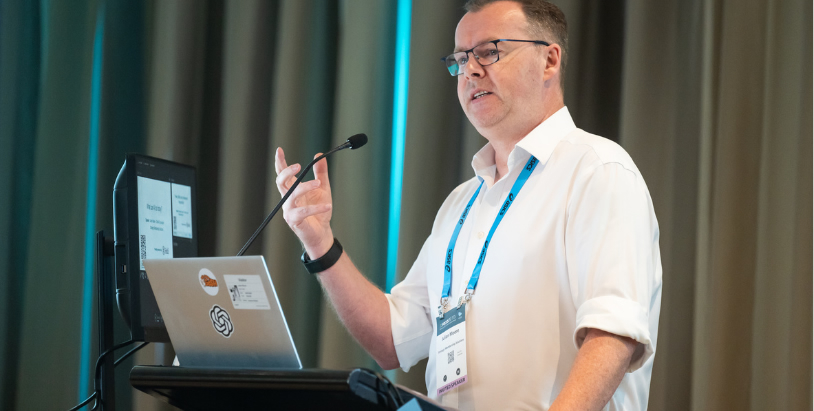
While AI consultant Julian Moore provided the excitement, lawyer Azmeena Hussain from APA partner Maurice Blackburn was the voice of reason, noting that legally, physiotherapists and practice owners need to take responsibility for all AI outputs.
‘When it comes to your obligation as practitioners, implementing AI does not adjust your duty of care,’ Azmeena said.
She noted that before using an AI solution, users should educate themselves on the platform – where data is stored, how it is shared and whether data that should remain confidential – such as identifiable patient details – is being used to educate the platform. Patient consent is another area of concern, Azmeena said.
‘Patients need to be told every time it is used and this needs to be documented,’ she told the audience, adding that from mid-December 2026, Australian privacy laws require healthcare organisations to disclose if they use AI or a computer program to make a decision that could significantly affect an individual’s rights or interests and the program uses personal information to make this decision.
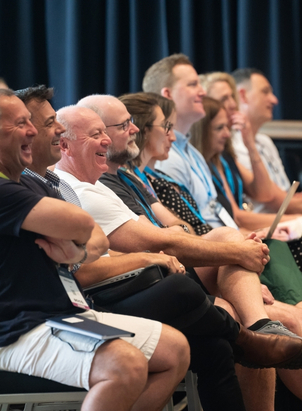
The pre-conference AI workshop was entertaining as well as useful.
During the second half of the workshop, delegates had the opportunity to try AI out for themselves.
In Breakout 1, Associate Professor Belinda Lange led the delegates through the basics of using AI.
Meanwhile, in Breakout 2, Barry Nguyen challenged them to create an AI-powered tool to help complete a task.
He encouraged participants to start with something small and simple rather than trying to do everything at once.
‘Start with a task you know and understand.
Think about who struggles, what they struggle with and why we should switch to an AI-powered solution,’ Barry said.
In a miniature Shark Tank-style competition, delegates were encouraged to show off their new AI tools.
Monique Kurdian, a physiotherapist based in Tasmania, won a prize of AI-enabled glasses from Julian for her interactive balance-training app, which gamifies balance training.
‘It’s actually an idea I’ve had for several years but the workshop gave me the opportunity, tools and momentum to finally turn the idea in my head into something I could visualise and start building,’ Monique said.
A plenary session on Friday morning, with presentations by Azmeena and Julian as well as Professor Leo Ng from Swinburne University of Technology and the University of Queensland’s Professor Trevor Russell, reiterated the messages from the workshop and looked at a variety of aspects including how AI is being used in practice, in business and in education and what should be considered before implementing AI solutions, such as ethical concerns and patient perceptions of AI use in clinical practice.
‘We should really be using AI to bolster the experience the patient has of their physiotherapy consultation. How can you make it better? How can we improve as a profession?’ Trevor said.
Overall, the presenters said that users should be aware of the risks of AI and its potential for misuse but also be excited about the future.
‘I think the future will be human-centred AI care, where physiotherapists will work with AI to give the best possible care to the patient. And for that, I’m excited,’ Leo said.
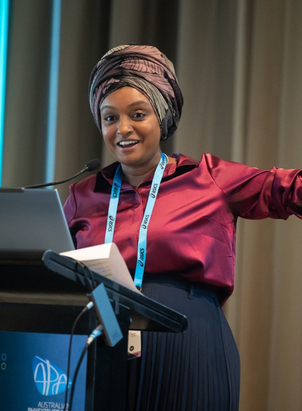
Lawyer Azmeena Hussain talked about the ethical obligations of clinics and physiotherapists using AI.
Opening with resilience
The opening plenary session literally went off with a bang, as keynote speaker Richard de Crespigny – the Qantas pilot who safely landed a badly damaged Airbus A380 carrying 469 passengers and crew after one of the engines exploded soon after take-off in 2010 – played a recording of the first 30 seconds of the event, from the explosion to the sounds of the instrument panel alarms screaming.
Richard used the midair incident to illustrate the power of resilience – among the crew members but also the passengers – to find a solution for the catastrophic damage to the plane and land safely.
‘You must harness the disruption, build your resilience and then you will survive,’ Richard said.
Opening the session, APA CEO Rob LoPresti and National President Dr Rik Dawson outlined some of the achievements of the APA during 2026 and plans for 2027, particularly in advocacy.
‘We are all in this room because we share this one passion.
We are ambitious for the future of our profession and we believe that healthcare reform needs to support physiotherapy services because the status quo is unacceptable and unsustainable,’ Rik told the audience.
He highlighted the APA’s dedication to positioning physiotherapists as first contact practitioners, drawing a line from the work done by Prue Galley and her colleagues to allow physiotherapists to practise without a medical referral to the current efforts of the APA to improve access to Medicarefunded physiotherapy sessions.
‘At the APA, we believe that access should depend on clinical need, not postcode or capacity to pay. And all of these reforms share one principle. Australians should get the right care, by the right professional, at the right time, at the right place,’ he said.
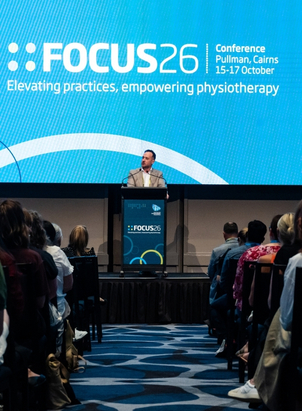
APA CEO Rob LoPresti opened FOCUS26 in Cairns
Practising sustainably
A recurring theme of FOCUS26 was sustainability, as in creating a sustainable business or a sustainable environment for your workplace.
This was the key theme of the Business and Leadership Breakfast, held on the second morning of the conference, which looked at creating sustainable growth within a business while offering attractive career pathways and how to manage – or rather, avoid – burnout in staff members.
The breakfast, a popular event during the conference, attracted 110 participants.
Speakers were osteopath Jade Scott and physiotherapists Helen Weston and John Fitzgerald.
Jade, whose focus is now on building and scaling allied health clinics, said that employees had different needs at different stages of their careers.
While a new grad might need mentoring and increased oversight as they learn how to practise, a mid-career physiotherapist might be interested in working longer hours to earn more money.
A parent might want shorter or more flexible hours to accommodate young children and school pick-ups or an employee might want to combine clinical practice with research or teaching.
Helen said that increasingly, work-life balance was a key factor in ensuring that employees don’t experience burnout.
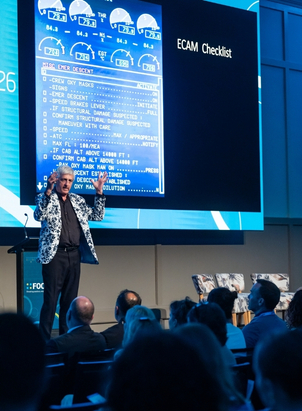
Former Qantas pilot Richard de Crespigny, who safely landed a badly damaged plane after an engine exploded, talked about resilience.
‘Sustainable work isn’t about working less; it isn’t about our limits. It’s actually about being mindful of what’s around us and building a career that we will love,’ she said. Finally, John talked about how he has combined the sustainability of his business with the development of a supportive workplace culture. ‘Sustainable business and careers shouldn’t compete,’ John told the audience.
At his practice, Advance Rehab, he has implemented new graduate transition programs and mentoring to assist early-career physiotherapists and offers flexible working hours to assist with retaining staff.
‘I ask them, if you could design your ideal working conditions, what would it look like?’ he said. While the financial sustainability of a business was important, he said, so was the sustainability of people.
‘We have to design both and grasp that the thing that keeps it all together is the culture.’ Jade’s messages on burnout were also foremost in her plenary presentation about building emotional intelligence, which she calls ‘the hidden competitive advantage’.
Drawing on her own life and career, she noted that while empathy is a strength in a clinical setting like physiotherapy, compassion is a fast track to burnout.
Retaining humanistic values
UK-based physiotherapist Rachael Moses OBE, a consultant physiotherapist and national clinical adviser for the UK’s National Health Service, spoke in her plenary presentation about ensuing that physiotherapists and the physiotherapy profession don’t lose their humanistic values.
Her presentation wove the history of physiotherapy through the modern profession, touching on aspects of her humanitarian work, from helping to develop clinical guidelines during the COVID-19 pandemic to the work she has done in the Ukrainian and Middle Eastern conflict zones. She asked physiotherapists to support global health efforts where they felt they could.
‘Think about your humanistic values and maybe what you can do, not only in your own communities, your own businesses, your own hospitals, your own universities, but also on a more global scale,’ Rachael said.
An award and a phenomenal success
The final plenary was presented by positive culture and wellbeing speaker Toni Powell, whose high-energy presentation on driving away stress saw members of the APA leadership team dancing on stage with her.
In closing the conference, outgoing APA chair Mark Round announced the establishment of the APA Gillian Webb Educators Award, which will honour educators who have made sustained and exceptional contributions to physiotherapy education, recognising their excellence and lasting impact across academic education, clinical education and professional learning.
The inaugural recipient will be presented with the award at FOCUS28.
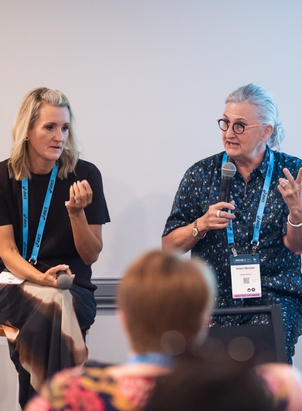
Jade Scott, Helen Weston and John Fitzgerald talked about the importance of balancing financial sustainability with career sustainability in physiotherapy practice.
‘Over more than five decades, Professor Webb has helped shape physiotherapy education through her leadership in curriculum development, accreditation, professional organisations and international capacity building.
Naming the award in her honour acknowledges her enduring legacy and reflects the values of excellence, leadership and commitment to education that the award seeks to recognise,’ Mark said.
The next APA conference – APASC27, Physiotherapy Beyond Limits, which will be held at the Gold Coast Convention Centre on 27–30 October 2027 – was also announced before Mark closed the conference with thanks to all of the speakers, the exhibitors, the sponsors, the conference committee, APA staff and volunteers and the conference delegates.
‘The work you have done has made this conference a phenomenal success,’ he said.
© Copyright 2026 by Australian Physiotherapy Association. All rights reserved.