Bringing rehabilitation home
This year, World Physiotherapy Day on 8 September celebrates the vital role that physiotherapists play in cardiovascular disease and stroke prevention, management and rehabilitation. For Ashan Weerakkody, that role goes far beyond the clinic.
When Ashan Weerakkody MACP reflects on the path that led him to neurological physiotherapy, there is one thing that stands out.
The APA Titled Neurological Physiotherapist and APA Titled Research Physiotherapist’s career has rarely followed the plan.
Like many physiotherapists, Ashan’s first interactions with the profession were as a patient.
Growing up in Geelong, on the shores of Corio Bay outside of Melbourne, Ashan was a competitive swimmer whose recurring shoulder injuries introduced him to a wide range of health professionals before one physiotherapist changed the way he thought about his future.
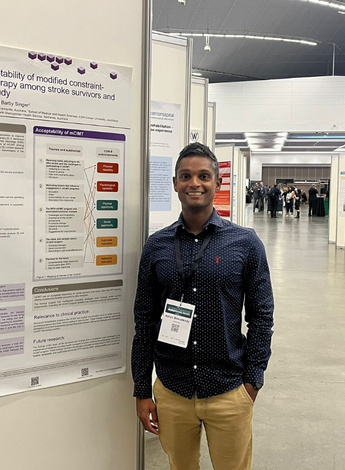
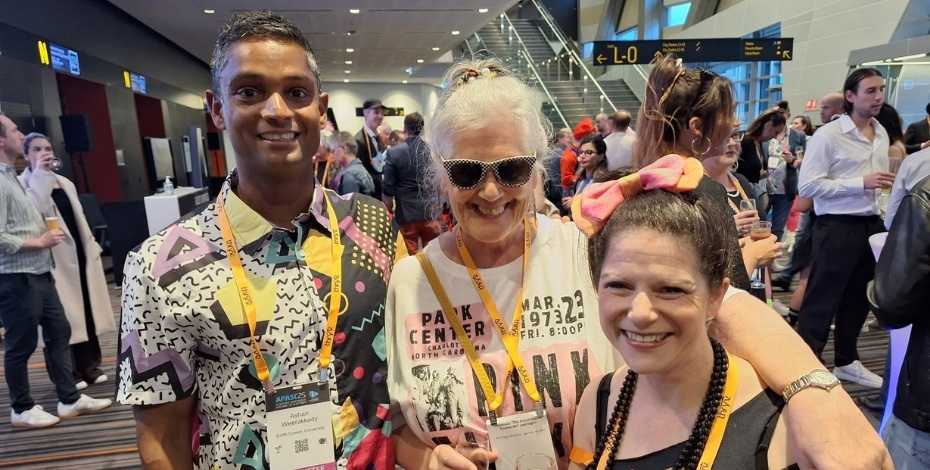
Ashan in front of his poster presentation at the World Congress of Neuro Rehab in Vancouver 2024.
‘I’d seen pretty much every allied health professional and doctor there was.
'Then I was exposed to a really excellent shoulder physio and, in my mind, I thought this would be a pretty cool job.’
From that point onwards, physiotherapy became the goal for Ashan.
By Year 9 he had already decided on his career and the remainder of high school was focused on securing a place in the Bachelor of Physiotherapy program at La Trobe University.
Graduating in 2008, Ashan accepted a Grade 1 rotation position at St Vincent’s Hospital in Melbourne.
He followed the path of many early-career physiotherapists and moved through a range of clinical areas including general medicine, geriatric rehabilitation and intensive care.
At the end of his first year as a new graduate, Ashan undertook a rotation in the Northern Territory, exposing him to what it was like to work with vulnerable communities.
The experience left a lasting impression for two reasons: it was his first taste of community-based physiotherapy and it opened the door for him to return later in his career.
Ashan’s first dedicated neurological rehabilitation rotation also proved pivotal.
The chance to work alongside experienced neurological physiotherapists reinforced something that has remained central to his practice ever since: good rehabilitation is about restoring independence, not simply treating impairment.
‘I learned so much there and realised that, while physio is a very rewarding profession anyway, with neuro rehab the impact that you have on people’s lives is so significant.
'It changed the direction I wanted to take in my career.’
Out on Community
Ashan says another defining experience in his career took the form of a secondment to Katherine in the Northern Territory.
Initially intended as a short-term opportunity before embarking on the traditional overseas working holiday, the placement broadened Ashan’s experience of healthcare inequities, Indigenous health and the realities of delivering rehabilitation across some of Australia’s most remote communities.
After going back to Melbourne for another year of gaining experience, he returned to Katherine.
Working within the Katherine Region Aged and Disability Service meant covering an area roughly the size of Victoria.
Weeks often involved long hours of four-wheel driving to remote communities, charter flights during the wet season and a genuinely multidisciplinary model of care.
Physiotherapy sat alongside equipment prescription, home modifications, aged care assessments, case management and paediatric services, all often delivered by the same clinician, he says.
‘It was really an incredible experience.
'Obviously quite challenging in terms of seeing such disadvantage and working with the most vulnerable people within an already vulnerable community.’
The experience fundamentally reframed how he viewed rehabilitation.
Rather than seeing physiotherapy as something delivered within hospital walls, Ashan began to appreciate the value of helping people function within their own environments.
It was during his time in Katherine that another unexpected chapter began.
Ashan met his future wife while working in the region, extending what had originally been a planned six-month stint into a year before the couple eventually relocated to Perth, Western Australia, ‘chasing the sun’.
In the home
In Perth, Ashan joined Rehabilitation in the Home, an early supported discharge service providing rehabilitation in patients’ homes.
Over the next 11 years, the role became the foundation of his clinical expertise, particularly in stroke and acquired brain injury rehabilitation.
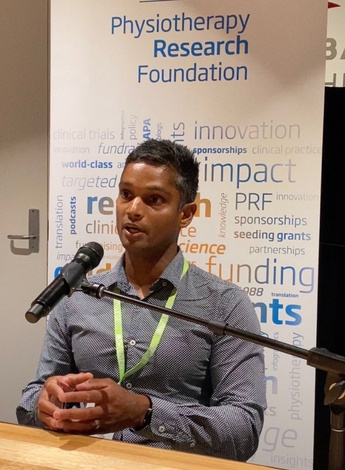
Ashan Weerakkody speaking during a podcast at the APA Ignite conference 2023 for the Conference Conversations podcast.
While the service managed a broad case load that included orthopaedic and respiratory conditions, neurological rehabilitation quickly became his primary focus.
At the same time, Ashan started postgraduate study in neurological rehabilitation through the University of Western Australia, allowing his academic development to progress alongside his clinical practice.
Looking back, he sees a clear thread connecting those experiences.
‘The two things that really shaped my career were starting in the Northern Territory, which drove me to community-based rehab, and then working for Rehabilitation in the Home, where I developed strong neuro rehab skills by delivering care in the community.’
Those years cemented a philosophy that continues to underpin his current practice at Cortex Neuro Rehab, where he now provides mobile neurological physiotherapy throughout Perth’s northern suburbs.
Rather than asking people recovering from stroke or living with neurological conditions to adapt to clinical environments, he takes rehabilitation directly into their homes and communities, where meaningful function goals can be practised in the context in which they occur.
For Ashan, that context matters enormously.
A patient learning to transfer from bed may have mastered the task on a height-adjustable plinth in hospital but that success does not necessarily translate to navigating an ordinary bedroom, an uneven front step or a cluttered hallway.
Similarly, someone whose goal is returning to their local cafe needs therapy that reflects the physical demands of negotiating footpaths, uneven terrain and crowds rather than simply walking uninterrupted at a rehabilitation gym.
‘The massive advantage is that you can work directly in the context of people’s goals.
'If someone wants to get to the toilet independently or walk to their local cafe, we can practise those things where they happen.’
It has become increasingly apparent throughout his career that geography shapes access to neurological rehabilitation across Australia.
Whether working in metropolitan Perth or remote Northern Territory communities, Ashan has repeatedly seen how postcode can influence the services available to people recovering from stroke.
That inequity has only strengthened his belief that physiotherapists have an essential role to play throughout the entire stroke continuum – from early mobilisation in acute care to supporting lifelong physical activity and participating in the community.
The burning question
Ashan’s move into research came almost by accident.
Describing himself as a ‘clinician at heart’ rather than someone who set out to build an academic career, Ashan was introduced to research through a quality improvement project aimed at increasing the use of constraint-induced movement therapy after stroke.
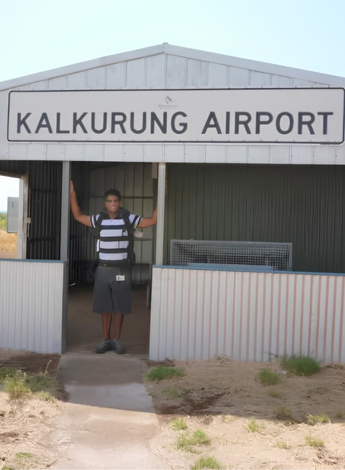
Ashan the departure lounge, waiting for a charter flight, for a visit to the remote community of Kalkarindji, Northern Territory.
Despite strong evidence supporting the intervention, it was rarely being implemented in routine clinical practice.
The team’s first attempt to change practice was unsuccessful.
‘We’d run some education sessions and it really didn’t do anything.
'Then we went back to the drawing board and started again.’
Instead of relying on education alone, the team adopted an implementation science framework that incorporated behaviour change strategies, peer support, mentoring, resources and structured training.
What began as a local quality improvement initiative gradually evolved into a master’s by research before ultimately becoming a PhD examining the implementation of evidence-based stroke rehabilitation.
‘Research has taught me a lot about the challenges of how we adopt evidence-based practice in real-world clinical settings.
'Physio research is exploding and stroke rehab research is exploding but how do you change clinician behaviour to adopt that? I’ve learned a lot from that.’
This question sits at the heart of Ashan’s work today.
While the evidence supporting stroke rehabilitation continues to grow, translating that evidence into everyday clinical practice remains a significant challenge for the profession.
Ashan believes that one of the largest evidence–practice gaps is not identifying what works but delivering enough rehabilitation for people to achieve the best possible outcomes.
That challenge is particularly relevant in 2026, as World Physiotherapy Day focuses on cardiovascular disease and stroke, highlighting the profession’s role in prevention, management and rehabilitation across the continuum of care.
Ashan sees physiotherapists as central to every stage of stroke recovery.
In acute care, physiotherapists are responsible for early mobilisation, helping patients regain movement as soon as it is clinically appropriate while advocating for access to ongoing rehabilitation.
During inpatient rehabilitation, they guide recovery of mobility, balance, transfers and upper limb function, using evidence-based interventions tailored to individual goals.
Beyond discharge, their role shifts towards supporting longer-term physical activity and participation while helping reduce the risk of recurrent cardiovascular events.
‘The majority of stroke survivors don’t meet the minimum physical activity guidelines.
'Our role is understanding the barriers and tailoring interventions so people can meet those guidelines because that’s crucial, not only for maintaining physical function and quality of life, but also for preventing further cardiovascular events and strokes.’
He believes one of the biggest misconceptions about stroke rehabilitation is that recovery plateaus after the first few months.
‘I wish people knew that people can continue to improve lifelong. I’ve even got a client who had a stroke in 1998 who’s still improving.’
For Ashan, this means ensuring that every person has the opportunity to access rehabilitation, while recognising that recovery is shaped by both clinical expectations and access to services.
Having worked in metropolitan, regional and remote settings, he has seen firsthand how geography influences stroke care.
Those experiences continue to drive his commitment to improving service delivery through both clinical practice and research.
Alongside running Cortex Neuro Rehab, Ashan presents APA neurology courses, supervises research students and mentors emerging clinicians.
Although he continues to contribute to research, Ashan remains committed to clinical practice.
‘I’ll always have some form of clinical work.’
© Copyright 2026 by Australian Physiotherapy Association. All rights reserved.