Rethinking robotics
At the Queensland Branch Awards on 14 November, keynote speaker Jess Reid from RoboFit will discuss how electromyography-triggered robotics is changing outcomes for her patients. Chloe Pignéguy reports.
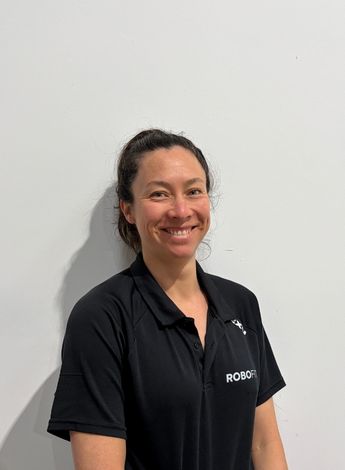
Jess Reid APAM never expected to build a career around robotics.
Now, as team lead at RoboFit’s Wollongong practice, she works with patients every day using electromyography (EMG)-triggered robotics – a surprising shift for a self-described ‘tech sceptic’.
Jess always knew she wanted to be a neurological physiotherapist. However, the primary draw of working at RoboFit was not the company’s innovative use of exoskeleton technology but its values and culture.
‘The co-founders Dan Hillyer – who has lived experience of a spinal cord injury – and director Maryanne Harris look at the entire national disability landscape rather than just RoboFit as an enterprise.
They understand that people fall through the cracks of the system and that therapy has the capacity to give you so much back.’ In her talk at the 2026 Queensland Branch Awards, Jess will share the success she’s experienced with EMG-triggered exoskeleton robotics – opening physiotherapists’ outlook to the emerging role of cybernetics in the future of physiotherapy.
Before starting at RoboFit, Jess was unsure that robotics could give patients the outcomes they wanted. ‘I was never taught to value robotics because that’s thought to be futuristic technology that we’d use 20–30 years down the track.
And now, all of a sudden, I’ve been offered an opportunity in a company that uses some pretty amazing quality robotics… what does that look like for clients? It’s something I hadn’t experienced before and that there wasn’t a lot of strong research about – and there still isn’t.
But research is only one part of our evidence.’
It was Jess’s patients who requested that she bring in robotics as part of their treatment and although she was dubious, she gave it a shot.
‘I like to think that I’m always ready to learn, particularly for my clients, because they know more about their journeys, their experiences and their condition than I do.
I might know the textbook but every person is different.’ The impressive outcomes that she started to see in her patients quickly quelled her scepticism.
‘I have a couple of clients who live rent-free in my head when I’m at work because of how amazing their journeys have been. I have one particular client who presented post-stroke.
When she came in, she was a full-time chair user and couldn’t stand up by herself. She wanted to use the robotics and drove a considerable distance to come and trial them with us.
‘Within about three months, she was actively able to walk through both of her legs on the treadmill in a body weight support system. She had no balance.
So, outside of the robotics, we were working on functional things like a sit to stand to be able to stand unsupported.’ Jess says there is a common misconception among practitioners that the patient is not actively involved in the rehabilitation process when using robotics, that the machine is doing all the activity for them.
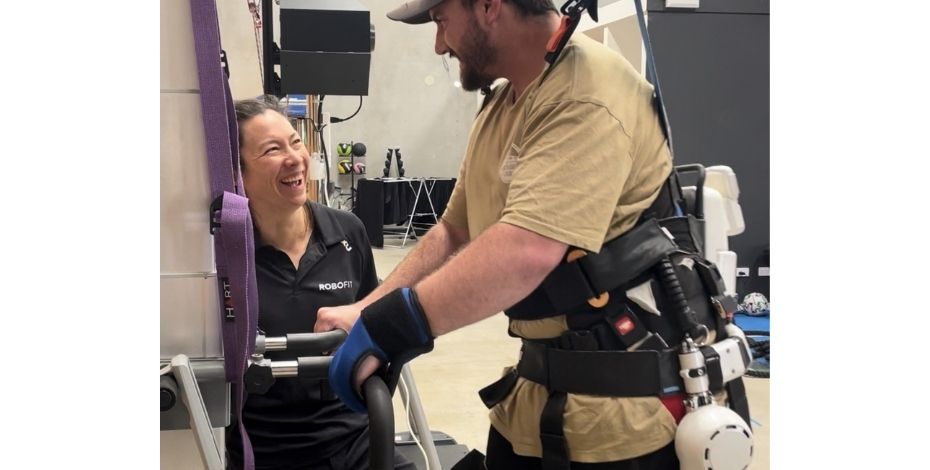
That, she says, isn’t the case. At RoboFit, the physiotherapists and exercise physiologists use a neurocontrolled exoskeleton hybrid assistive limb device otherwise known as HAL, which comes in three forms: lower limb, single joint and lumbar exoskeleton.
‘HAL is EMG-triggered. It uses the transcutaneous readings from the patient’s muscles’ signals. We put electrodes on the skin and then it listens to what’s actually happening at the muscular level.
The patient has to try to step. If they don’t try, the robot’s doing nothing.’ Managing patient expectations is also important. ‘There are so many myths about robotics.
Patients think, “I’ll just be able to walk even though I haven’t walked in 10 years. I can go to the shops now. I can do all of these things that I couldn’t before.”
I think we as a corporation, but also I as an individual clinician, need to set those expectations really early, that this is going to be hard work.’
Jess says the many components involved in relearning how to walk in a straight line – how to stand or weight shift or move in a coordinated fashion – are aided by the robotics, which increases the patient’s confidence as well as their understanding of what those movements feel like.
‘Using HAL creates cardiovascular priming; we’re able to get somebody’s heart rate up because they’re walking and exercising for longer. They’re able to take more steps; they’re able to walk further.
All of these amazing things happen, along with the endorphins and serotonin that come once they’ve achieved something they were told they might never do.’
At RoboFit, cybernetics is primarily suggested for those who have multiple sclerosis, spinal cord injury, chronic pain, motor neurone disease or acquired traumatic brain injury or who have had a stroke.
However, this technology is not only applicable to neurological physiotherapy but also in the paediatric, gerontology and musculoskeletal fields, Jess says.
‘In geriatric populations, for someone who is really deconditioned and can only walk three to five metres in their four-wheel walker, a robotic device can assist them to do the extra 80 per cent of the movement that maybe they have the capacity to do, to enable them to improve their fitness more quickly.’
Meanwhile, in paediatric physiotherapy, cybernetics is being used for children with cerebral palsy and the neuroplastic benefits that clinicians see are far-reaching. HAL is designed to be able to assist just about anyone, no matter how small the electrical muscular signal is.
‘There’s no limit to who can use the device because we can enhance how much the robot is hearing from the signal. On a healthy individual who has full muscle innervation, we would just use a one-to-one.
For somebody who’s had a stroke, where the muscle signal that’s coming through is weak, we can ask the robot to blow that up.
And we can blow that up two, five, 10 times, all the way up to almost 100 times the normal signal strength. We can then show someone that their muscle works, even if they can’t necessarily feel it.’
Jess’s patient who was a full-time chair user has continued to see major improvements.
‘The robotics gave her the confidence to know that she has the capacity to walk and it gave her and her husband so much hope.
Last week, she slowly and carefully walked a total of four kilometres along the beach with her husband – without a stick.’ Jess hopes there will be increased collaboration between tech and non-tech physiotherapists in the future.
‘I think there’s a lot of value in robotics for the right clients and the right clinicians.
What the research will say is a different question. I’m very curious to see how that will unfold in the next decade or so, particularly as robotics continues to advance.’
Register for the Queensland Awards Dinner on 14 November in Eight Mile Plains, Queensland.
© Copyright 2026 by Australian Physiotherapy Association. All rights reserved.