

Madolyn's story
When Madolyn Ryan discovered she was pregnant, she had no idea that the appointment would also mark the beginning of a cancer journey.
At around five weeks pregnant, Madolyn asked her doctor to check a lump in her left breast that she had had for several years.
She had previously had ultrasounds where she was told it was a benign cyst but Madolyn had noticed more changes in the lump a few months before finding out she was pregnant.
Further investigation and a biopsy confirmed breast cancer when she was around 10 weeks pregnant.
What followed was an overwhelming time of appointments and decisions, as obstetric, oncology and breast surgery teams worked together to determine the best plan for Madolyn and her unborn baby.
‘There was so much information coming in and each day I would find out something new.’
Unable to begin chemotherapy until her second trimester, Madolyn used the time to prepare physically.
Exercise had always been part of her life – she enjoyed sport, the gym and high-intensity training – and she was determined to maintain as much of that as possible.
A friend worked at CanConquer and referred Madolyn to the service and into the care of physiotherapist Kylie Moffitt.
From there, she learned how exercise could be adapted around her cancer treatment and pregnancy.
‘I just kept trying to do everything as I usually would, exercise-wise and physically, because I’ve always known that helps anyway.’
Kylie helped Madolyn understand how to monitor and modify her exercise, including using a heart rate monitor and adjusting intensity around chemotherapy.
On many treatment days she would train at 6 am before an 8 am chemotherapy session.
When she was feeling well, Madolyn could exercise more intensely; in the days following treatment, she would scale things back, focusing predominantly on strength-based work.
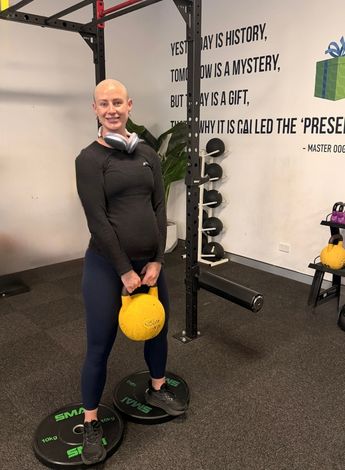
Madolyn Ryan working out at CanConquer. Photo Dylan Crandell Photography.
The approach was not about simply pushing through.
One chemotherapy treatment left Madolyn particularly unwell and there were occasions when she passed out or vomited while exercising.
Listening to her body and adapting the program became essential.
She also noticed how different she felt when she was unable to exercise before one chemotherapy session.
The value of physiotherapy and exercise extended well beyond physical conditioning for Madolyn.
At a time when so much of her treatment was laid out for her, exercise gave her something she could control.
‘It was something I could do myself rather than being told you have to have this type of chemo or you need to take this type of medication.’
Maintaining strength was also important.
While Madolyn had heard about a loss of muscle mass associated with chemotherapy, she felt she was able to preserve her strength well.
Halfway through treatment, Madolyn realised that she had not become as unwell as expected.
‘I recall thinking at the time, “I really need to keep this up.”
‘I knew that if I didn’t, I probably wouldn’t recover as well and feel as good.’
Madolyn’s cancer treatment continued alongside her pregnancy.
At 38 weeks, Madolyn was induced and welcomed her son, August.
Two weeks later she underwent a double mastectomy.
When speaking with InMotion, Madolyn was 10 days post-surgery and still experiencing significant pain.
Recovery was proving slower than she had hoped, particularly as she adjusted to life as a new mother.
‘Instinctively I’m thinking, “I want to get up and help him.”
‘I want to pick him up. I want to feed him. I want to burp him and I can’t.’
Madolyn’s rehabilitation with Kylie is continuing.
She has undergone SOZO assessments at different stages of her treatment and pregnancy and she anticipates returning to physiotherapy as her surgical recovery progresses.
Scar management, restoring movement and monitoring for lymphoedema are now part of the next phase of her rehabilitation.
Looking back, Madolyn says she wishes she had been told about physiotherapy and exercise much earlier in her cancer journey.
‘It was wild to me that no-one explained that there were things you could do other than just the drugs.’
Read more about the importance of exercise in cancer rehabilitation.
© Copyright 2026 by Australian Physiotherapy Association. All rights reserved.