
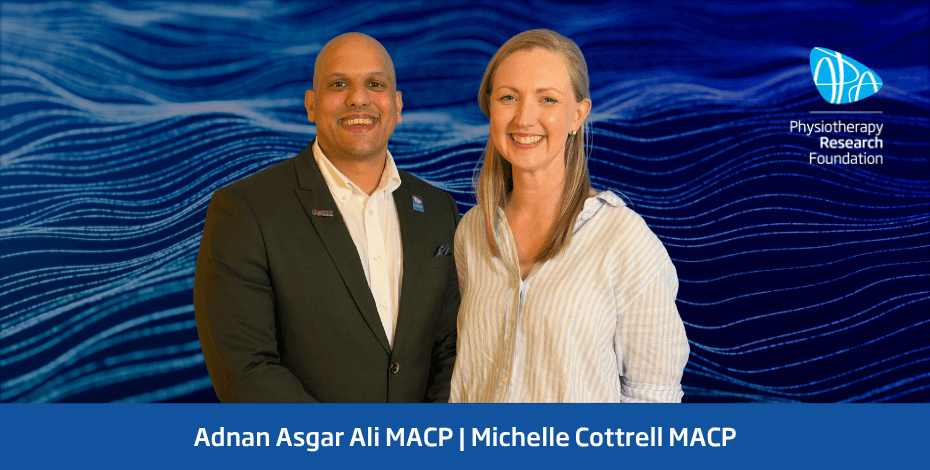
Conducting complex MSK assessments collaboratively via telehealth
In this episode, Michelle Cottrell and Adnan Asger Ali discuss the PACE-RURAL project, an implementation study providing opportunities for collaboration between rural clinicians and allied health specialist clinicians, and for both patients and rural clinicians to receive support and education in real-time via telehealth.
Watch the full podcast episode on YouTube.
Adnan
Thanks for joining us. I'm with Dr Michelle Cottrell, senior research fellow at the University of Queensland. And my name is Adnan Asger Ali. I'm the national chair of the APA Musculoskeletal Group. And we're going to talk about PACE-RURAL, which is a study that's happening at the moment. Can you tell us more about it?
Michelle
So PACE-RURAL is a study that has quite a number of academic institutes as well as organisational partners. We're very fortunate for that funding to be coming from our MRFF, Primary Care Research Grant. The aim of this study is being able to
try and support patients who are living with chronic musculoskeletal conditions, who also reside in regional and rural areas access to better care to manage their condition. We know that those people who live in regional and rural areas carry a higher musculoskeletal burden. But we also know that only 20% of our national health care workforce provides care in these regions. So it means for these clinicians and these health practitioners that they really need to be a jack of all trades because of all the types of clinical cohorts that might come through their door.
PACE-RURAL is looking at a way of being able to connect rural and regional clinicians and their patients who are presenting with these complex conditions to be able to access expert care by the way of clinicians such as specialist physiotherapists, and doing this through telehealth in a collaborative care approach. The aim of the research program primarily is to look at better understanding the impact that this collaborative care model has on being able to improve our patient health outcomes. But second to this, and as important, it is also evaluating the way in which both our patients and our rural clinicians are accepting of the program and also their experiences of it.
Adnan
Yeah, that sounds really interesting. So when we look at, you know, our workforce shortage in rural and regional areas, what do you think the role of PACE-RURAL is there to help with the workforce?
Michelle
Having our clinicians engage with PACE-RURAL as our clinician participants, what this means for them is it provides them an opportunity to be able to collaborate with more specialised physiotherapists, particularly in areas of complex musculoskeletal conditions, of particular areas of the body, so that they can help support those clinicians not only in the treatment, diagnosis and management of those patients, but it also provides those clinicians access to the specialist from a mentorship and a professional development opportunity. So we're really trying to look at opportunities throughout the trial where we can bring the specialists and the rural clinicians together outside of the consults that they do do with the patients, so that they can build those connections, and also to provide that education support and professional supervision to the rural clinicians.
Adnan
That sounds really exciting for me as a physiotherapist to be able to access care like that and mentoring like that. Sounds like a very exciting project. In saying that, though, it sounds quite complex in the sense of how it's set up with, you know, multiple organisations at play, potentially public and private. Given that our system is so fragmented in primary care, public, private, like I mentioned, what's the trial design? What have you and the team done to try and make that as accessible to all as possible?
Michelle
I think what's important about this particular trial is the study design is one of which it's a hybrid implementation effectiveness trial. And so not only are we trying to evaluate is this model of care effective from, say, a health outcomes perspective. But where a large proportion of it is also evaluating the implementation of it. Obviously you're not going to be able to impact a lot of the fragmented healthcare that we do see at a local and a state and a national level. There are a lot of things that have been put forward as part of this research program, developed as part of an initial co-design process with organisational partners, people who live and work in rural communities as well. And part of these things are really simple strategies that we are putting in place. So these are things like ensuring that there is appropriate internet connectivity in some of these more rural and regional areas.
And then if that's not possible, we have been able to collaborate with some of our external providers to be able to support the clinicians when IT infrastructure is a bit of a challenge to support the telehealth consults. One of the other things that we are doing, which was spoken really strongly by our rural clinicians, is really making sure that we build those networking and that collaboration between the rural clinicians and the specialist physios as well, doing it early and also doing it often. So trying to provide a lot of opportunities throughout the trial and throughout that interaction so that they can build that relationship, because we know that if they have that strong relationship, they'll carry that forward into that clinical consult where the patient is present. So they're just a couple of the strategies that we've taken forward through a co-design approach that was initially done as part of this research programme as we move through the intervention phase of the trial.
Adnan
That sounds really exciting and it’s reducing some of those barriers that traditionally have been there with accessing care in rural, regional and remote. But I want to flip that a little bit and talk about the effect on physios. I think that's really great because myself, in my career, I don't think I met a specialist physio until I did my masters, which was a number of years after graduating and now with my role with the APA, I've been really involved with a number of projects and come across a number of specialists, and these guys are like the rock stars of physio, right? They are our experts. They are excellent educators and really are the peak of the profession. Working with the fellows would be so rewarding as an early career physiotherapist, and just getting that expert care at the right time would be so timely.
So how does the session look like for me as a physio? Let's say I'm down in Ingham. And I have a difficult patient that I'm having a bit of trouble with. How do I get in touch with the program and how does that look like from a physio point of view?
Michelle
This is a really good question, because what a lot of the clinicians who have come on board to the PACE-RURAL trial, is they are really hoping and they're looking forward to this option, an opportunity to be able to work quite closely with these specialists, particularly as they work to support the assessment, diagnosis and treatment of some of these more complex musculoskeletal conditions.
When you're working with patients who do live more rurally, there is often an added complexity of some psychosocial challenges that need to be considered and really sensitively managed throughout that interaction that you have with that patient. As a clinician, what happens through the trial is those patients who they consider eligible and would be willing to participate and we think would do well with the co-consultation, they let us know as the research fellows as part of the trial, if the patient is willing to be part of the trial, we obviously go through a little bit of paperwork with them. Those patients who are considered to be high risk of persistent disabling pain, which is based on scoring more than 50 points on the Örebro, they are the ones who are stratified into the high-risk category. From there, as a team, we work very closely with the rural clinicians’ practice, so be it through their receptionist or their practice manager, the patient as well as the specialist, to make sure that we can organise a time in a relatively short period of time, probably a couple of weeks after, so that we do maintain that continuity of care of the patient to be able to get an appointment where ideally, it's where the patient is with the rural clinician and then the specialist physiotherapist is telehealthing in, using video conferencing.
As part of the trial, we're really fortunate to be able to have a quite a large number of specialists within the field of physiotherapy, we've got specialist musculoskeletal, specialist pain and specialist sports physiotherapists that we have recruited into the trial. So the aim that we also have not only matching that person up with a specialist, but also the right specialist. So if it's someone whose goals are to return to high-performance sport, we really are trying to match them up with the right specialist as well. So that helps to build not only that relationship between the clinician and that specialist, but also provide a really great opportunity for really specific professional development and skills within that particular patient's case.
Adnan
That sounds like those two benefits I'm looking at. The patient gets the benefit. The right person at the right time, at the right place. We’re all just in Rick’s plenary just then. And that's literally one of the things that he said. So it's really important that we can give the patient great care. But it sounds like we're really supporting the rural clinicians with specialist input, hoping that they stay a little bit longer because we have a real drain in our profession, as we all know, that we lose so many of our early-career physiotherapists in the early part of the career, and we're not maintaining. So hoping that this trial then can help form some relationships.
Michelle
Absolutely.
Adnan
And some mentoring outside of the clinical encounter.
Michelle
That's right. And so having that mentorship of the clinician, particularly if it's a clinician who does have a particular interest in musculoskeletal physiotherapy because like I said, they often, if you are a one- or two-physio town, you've got to be quite good at most things.
But the bigger picture of this is if we can provide that support and education, for one or two patients that they have, they can carry that forwards. And what we want to be able to see, reduce at a more broader level, which we might not be able to measure within this study, but the opportunity to try and avoid the stepped model of care that you can see where patients who present with complex problems that might feel like they are out of the scope of that physio, and then there is a decision to be made to escalate that care. And that escalation often happens within the public system, and whether that's to a medical speciality. And we know with the management of the vast majority of chronic musculoskeletal conditions our first-line treatments are about non-surgical care, be it physio and some other adjunct allied health treatments such as psychology or dietetics or whatever might be appropriate.
So the hope also of this is to not only support the actual patients collaboratively with the specialists, but to be able to bring that knowledge through to the next few patients so that it may help to manage those patients more locally. So that we're not having to escalate unnecessarily because that has a burden not only on the patient from time and money commitment, but also on the broader health system.
Adnan
We can all attest that chronic musculoskeletal burden not only is an issue for our communities, but also it's a big cost to the system.
Michelle
Yeah, absolutely.
Adnan
And so hopefully this project can help reduce some of that. But really interested in that capacity building element as well, because we're lifting up and giving skills to our rural/regional physios and opportunities for mentoring. So if we talk next with this co-consult, obviously you try to be there in person, but the specialists often can't be there or you know, we don't have too many specialists around. So they're probably located in metropolitan areas. But although there are some rural specialists that are participating in the trial.
Michelle
Yes, that’s right.
Adnan
So that's really exciting. Using telehealth, how does that work with a musculoskeletal consult? You know, I'm a musc physio. I like to see, touch, feel, assess with my hands. Not being able to do that, how does that work? I'm struggling to, you know, comprehend that a little bit.
Michelle
Yeah. It’s a great question and one that I am asked quite a lot and challenged quite a lot.
Adnan
I'm sure.
Michelle
It's a very legitimate question as well because we as a profession, I do believe, particularly as musculoskeletal physios, part of our professional identity is hands on. Our patients also think that we're going to put their hands on. So it is that quite a juxtaposition that we find ourselves in when suddenly, and obviously we can attest to this when Covid hit and we were all essentially forced to move to telehealth, it really challenged our identity. But we know from a lot of really good evidence and research coming out, a lot of it is coming out of Australia that the role that telehealth plays in the management of very common musculoskeletal conditions is as good as providing that care in person. So when we do research on telehealth, it's never to try and prove that it is better than in person.
But what we're always looking at is the opportunity, is it as good as because there are many people, be it in remote communities, be at 100 metres down the road from their physio practice or their local hospital, who cannot attend in person for whatever those reasons are. So I think it's really important that as an individual, as a human being, as a practitioner, we really think about what is best for the patient as well. For some people, we might be able to support them through telehealth because that may be the only way in which they might be able to access the care.
In terms of being able to assess and treat through telehealth, like I said, there are a number of studies out there that look at the agreement between particular tests, doing it via telehealth or in person. Some have great agreement, some have not very good agreement. And that's okay because again, it feeds into the evidence about what is appropriate to do via telehealth. And if there is a particular test that you need to do to help with your differential diagnosis or your decision-making skills, and if you know that you can't do that via telehealth because of the evidence or because of maybe the environmental setup, that then still helps to open up a conversation with that individual about what can we do to get that test done. Can you go to your local GP? Could you go do this? So I think that helps with that buy-in with that individual as well, instead of just expecting them to possibly travel four or six hours to do something where 90% of it, if not all of it, could be done remotely, either in their home, in their neighbour's home, or even at the local health care centre if they don't have the right internet connectivity and things like that.
I think that's why I become quite passionate about the opportunity that telehealth can provide someone. So coming from growing up around and having a lot of family that live in rural and remote Queensland is, allowing that person to access care closer to home.
Adnan
I think that's really important, you know, having equitable access like that, because healthcare is a human right, and we should be able to deliver healthcare in people's communities where they feel most comfortable. So great work with getting this
telehealth research off the ground and showing that it's, you know, equal, if not the effectiveness is the same essentially.
Michelle
The most important thing that I continue to say as well is in some cases it is not appropriate as well. And I think it's around having that conversation and understanding, and it's really where we look at the opportunities here is it's often it is that hybrid model as well. It just depends on what you do. And I think with telehealth, what it definitely demonstrated during our Covid times was it meant that you had to be very particular about what you're asking the patient to do and what you were trying to get out of that session as well.
So I actually think the benefit of telehealth, whether it be with a patient directly into their home or with a clinician with them on the remote end, it makes you, as a clinician, really think about what you want to ask them and what you want them to show you through assessments to help those diagnosis skills. So I do actually think it helps to challenge you as a clinician around those skills that you have. It also challenges you in terms of the way in which you communicate to someone, because you can't just put your hands on them and, you know, force their legs or their arms to do whatever it is you want. And we all know that as individuals, we take on instructions very differently as well.
So it is very much an acknowledgement, yes, telehealth, it challenges us as physios because for the majority of us who have been in the profession for a little bit of time and haven’t had the opportunity to do telehealth as part of our university degrees, we have learnt a certain way of doing things, but I don't think that's necessarily a bad thing because a lot of the skills that you can learn when you are providing care via telehealth, you can then transfer them into the in-person environment as well.
Adnan
With telehealth, you know, most practice management systems or exercise software programs now have telehealth capabilities. And so a lot of our physios might be wanting to engage more spread their net a little bit wider and see patients from further away because they might have a particular expertise. What are three tips from, you know, one of the expert telehealth musculoskeletal clinicians in the country? Let's give our audience three tips to how would they start doing more telehealth?
Michelle
So my biggest tip for anyone is be prepared. And that's not only you as a clinician or you within your practice or your local outpatient department, if you work in a hospital, getting your admin team to support you, but it's also for the patient as well.
A 30-minute consult where you spend 20 minutes of that, trying to make sure you have your connection or someone's microphone isn't working, is not going to be a good use of your time. It's also going to give you and the patient a really bad experience. So a lot of the work that we've done over the years in the hospitals that I have sort of supported the implementation of telehealth, is really working quite closely with your admin team as well to prepare the patient.
We often do test connections with patients, particularly those who do live rural and remote, to make sure that they actually have sufficient connection. And so we problem-solve a lot of things before they actually come and see the clinician. It also means that we get them to show us their environment. You know, working within some of the services I've worked in, we come into beautiful homes, we've come into people's caravans. We've also done sessions in the paddocks with the cows in the background, because that just happened to be where the person was at the time, but they were still able to engage in their sessions. So, it is also trying to educate the patient around how to best set themselves up so that you get the most out of that.
I think part of that also is, as much as possible in terms of preparing yourself, is thinking around what is it you actually need to get out of this? Because telehealth sessions, typically they either take longer or you can do less with them. So if you don't have the opportunity to take longer in these appointments, is really think about beforehand what are the key asterisk things that you need to get through to help, either with your diagnosis, with your clinical decisions, or how you're going to know treatment is progressing.
The other things is probably in terms of hot tips is communication. So like I said before, we can't put our hands on people through telehealth. Some people are really good that when you give them verbal instructions, they get up and they do everything perfectly. Some people are terrible at it. It doesn't matter how educated you are, what your age is or anything like that. It's just the way in which we process things.
And so it's really understanding how people respond to instructions and getting yourself up as well and demonstrating it to them as well. So we often do that in person. So thinking as a clinician, you're not just stuck in front of a computer on a chair, get up, move around, use your space as well.
And the last tip I have is not so much of from a clinical interaction, but it's around thinking of, or planning around, your safety protocols as well, because, while we know from the evidence that we have and the research that happens that providing care via telehealth is safe, there is either no or no adverse events or similar adverse events to the in-person alternative. And normally that's aggravation of pain as opposed to something happening as a result of telehealth. It is always wise to understand what your safety protocols are. So some things that we do in the services I work in is we always do our three points of identity check to make sure we've got the right person in front of us. So just simple name, date of birth and their address is what we do. And that's part of the informed consent process. But we also confirm where they physically are at the time of that appointment as well, because they might not be at home, they might be at work or might be at the friend's place, things like that. And that is in the event that, if something happens and you need to call emergency services or you need to call next to kin, you actually know where the person is.
In addition to that as well, we always encourage the patients to have their phone right next to them, because if there is a tech failure and we can't connect with them and we're not quite sure what's going on, particularly for people who might have you know, other co-morbidities that you might be concerned about, you always know that the phone is there and you can call them as well.
Adnan
What I'm hearing from that is that we've just got to be prepared, be prepared, be prepared.
Michelle
Yes.
Adnan
So there needs to be a bit of work that goes into this on the physio’s end whilst preparing and trying to engage more with telehealth. Sounds like an exciting project, PACE-RURAL, all the best with it and hoping that we, you know, can get this as an ongoing thing in the future. So good luck to you and the team.
Michelle
Thank you.
Adnan
Thank you for joining us today, and good luck and enjoy your time here in Cairns.
Michelle
Great, and thank you for having me.
Get to know our interviewees
Dr Michelle Cottrell MACP
Dr Michelle Cottrell is a Musculoskeletal Physiotherapist and was awarded her PhD from the University of Queensland (Australia). The focus of her doctoral thesis was the development, implementation and evaluation of telehealth, as an additional method of service delivery, into an established public tertiary-level physiotherapy-led screening service. In conjunction with her research, she coordinates the implementation of telehealth into other complex clinical tertiary-based services including burns and lymphoedema.
Adnan Asger Ali MACP
Adnan Asger Ali is an APA Titled Musculoskeletal and Pain Physiotherapist, Director of Accelerate Physiotherapy, and PhD candidate at the University of Sydney, where his research focuses on healthcare access for rural and remote populations. He chairs the APA Musculoskeletal National Group and the IFOMPT Business and Finance Committee, and serves as a Non-executive Director at Capital Health Network.