
Balancing different approaches to treating low back pain
Low back pain is a common and debilitating condition affecting many people. In recent years, guidelines such as Australia’s Low Back Pain Clinical Care Standard have been developed to provide a framework for best practice clinical care, covering components such as when to use imaging and medication.
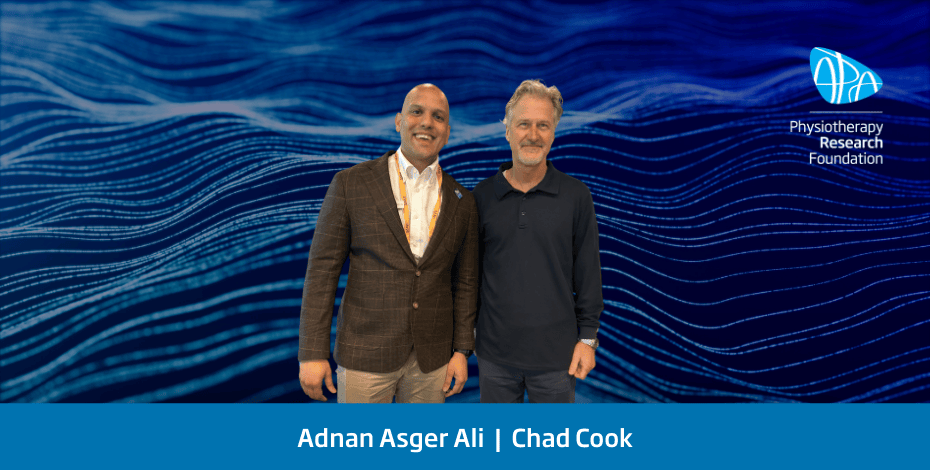
In this episode, Adnan Asger Ali and Chad Cook explore approaches to treating low back pain, including manual therapy, CFT and exercise-based therapies. They also examine how physiotherapists can balance patient expectations with best-practice, evidence-based care.
This podcast is a Physiotherapy Research Foundation (PRF) initiative.
Watch the full podcast episode on YouTube.
Adnan
Hi, Chad. Thanks for joining us. I'm Adnan Ali. I'm the national chair of the Australian Physiotherapy Association's Musculoskeletal group. And we're so honoured to have you join us at our APA scientific conference in 2025 in beautiful Adelaide.
Chad
Well, it's been a great experience and I really appreciate the invite. Every time I'm here in Australia, it's nothing but nice people and great weather and it's been wonderful.
Adnan
Great. And you know, you've been in and I invited keynote here for our musculoskeletal stream and, we're having a bit of crisis. It's probably happening everywhere in Australia, in the world, but in Australia in particular. We're really seeing our new graduates struggling with graduate readiness. And the APA launched their white paper at this conference on the next generation of physios. As the chair of the musculoskeletal group, we’re sort of really noticing our grads and hands-on skills are not putting them in good stead to help our patients in our communities. What's that like in the States? How's that been?
Chad
You are probably the 25th person who’s told me this, which is stunning to me. But in the States we went through something similar about ten years ago, and we're starting to see the pendulum swinging backwards because I think a lot of the physios have recognised the value of providing hands-on care for a number of reasons. I mean, for outcomes, certainly, but also just to connect with the patients and to provide a value-added service so that they think they're getting something that they need.
Adnan
Yeah, and I was fortunate enough to be in both of your sessions at this conference. And you spoke about mechanisms. And I guess the people that, you know, are against that, as you said in your talk, and it's sort of disproved. Maybe we're not talking about the right things, in terms of manual therapy? Can you just give us a little bit of information around the, for example, the shared mechanisms that you spoke about? I think that's really important point to touch on.
Chad
Yeah, so first of all, to be invited to speak about mechanisms, I thought there might be three people in the audience. And we had a pretty good turnout, which was great. Mechanisms are essentially the physiological or psychological processes behind an intervention. The reasons why we see the outcomes that we do. And there has been a lot of study around manual therapy and mechanisms. In fact, if you look at the animal or pre-clinical research, there's over a thousand studies that have looked at this. The challenge is extracting that information to a clinical space. That's a big challenge. Historically, as you know, we've described the reasons manual therapy works using theories. Some of the theories over 100 years old. Most have not held up to scientific inquiry. And that part needs to be adapted. We still have some holdovers that, you know, really believe that. And they communicate things to their patients that probably shouldn't be communicated. There's a whole new set of researchers that are doing their best to really better understand it and improve the communication.
Adnan
Yeah, that's great. Thanks for giving us an insight to that. And I think that's often forgotten.
Chad
Yeah.
Adnan
Or not thought about in depth, but in Australia, you know, and the world, low back pain is a common debilitating condition and it affects so many people. In recent years in Australia, we've had the Australian Clinical Care, this is a mouthful, Standards that have been developed for people with acute lower back pain. And that has given us a bit of a framework for best practice in clinical care. It's been a bit light on on manual therapy, for a variety of reasons. But it covers components such as, you know, use of imaging and medication and things like that. And manual therapy does get a small mention, but if you're new to the profession, I don't think you're holding on to that one line that's in there. What's, in a physiotherapy perspective, what is best practice, evidence-based care for people with lower back pain?
Chad
I want to say something quick and then I'll get into your question. It's somewhat ironic to me to have just one line in there when, if you look at the majority of the low back pain clinical practice guidelines in the world, manual therapy is recommended in all of them.
Adnan
Yeah.
Chad
In fact, there's a recent study that actually showed the most commonly recommended component across all of the low back pain guidelines is manual therapy. So it's interesting to see, you know, the somewhat of a less emphasis, I think.
Adnan
Yeah.
Chad
In your papers. So with respect to best practice for low back pain, it, I think it somewhat depends on the scope of practice for those physical therapists. I've had the ability to teach, or the luxury, I guess, to teach in a lot of different countries.
Adnan
Yeah.
Chad
Over 40.
Adnan
Yeah.
Chad
And physios have very different roles in those countries. And, I know in Australia, someone has a musculoskeletal problem, they don't think about seeing a PCP or, you know, some ortho specialist. They think about seeing a physio.
Adnan
Yep.
Chad
So that physio has to be knowledgeable of a much wider range, I think, of components. So here in Australia I would think they would have to understand, you know, that imaging is not necessary in most cases. That opioids aren't really any better than, you know, off the counter NSAIDs, but they have high risks related to that. I think understanding that, what people tell you is actually really influential. So that first provider you see, they kind of set you on your journey of health care. They can make a huge impact on the direction that that person goes. Self-management is often the very best thing that a person can do. And I think it's really important that, in that initial encounter, we say that. the last piece of it, I think, it's really about recognising that low back pain is a symptom. It's not some sort of disease process. So, not to make light of it, because as a person who has low back pain themselves, it isn't light. It can really set a person back for, you know, weeks and months. But recognise that it can be managed quite a bit.
Adnan
Yeah. That's great. And I guess there's a lot of, you know, things out there coming from a manual therapy background. You know, your Mulligans, your McKenzies, you know, Kaltenborns, and we've got so much out there, some of our younger career physios might have a bit of a struggle trying to find out which modality is best for the patient. You know, more recently, exercise-based therapies, cognitive functional therapy. So many modalities. If you look in the exhibition hall today, we have, you know, all these other electrode therapies. What, you know, to help to not overwhelm, how can we sort of marry those different approaches together and know what to use when?
Chad
It's a great question. I'm going to use kind of the lazy answer and say clinical reasoning, primarily because, I mean, we don't have sets of rules that tell us, you know, if they have these baseline characteristics, they probably need a certain type of intervention. Doesn't really work that way. CFT has done a nice job. They recently did a nice heterogeneity of treatment effect study where they looked at a moderator analysis and identified people with high disability should probably receive CFT. And that's exactly the type of work we need to do.
Adnan
Yeah.
Chad
There's some work on the manual therapy side. But to me it doesn't really move the needle clinically. As a clinician, I'm not going to take that information and roll with it. Exercise hasn't done a great job in that area. We really don't know who's likely to benefit from exercise. Modalities. I have no idea.
Adnan
Yep.
Chad
But even things like surgery, right?
Adnan
Yeah.
Chad
Which are very invasive, you would think they would have the most strident rules on this person should get surgery. There's very little information on that. So we're kind of in the same boat. So for, especially newer learners or people that are new to the profession, I think it's hard to navigate that. I think I think you really have to bond with your patient and connect with them and really find out, you know, what has worked with them before. What are they thinking, what are their preferences, what will work for them, and to meet them where they're at?
Adnan
Yeah, totally agree with you there. If we use our clinical reasoning and keep the patient at the centre of everything that we do, I think most of the time the patient has the right answer, we just gotta ask the right question.
Chad
There's a massive push toward patient-centred care in the United States. And there is a misassumption that patient-centred care is, that I am divorcing my responsibility as a caregiver, and I'm allowing the patient to have an a la carte choice of what they want. That's not patient-centred care.
Adnan
No.
Chad
It's basically a connection of communication between two parties. They want to know what your expertise recommends. And that piece of it, I think, is truly what patient-centred care is. You know, there are three studies now that show if you do a smorgasbord-type of an approach of interventions, where you say none of them are better, basically you pick the one you want, it actually leads to worse outcomes.
Adnan
Right.
Chad
So we need to stay away from that. We need to give people our opinion on why a dedicated approach is beneficial for them, and then help them walk through that process.
Adnan
I wasn't aware of that paper. What are some of the other recent studies? And I know you've recently, or soon to be, publishing a couple, studies about manual therapy that our members might not be aware of.
Chad
Yeah. So about manual therapy, I think, there are a couple that have been published recently and I talked about one today in the presentation. And Keter is the first author. And it's basically what do we know about the mechanisms of manual therapy. That was published in July in PLOS One. And I think it fills a huge gap in our overall knowledge on that. There is another paper by Terry Loghmani, also in PLOS One. And what we've done is we've built a structural diagram of all of the potential ways you can modify your manual therapy approach. So whether it be through force or whether it be through contextual factors, whether you frame it differently to somebody, whether you frame it more around the physiology, all of that is built within this model. And it's a stunningly impressive piece of work that involves not just physios, but chiropractors, osteopaths, basic scientists, biomedical experts, etc. You mentioned shared mechanisms earlier.
Adnan
Yeah.
Chad
There is some work coming out on shared mechanisms as well. I think the psychologists do most of the work in that space. But that's alright. They’re great researchers and they gave us a wonderful roadmap on ways to look at that. Our trial will be finished pretty soon. The primary outcome is basically disability and pain.
Adnan
Yeah.
Chad
We compared six months of outcomes for manual therapy versus exercise. The results are exactly the same. There's no difference. But what we did is we looked at the mechanisms and we also looked at what mediates those particular outcomes so those results will come out soon, too. There's just a lot.
Adnan
That's great. That's great that, you know, it's an emerging area of research to validate some of these findings, but also, I like that you mentioned it's freely available to anyone. So, you know, you can go on PLOS One.
Chad
Yep.
Adnan
It's open access to anyone, anywhere in the world can have access to this. So great job for sharing it with the world. I’m gonna ask the hard-hitting question here now. Who do you find benefits the most from manual therapy?
Chad
That is a hard question. You know, I'm a person that, I think, doesn't back down from recognising some of the limitations of manual therapy and one of the biggest limitations is, we really don't understand yet who is, at baseline, when you're doing that interview with your patient, you’re doing your assessment, we don't fully understand who's likely to benefit from manual therapy or who may benefit from something else. There are some small moderating effects that we've seen, and those are people that have high levels of pain. Those are people that have pain for less than a year. Non-smokers, they tend to benefit, too. And I just noticed this morning there was a study, a secondary data analysis on a study – a neck study that compared manual therapy to exercise, that was not our work, it's Deborah Falla's work - and they found other things, like in-range pain tends to benefit from manual therapy. Individuals who have asymmetries in movements like left to right for side bending or rotation, they tended to benefit more from manual therapy versus exercise. I haven't read their methodology, so I can't vouch that it's really good. But Deborah does great work. So there's emerging work that's coming forward.
Adnan
Yeah.
Chad
You know, if you ask me gestalt-wise, what I would choose, I think it's meaningful if the patient says, you know, I just wish they could, you know, somebody could get in there and move this or help me move through this stiffness or something like that. I look for subtle cues in the interview and also during the assessment. I look at how they respond to movement, whether that's active or passive. I think those things can give you some understanding if a person is a candidate, too.
Adnan
Yeah. That's great. I noticed you brought in the assessment into the picture and, you know, those subtle cues are not something that an AI scribe can pick up either. So it's really still important we're not throwing the baby out with the bathwater. And, you know, keeping our skills, the soft skills that aren't necessarily, you know, with technology, used much now. I guess the next question then this leads onto is, how do we know when manual therapies is then not going to be helpful for the patient?
Chad
Alright, so I love that question. For me it's pretty clear. I use manual therapy early and I don't use it a lot.
Adnan
Yeah.
Chad
And because we've had access to really large data sets, anywhere up to 500,000 patients, we look at the point of diminishing returns on individuals who do receive a manual therapy-dominant approach. And it tends to be about five visits. So I tend to tell the patient straight off the bat, we'll use this three, four, five sessions. That’s it. That’ll pretty much be running its course.
Adnan
Yep.
Chad
The next question I get is, when do you transition from manual therapy to exercise?
Adnan
Yeah.
Chad
There is no transition. It is packaged together from day one. And we actually show how the exercise is augmented with the manual therapy. They work together.
Adnan
Yeah. And I think that's a really important point you raise and sometimes it's hard when, you know, you write an insurance form and, you know, this is what I'm recommending because it seems like it's siloed.
Chad
Yeah.
Adnan
Like I do this and then I do that and then I do that. So I do manual therapy, then I do exercise and then I do patient advice. But actually it's, that happens the minute the patient walks in the door, doesn't it.
Chad
100% agree. And if it isn't happening that way, if you are siloing it, then you probably need a little fixing on you, the way that you manage your patient. It should be highly integrated.
Adnan
Yeah.
Chad
I actually think CFT works well because it is so integrated. The movement approaches. The active cognitive strategies are built into the approach. That's exactly what we should do. It should be where the patient, I think, has a hard time differentiating where one starts and one ends. To me, that's a good manual therapist that does that.
Adnan
I guess then we look at how, you know, there's almost that expectation, I guess, sometimes, if this person may not benefit from manual therapy, but they're coming in with that, I want manual therapy. How do we sort of balance those as expectations that the patient has of what they want versus, you know, best practices or what they need?
Chad
When I think about that, I think of two things. The first one is that, first of all, patient preferences, patient beliefs, patient values, that's one of the three-legged elements of evidence-based practice. So you have to extract that from your patient. That should be automatic in that initial interview. And then the next thing, I think about, is communication. So if you're my patient and my patient says something, they accuse me that they think they need manual therapy, I'm going to follow up and say, tell me why you think that. What, you know, what is it about that thought? Tell me more about that. Let the patient tell you. Let them walk you through that process. So communication, to me, is the most important thing. And some people have it, some people don't.
Adnan
Yeah.
Chad
Some people have that ability to really drill down and get granular on where are you coming from as a patient. How is this going to work for you? And, I think, the best clinicians, whether they use manual therapy or not are the ones that are able to do that.
Adnan
Yeah, I definitely agree with that. And, you know, we've seen, honoured members being inducted into the honoured membership. Professor Trudy Rebbeck was from the muscle group, and she was given the honoured membership yesterday. And it's interesting attending the specialists graduation yesterday. You know, they came from so many different groups. But I think at the end of the day, the thing now that they're all expert at is clinical reasoning.
Chad
Yeah.
Adnan
Can you talk a little bit more about, you know, how important clinical reasoning is for our profession and why it should be the tool that we use for almost everything that we do?
Chad
I'll do my best.
Adnan
Yeah.
Chad
You know, it's funny because I get asked to talk about clinical reasoning. I actually think it's very complex.
Adnan
Yep.
Chad
And we had a phase about 10 to 15 years ago in the United States where the clinicians were really separating themselves from having to reason in front of their patient. And they wanted, you know, diagrams and they wanted clinical prediction rules, and they wanted, you know, direct strategies with patients so they didn't have to think. The problem is, patients are so complex and there's such variability in the way they respond to even efficacious interventions, that you have to use clinical reasoning. You have to step back and think about what is happening with your patient. You have to have goals and objectives which are married to the same ones that the patient has. And you need to have the ability to see if what you're doing is moving that person in that direction. To me, clinical reasoning is being able to guide the process, but also recognising if that person is moving in the direction that you want and then it's adapting if they're not.
Adnan
Yeah.
Chad
And you can read books, you can read papers on it, but the best thing you can possibly do, alright, two things I think, is one, see a lot of patients because your strategies will improve. And secondly, when you're stuck with somebody, if you see something that's new and you don't know what to do, get a mentor. Get somebody who's seen that before, who can help guide you in that process.
Adnan
Yeah, and I think, some of the work that's being done now in Australia, particularly with the APA, has a mentorship program now for a variety of groups, which has really been quite successful, but also with the growth of our college, having those experts that we can then call on when we do have those difficult cases.
Chad
Do you mind if I add to that a little bit?
Adnan
Yeah sure.
Chad
So I've been out 35 years.
Adnan
Yeah.
Chad
And I've mentored a lot of individuals. I've had a number of PhD students. I still have mentors. And lately I have used clinical psychologists as my mentors because their strategies on how to communicate and introduce an approach to a patient tend to be so much more effective than what I have experienced or learnt. So there's never a time point in somebody's career where they can't learn something from somebody else.
Adnan
Yeah, I think it's that, you know, we're all lifelong learners and we really just need to embrace that. It doesn't end when you graduate from uni. It should be this ongoing journey that happens throughout your career. I'm just going to pick on a word that you said on the last point about clinical reasoning, and it's “adapt”, and I think we all, again, think, you know, things in silos and straight line, I did this, therefore they should be better.
Chad
Yeah.
Adnan
But I really like that graph and that analogy of, you know, what patient thinks their rehab should look like is just this linear graph. And what it actually looks like is probably a bowl of spaghetti, right? And I think it's that experience and that expertise helps us be a little bit more adaptable about that, but also that comes with time in practice and good mentorship, don't you think?
Chad
For certain.
Adnan
Yeah.
Chad
Yeah. You don't really start recognising patterns, I think. So there's this, and I forgot what it was called, but it's basically, they looked at outcomes based on reasoning processes. It's Straus and Straub actually published the paper. And what they found was the very early clinicians. They don't have a lot of strategies yet. Right? They haven't seen a lot of patterns. They're basically taking what they learned from the uni, which is typically very clinical practice guideline oriented. They have reasonable outcomes, not fantastic outcomes, but reasonable. And as they're exposed to more things, some good, some bad, their outcomes actually decline at about five years because they're competing, you know, there's so many different things just like we saw in the exhibit hall, there's a thousand E-stims and ultrasounds and different things and needling and, you know, and they're kind of battling their way through that thought process. But right about ten years they're able to kind of push away the noise and recognise that, you know, these are the interventions that seem to make the biggest difference. And these are the patients that likely will benefit from those interventions. And what you see is this reverse or basically a U-curve.
Adnan
Yeah.
Chad
Where you improve a ten, you're better initially, and you're worse in the middle.
Adnan
Yeah.
Chad
And I think that's actually true.
Adnan
Yeah.
Chad
And I know that that's what I suffered from when I first started I was better initially. I got worse when I started really trying to figure out who I was and what I needed to do. And became much more simplistic later on and more directed.
Adnan
That's really interesting about that five-year and ten-year time points that you use, because in Australia we have a big problem, with this seven-year problem that we lose a lot of our physios at that seven-year mark, and if only some of them held on for a bit longer, and, you know, the tide will turn. Hopefully, you know, a fourth-year physio will listen to this podcast and just say, actually, you know, we got a hold on a little bit longer. And it does come. It will come. We just got to be open to it.
Chad
By the way, same problem in the APTA, ours is the five-year mark.
Adnan
Yeah. Right.
Chad
So we've done a number of strategies to try to keep people connected to the profession. And it's not easy. I don't think there's any secret sauce to do that. But it is so important for people to stay connected to the profession.
Adnan
Yeah. And I guess professional associations like the APA, are part of the fabric that ties us together. And it's so good that they can put on this scientific conference here in Adelaide. To finish off, Chad, last pearl of wisdom. What advice do you have for that graduating, next-generation physio here in Australia and the rest of the world?
Chad
So the biggest advice, and I say this every time, is that you have an opportunity to help people and you should not take that lightly. That is an amazing experience. It's an amazing gift. And, you know, there are many people that would love to be in that place, the place that you're at. So you should be very proud of that experience. The second thing I would recommend is, to find a mentor. Find people that will help you grow, or find a set of people that you can share ideas with and continue to read new literature. The third would be, stay curious. It's easy to become mundane, I think. Somebody asked me one time, because I'm a fairly productive researcher. They said, How are you so productive? I said I'm just absolutely curious. I'm looking for the answers. And the answers are out there somewhere. But the journey is what’s so amazing, right? Even before you get to the answers. I guess those three would be a start. I’d probably have 50 more if we had the time.
Adnan
Great. Thanks, Chad Well, three pearls of wisdom from Chad Cook. Thank you so much for coming to Australia. Thanks for being here. And thanks for sharing your immense amount of knowledge with our community, and we look forward to hearing more about your research in the coming years.
Chad
Thank you. And I always appreciate the hospitality. I always have a great experience when I come to Australia. Such great clinicians. High spirited. I had a wonderful time.
Adnan
Great. Hi, Chad. Thanks for joining us. I'm Adnan Ali. I'm the national chair of the Australian Physiotherapy Association's Musculoskeletal group. And we're so honoured to have you join us at our APA scientific conference in 2025 in beautiful Adelaide.
Chad
Well, it's been a great experience and I really appreciate the invite. Every time I'm here in Australia, it's nothing but nice people and great weather and it's been wonderful.
Adnan
Great. And you know, you've been in and I invited keynote here for our musculoskeletal stream and, we're having a bit of crisis. It's probably happening everywhere in Australia, in the world, but in Australia in particular. We're really seeing our new graduates struggling with graduate readiness. And the APA launched their white paper at this conference on the next generation of physios. As the chair of the musculoskeletal group, we’re sort of really noticing our grads and hands-on skills are not putting them in good stead to help our patients in our communities. What's that like in the States? How's that been?
Chad
You are probably the 25th person who’s told me this, which is stunning to me. But in the States we went through something similar about ten years ago, and we're starting to see the pendulum swinging backwards because I think a lot of the physios have recognised the value of providing hands-on care for a number of reasons. I mean, for outcomes, certainly, but also just to connect with the patients and to provide a value-added service so that they think they're getting something that they need.
Adnan
Yeah, and I was fortunate enough to be in both of your sessions at this conference. And you spoke about mechanisms. And I guess the people that, you know, are against that, as you said in your talk, and it's sort of disproved. Maybe we're not talking about the right things, in terms of manual therapy? Can you just give us a little bit of information around the, for example, the shared mechanisms that you spoke about? I think that's really important point to touch on.
Chad
Yeah, so first of all, to be invited to speak about mechanisms, I thought there might be three people in the audience. And we had a pretty good turnout, which was great. Mechanisms are essentially the physiological or psychological processes behind an intervention. The reasons why we see the outcomes that we do. And there has been a lot of study around manual therapy and mechanisms. In fact, if you look at the animal or pre-clinical research, there's over a thousand studies that have looked at this. The challenge is extracting that information to a clinical space. That's a big challenge. Historically, as you know, we've described the reasons manual therapy works using theories. Some of the theories over 100 years old. Most have not held up to scientific inquiry. And that part needs to be adapted. We still have some holdovers that, you know, really believe that. And they communicate things to their patients that probably shouldn't be communicated. There's a whole new set of researchers that are doing their best to really better understand it and improve the communication.
Adnan
Yeah, that's great. Thanks for giving us an insight to that. And I think that's often forgotten.
Chad
Yeah.
Adnan
Or not thought about in depth, but in Australia, you know, and the world, low back pain is a common debilitating condition and it affects so many people. In recent years in Australia, we've had the Australian Clinical Care, this is a mouthful, Standards that have been developed for people with acute lower back pain. And that has given us a bit of a framework for best practice in clinical care. It's been a bit light on on manual therapy, for a variety of reasons. But it covers components such as, you know, use of imaging and medication and things like that. And manual therapy does get a small mention, but if you're new to the profession, I don't think you're holding on to that one line that's in there. What's, in a physiotherapy perspective, what is best practice, evidence-based care for people with lower back pain?
Chad
I want to say something quick and then I'll get into your question. It's somewhat ironic to me to have just one line in there when, if you look at the majority of the low back pain clinical practice guidelines in the world, manual therapy is recommended in all of them.
Adnan
Yeah.
Chad
In fact, there's a recent study that actually showed the most commonly recommended component across all of the low back pain guidelines is manual therapy. So it's interesting to see, you know, the somewhat of a less emphasis, I think.
Adnan
Yeah.
Chad
In your papers. So with respect to best practice for low back pain, it, I think it somewhat depends on the scope of practice for those physical therapists. I've had the ability to teach, or the luxury, I guess, to teach in a lot of different countries.
Adnan
Yeah.
Chad
Over 40.
Adnan
Yeah.
Chad
And physios have very different roles in those countries. And, I know in Australia, someone has a musculoskeletal problem, they don't think about seeing a PCP or, you know, some ortho specialist. They think about seeing a physio.
Adnan
Yep.
Chad
So that physio has to be knowledgeable of a much wider range, I think, of components. So here in Australia I would think they would have to understand, you know, that imaging is not necessary in most cases. That opioids aren't really any better than, you know, off the counter NSAIDs, but they have high risks related to that. I think understanding that, what people tell you is actually really influential. So that first provider you see, they kind of set you on your journey of health care. They can make a huge impact on the direction that that person goes. Self-management is often the very best thing that a person can do. And I think it's really important that, in that initial encounter, we say that. the last piece of it, I think, it's really about recognising that low back pain is a symptom. It's not some sort of disease process. So, not to make light of it, because as a person who has low back pain themselves, it isn't light. It can really set a person back for, you know, weeks and months. But recognise that it can be managed quite a bit.
Adnan
Yeah. That's great. And I guess there's a lot of, you know, things out there coming from a manual therapy background. You know, your Mulligans, your McKenzies, you know, Kaltenborns, and we've got so much out there, some of our younger career physios might have a bit of a struggle trying to find out which modality is best for the patient. You know, more recently, exercise-based therapies, cognitive functional therapy. So many modalities. If you look in the exhibition hall today, we have, you know, all these other electrode therapies. What, you know, to help to not overwhelm, how can we sort of marry those different approaches together and know what to use when?
Chad
It's a great question. I'm going to use kind of the lazy answer and say clinical reasoning, primarily because, I mean, we don't have sets of rules that tell us, you know, if they have these baseline characteristics, they probably need a certain type of intervention. Doesn't really work that way. CFT has done a nice job. They recently did a nice heterogeneity of treatment effect study where they looked at a moderator analysis and identified people with high disability should probably receive CFT. And that's exactly the type of work we need to do.
Adnan
Yeah.
Chad
There's some work on the manual therapy side. But to me it doesn't really move the needle clinically. As a clinician, I'm not going to take that information and roll with it. Exercise hasn't done a great job in that area. We really don't know who's likely to benefit from exercise. Modalities. I have no idea.
Adnan
Yep.
Chad
But even things like surgery, right?
Adnan
Yeah.
Chad
Which are very invasive, you would think they would have the most strident rules on this person should get surgery. There's very little information on that. So we're kind of in the same boat. So for, especially newer learners or people that are new to the profession, I think it's hard to navigate that. I think I think you really have to bond with your patient and connect with them and really find out, you know, what has worked with them before. What are they thinking, what are their preferences, what will work for them, and to meet them where they're at?
Adnan
Yeah, totally agree with you there. If we use our clinical reasoning and keep the patient at the centre of everything that we do, I think most of the time the patient has the right answer, we just gotta ask the right question.
Chad
There's a massive push toward patient-centred care in the United States. And there is a misassumption that patient-centred care is, that I am divorcing my responsibility as a caregiver, and I'm allowing the patient to have an a la carte choice of what they want. That's not patient-centred care.
Adnan
No.
Chad
It's basically a connection of communication between two parties. They want to know what your expertise recommends. And that piece of it, I think, is truly what patient-centred care is. You know, there are three studies now that show if you do a smorgasbord-type of an approach of interventions, where you say none of them are better, basically you pick the one you want, it actually leads to worse outcomes.
Adnan
Right.
Chad
So we need to stay away from that. We need to give people our opinion on why a dedicated approach is beneficial for them, and then help them walk through that process.
Adnan
I wasn't aware of that paper. What are some of the other recent studies? And I know you've recently, or soon to be, publishing a couple, studies about manual therapy that our members might not be aware of.
Chad
Yeah. So about manual therapy, I think, there are a couple that have been published recently and I talked about one today in the presentation. And Keter is the first author. And it's basically what do we know about the mechanisms of manual therapy. That was published in July in PLOS One. And I think it fills a huge gap in our overall knowledge on that. There is another paper by Terry Loghmani, also in PLOS One. And what we've done is we've built a structural diagram of all of the potential ways you can modify your manual therapy approach. So whether it be through force or whether it be through contextual factors, whether you frame it differently to somebody, whether you frame it more around the physiology, all of that is built within this model. And it's a stunningly impressive piece of work that involves not just physios, but chiropractors, osteopaths, basic scientists, biomedical experts, etc. You mentioned shared mechanisms earlier.
Adnan
Yeah.
Chad
There is some work coming out on shared mechanisms as well. I think the psychologists do most of the work in that space. But that's alright. They’re great researchers and they gave us a wonderful roadmap on ways to look at that. Our trial will be finished pretty soon. The primary outcome is basically disability and pain.
Adnan
Yeah.
Chad
We compared six months of outcomes for manual therapy versus exercise. The results are exactly the same. There's no difference. But what we did is we looked at the mechanisms and we also looked at what mediates those particular outcomes so those results will come out soon, too. There's just a lot.
Adnan
That's great. That's great that, you know, it's an emerging area of research to validate some of these findings, but also, I like that you mentioned it's freely available to anyone. So, you know, you can go on PLOS One.
Chad
Yep.
Adnan
It's open access to anyone, anywhere in the world can have access to this. So great job for sharing it with the world. I’m gonna ask the hard-hitting question here now. Who do you find benefits the most from manual therapy?
Chad
That is a hard question. You know, I'm a person that, I think, doesn't back down from recognising some of the limitations of manual therapy and one of the biggest limitations is, we really don't understand yet who is, at baseline, when you're doing that interview with your patient, you’re doing your assessment, we don't fully understand who's likely to benefit from manual therapy or who may benefit from something else. There are some small moderating effects that we've seen, and those are people that have high levels of pain. Those are people that have pain for less than a year. Non-smokers, they tend to benefit, too. And I just noticed this morning there was a study, a secondary data analysis on a study – a neck study that compared manual therapy to exercise, that was not our work, it's Deborah Falla's work - and they found other things, like in-range pain tends to benefit from manual therapy. Individuals who have asymmetries in movements like left to right for side bending or rotation, they tended to benefit more from manual therapy versus exercise. I haven't read their methodology, so I can't vouch that it's really good. But Deborah does great work. So there's emerging work that's coming forward.
Adnan
Yeah.
Chad
You know, if you ask me gestalt-wise, what I would choose, I think it's meaningful if the patient says, you know, I just wish they could, you know, somebody could get in there and move this or help me move through this stiffness or something like that. I look for subtle cues in the interview and also during the assessment. I look at how they respond to movement, whether that's active or passive. I think those things can give you some understanding if a person is a candidate, too.
Adnan
Yeah. That's great. I noticed you brought in the assessment into the picture and, you know, those subtle cues are not something that an AI scribe can pick up either. So it's really still important we're not throwing the baby out with the bathwater. And, you know, keeping our skills, the soft skills that aren't necessarily, you know, with technology, used much now. I guess the next question then this leads onto is, how do we know when manual therapies is then not going to be helpful for the patient?
Chad
Alright, so I love that question. For me it's pretty clear. I use manual therapy early and I don't use it a lot.
Adnan
Yeah.
Chad
And because we've had access to really large data sets, anywhere up to 500,000 patients, we look at the point of diminishing returns on individuals who do receive a manual therapy-dominant approach. And it tends to be about five visits. So I tend to tell the patient straight off the bat, we'll use this three, four, five sessions. That’s it. That’ll pretty much be running its course.
Adnan
Yep.
Chad
The next question I get is, when do you transition from manual therapy to exercise?
Adnan
Yeah.
Chad
There is no transition. It is packaged together from day one. And we actually show how the exercise is augmented with the manual therapy. They work together.
Adnan
Yeah. And I think that's a really important point you raise and sometimes it's hard when, you know, you write an insurance form and, you know, this is what I'm recommending because it seems like it's siloed.
Chad
Yeah.
Adnan
Like I do this and then I do that and then I do that. So I do manual therapy, then I do exercise and then I do patient advice. But actually it's, that happens the minute the patient walks in the door, doesn't it.
Chad
100% agree. And if it isn't happening that way, if you are siloing it, then you probably need a little fixing on you, the way that you manage your patient. It should be highly integrated.
Adnan
Yeah.
Chad
I actually think CFT works well because it is so integrated. The movement approaches. The active cognitive strategies are built into the approach. That's exactly what we should do. It should be where the patient, I think, has a hard time differentiating where one starts and one ends. To me, that's a good manual therapist that does that.
Adnan
I guess then we look at how, you know, there's almost that expectation, I guess, sometimes, if this person may not benefit from manual therapy, but they're coming in with that, I want manual therapy. How do we sort of balance those as expectations that the patient has of what they want versus, you know, best practices or what they need?
Chad
When I think about that, I think of two things. The first one is that, first of all, patient preferences, patient beliefs, patient values, that's one of the three-legged elements of evidence-based practice. So you have to extract that from your patient. That should be automatic in that initial interview. And then the next thing, I think about, is communication. So if you're my patient and my patient says something, they accuse me that they think they need manual therapy, I'm going to follow up and say, tell me why you think that. What, you know, what is it about that thought? Tell me more about that. Let the patient tell you. Let them walk you through that process. So communication, to me, is the most important thing. And some people have it, some people don't.
Adnan
Yeah.
Chad
Some people have that ability to really drill down and get granular on where are you coming from as a patient. How is this going to work for you? And, I think, the best clinicians, whether they use manual therapy or not are the ones that are able to do that.
Adnan
Yeah, I definitely agree with that. And, you know, we've seen, honoured members being inducted into the honoured membership. Professor Trudy Rebbeck was from the muscle group, and she was given the honoured membership yesterday. And it's interesting attending the specialists graduation yesterday. You know, they came from so many different groups. But I think at the end of the day, the thing now that they're all expert at is clinical reasoning.
Chad
Yeah.
Adnan
Can you talk a little bit more about, you know, how important clinical reasoning is for our profession and why it should be the tool that we use for almost everything that we do?
Chad
I'll do my best.
Adnan
Yeah.
Chad
You know, it's funny because I get asked to talk about clinical reasoning. I actually think it's very complex.
Adnan
Yep.
Chad
And we had a phase about 10 to 15 years ago in the United States where the clinicians were really separating themselves from having to reason in front of their patient. And they wanted, you know, diagrams and they wanted clinical prediction rules, and they wanted, you know, direct strategies with patients so they didn't have to think. The problem is, patients are so complex and there's such variability in the way they respond to even efficacious interventions, that you have to use clinical reasoning. You have to step back and think about what is happening with your patient. You have to have goals and objectives which are married to the same ones that the patient has. And you need to have the ability to see if what you're doing is moving that person in that direction. To me, clinical reasoning is being able to guide the process, but also recognising if that person is moving in the direction that you want and then it's adapting if they're not.
Adnan
Yeah.
Chad
And you can read books, you can read papers on it, but the best thing you can possibly do, alright, two things I think, is one, see a lot of patients because your strategies will improve. And secondly, when you're stuck with somebody, if you see something that's new and you don't know what to do, get a mentor. Get somebody who's seen that before, who can help guide you in that process.
Adnan
Yeah, and I think, some of the work that's being done now in Australia, particularly with the APA, has a mentorship program now for a variety of groups, which has really been quite successful, but also with the growth of our college, having those experts that we can then call on when we do have those difficult cases.
Chad
Do you mind if I add to that a little bit?
Adnan
Yeah sure.
Chad
So I've been out 35 years.
Adnan
Yeah.
Chad
And I've mentored a lot of individuals. I've had a number of PhD students. I still have mentors. And lately I have used clinical psychologists as my mentors because their strategies on how to communicate and introduce an approach to a patient tend to be so much more effective than what I have experienced or learnt. So there's never a time point in somebody's career where they can't learn something from somebody else.
Adnan
Yeah, I think it's that, you know, we're all lifelong learners and we really just need to embrace that. It doesn't end when you graduate from uni. It should be this ongoing journey that happens throughout your career. I'm just going to pick on a word that you said on the last point about clinical reasoning, and it's “adapt”, and I think we all, again, think, you know, things in silos and straight line, I did this, therefore they should be better.
Chad
Yeah.
Adnan
But I really like that graph and that analogy of, you know, what patient thinks their rehab should look like is just this linear graph. And what it actually looks like is probably a bowl of spaghetti, right? And I think it's that experience and that expertise helps us be a little bit more adaptable about that, but also that comes with time in practice and good mentorship, don't you think?
Chad
For certain.
Adnan
Yeah.
Chad
Yeah. You don't really start recognising patterns, I think. So there's this, and I forgot what it was called, but it's basically, they looked at outcomes based on reasoning processes. It's Straus and Straub actually published the paper. And what they found was the very early clinicians. They don't have a lot of strategies yet. Right? They haven't seen a lot of patterns. They're basically taking what they learned from the uni, which is typically very clinical practice guideline oriented. They have reasonable outcomes, not fantastic outcomes, but reasonable. And as they're exposed to more things, some good, some bad, their outcomes actually decline at about five years because they're competing, you know, there's so many different things just like we saw in the exhibit hall, there's a thousand E-stims and ultrasounds and different things and needling and, you know, and they're kind of battling their way through that thought process. But right about ten years they're able to kind of push away the noise and recognise that, you know, these are the interventions that seem to make the biggest difference. And these are the patients that likely will benefit from those interventions. And what you see is this reverse or basically a U-curve.
Adnan
Yeah.
Chad
Where you improve a ten, you're better initially, and you're worse in the middle.
Adnan
Yeah.
Chad
And I think that's actually true.
Adnan
Yeah.
Chad
And I know that that's what I suffered from when I first started I was better initially. I got worse when I started really trying to figure out who I was and what I needed to do. And became much more simplistic later on and more directed.
Adnan
That's really interesting about that five-year and ten-year time points that you use, because in Australia we have a big problem, with this seven-year problem that we lose a lot of our physios at that seven-year mark, and if only some of them held on for a bit longer, and, you know, the tide will turn. Hopefully, you know, a fourth-year physio will listen to this podcast and just say, actually, you know, we got a hold on a little bit longer. And it does come. It will come. We just got to be open to it.
Chad
By the way, same problem in the APTA, ours is the five-year mark.
Adnan
Yeah. Right.
Chad
So we've done a number of strategies to try to keep people connected to the profession. And it's not easy. I don't think there's any secret sauce to do that. But it is so important for people to stay connected to the profession.
Adnan
Yeah. And I guess professional associations like the APA, are part of the fabric that ties us together. And it's so good that they can put on this scientific conference here in Adelaide. To finish off, Chad, last pearl of wisdom. What advice do you have for that graduating, next-generation physio here in Australia and the rest of the world?
Chad
So the biggest advice, and I say this every time, is that you have an opportunity to help people and you should not take that lightly. That is an amazing experience. It's an amazing gift. And, you know, there are many people that would love to be in that place, the place that you're at. So you should be very proud of that experience. The second thing I would recommend is, to find a mentor. Find people that will help you grow, or find a set of people that you can share ideas with and continue to read new literature. The third would be, stay curious. It's easy to become mundane, I think. Somebody asked me one time, because I'm a fairly productive researcher. They said, How are you so productive? I said I'm just absolutely curious. I'm looking for the answers. And the answers are out there somewhere. But the journey is what’s so amazing, right? Even before you get to the answers. I guess those three would be a start. I’d probably have 50 more if we had the time.
Adnan
Great. Thanks, Chad Well, three pearls of wisdom from Chad Cook. Thank you so much for coming to Australia. Thanks for being here. And thanks for sharing your immense amount of knowledge with our community, and we look forward to hearing more about your research in the coming years.
Chad
Thank you. And I always appreciate the hospitality. I always have a great experience when I come to Australia. Such great clinicians. High spirited. I had a wonderful time.
Adnan
Great.
Get to know our interviewees
Adnan Asger Ali MACP
Adnan Asger Ali MACP is a Director of Accelerate Physiotherapy and PhD candidate at The University of Sydney, where he is researching implementation strategies for musculoskeletal care pathways in rural Australia as part of the PACE-RURAL project. Graduating from The University of Canberra, Adnan completed a Masters in Musculoskeletal Physiotherapy at La Trobe University and a Masters in Pain Management at The University of Sydney. He is one of a few physiotherapists in Australia holding dual APA titles as both Musculoskeletal and Pain Physiotherapist. A passionate advocate for physiotherapy, Adnan serves as Chair of the Australian Physiotherapy Association’s National Musculoskeletal Committee and sits on the Capital Health Network’s Clinical Council. His commitment to clinical excellence was recognised when he received Physiotherapist of the Year at the 2023 Allied Health Awards.
Professor Chad Cook FAPTA
Professor Chad Cook FAPTA is a professor at Duke University, with appointments in the Department of Orthopaedics, the Duke Clinical Research Institute, and the Department of Population Health Sciences. Chad is a physical therapist with over 35 years of clinical experience and is an active health services researcher and clinical board member for several healthcare companies. He is presently the Director of Clinical Research Facilitation at Duke Orthopaedics and the Director of the Center for Excellence in Manual and Manipulative Therapy at Duke University. Chad has been part of over 17 million in external funding, has published over 420 peer-review manuscripts, and has been an editor for four textbooks. He is a multi-award winner for research, teaching and service and has provided over 200 keynote/invited speaker lectures across 40 different countries.