
Barriers to physical activity for people living with disability
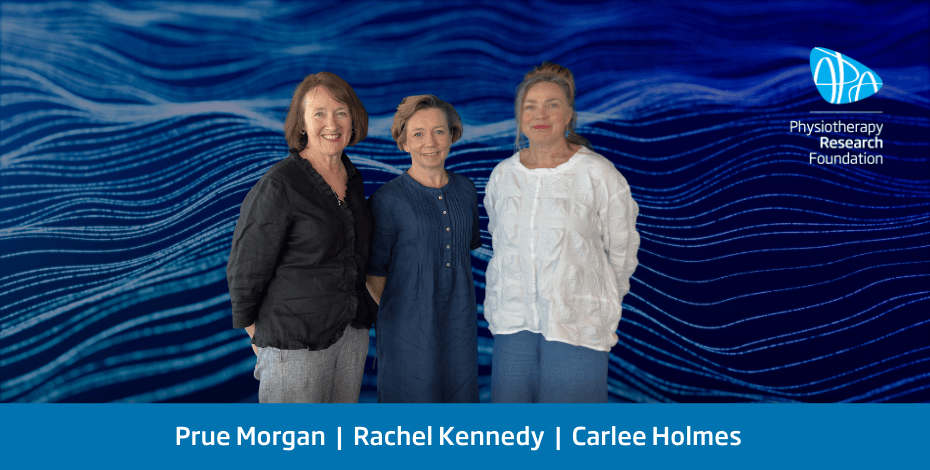
In this episode, Prue Morgan, Carlee Holmes and Rachel Kennedy look at some of the barriers to children and adults living with disability engaging in physical activity and how physios can help to overcome these barriers. Guidelines for physical activity for people with childhood-onset disabilities are similar to those for the general population but the barriers to participation are far greater. A number of studies have been done in Australia in recent years, trialling different approaches to increasing physical activity, especially in children.
This podcast is a Physiotherapy Research Foundation (PRF) initiative.
Watch the full podcast episode on YouTube.
Prue
So today we're talking all about physical activity for adults and children with cerebral palsy and other childhood-onset disabilities. My name is Prue Morgan, and I'm joined today by my colleagues, Carlee Holmes and Rachel Kennedy.
Rachel
Hi, Prue.
Prue
Welcome, guys.
Rachel
Thank you.
Prue
So we know that there are guidelines for physical activity for people with conditions such as cerebral palsy. And they are quite similar to that of the general population. But we do know that the barriers for participation are greater. And we do know that most people with significant disabilities do not meet those guidelines. However, there is a number of studies out there that have, you know, talked about different approaches to engaging people with significant disabilities in increasing physical activity, particularly children with conditions such as cerebral palsy. So today we're going to talk about, you know, what might be some of those barriers, what might be some ways that we as physiotherapists can address those or engage people across the lifespan with becoming more physically active. So perhaps let's start off and I'll throw to you, Rachel, by unpacking, like, what are some of those barriers or why are people with significant disabilities not engaging in physical activity?
Rachel
Yeah, sure. I think there's a real lack of support and understanding and knowledge. And this is both for young people with a disability as well as the people around them. And there's a real societal attitude that, you know, they might be in a wheelchair or they're walking with a stick or, you know, they've got a funny-looking movement. And that they can't participate in physical activity. But that, you know, that's not true. We know that. But I think there's a huge societal attitude that just because they've got a disability, therefore they don't have the ability to be physically active. And I think the cost of those supports to support a young person with a disability, accessing appropriate physical activities is quite significant. You know, they don't just need a parent to drive them to basketball so that they can get out of the car and play basketball. They need a support person that's there. They need a maxi taxi that's there, you know, to transport them, for instance. So just even the actual cost of accessing physical activity is quite a barrier for them, as well as the physical access of the environment. You know, it's not set up for people with disability. A lot of different physical activities are not set up. You know, the number of gyms I've been to where there's a stairs to access a key area of the gym, it's like, hello?
Prue
Yep. Absolutely. Carlee, any other barriers that you can think of?
Carlee
My work focuses on people with complex disabilities, and, you know, they may not be able to move their own bodies at all in any manner. So the limited choice of what's available to them. Gymnasiums don't have exercise equipment that they can access. So the choice of what they can do is a barrier. And there are things that they can do. But we need to think laterally as therapists and provide opportunities for them.
Prue
So can you expand on that a little bit more, like, how can those barriers be overcome?
Carlee
Firstly, finding out what people can do because everyone can do something.
Prue
Yeah.
Carlee
And for example, I use motorised cycling a lot with the people that I work with and they can't move their limbs. And so the machine, the motorised cycling machine moves them for them. They remain in their wheelchairs and they're physically active. And, you know, that's fantastic for them. And like, I have worked with people for many years and never seen them smile or laugh until I put them on the motorised cycle. And, you know, the joy of movement that we all know and that everyone can experience.
Prue
Yeah, absolutely.
Carlee
A big barrier.
Prue
Yep. So we've talked about some of the societal barriers, environmental barriers, barriers around, you know, access to appropriate equipment or facilities that enable people with profound disabilities, in particular, be more physically active. What about the cost? Because obviously in the current environment, that is also a barrier.
Rachel
Yeah. Yeah. And you know, things like, we have the NDIS, the National Disability Insurance Scheme here in Australia, which we're very lucky to have. But they don't cover the costs of a lot of activities. They'll cover the supports that are in place, so they'll cover the cost of a support worker. They'll cover the cost of the taxi to get them, say, to the gym, for example. But they won't cover the cost of gym access. So young people with disability who are already socially disadvantaged, economically, often disadvantaged, you know, and then have to fork out for the cost of that activity, which in the example I'm giving, is going to a community gym. You know, we know young people with disability from the work we've done, that, you know, they're willing to pay about $10 or $15 to access the gym, for example, but gyms are paying upwards of 20, you know, a cost upwards of $20 to access the gym. So, you know, it's above the budget that they've got, and that they're able to pay. Young people value, you know, they want to pay for access, but they can't afford it at the level that it is. And systems such as the NDIS and other government policies aren't there to support young people with disability to access those things.
Prue
Yeah.
Rachel
Yeah.
Prue
And we all know that in the long run, being more physically active enables better physical and mental health across the lifespan.
Rachel
Correct.
Prue
So putting in place or investing in supports to enable that physical activity earlier in life, particularly we're talking mainly about sort of adolescents or young adults when they're exploring or trying to identify new activities that they might be interested in. You know, it pays off in the long run because hopefully it prevents the development of some of those adverse physical and mental health disorders that this population are so vulnerable to.
Rachel
Correct. We know that there's cost savings to the health system if people are more physically active. And that goes for people with disability as much as it does us as able-bodied people. So, you know, if people with disability, and if we start young in childhood, adolescence into young adulthood, that will have a direct impact on into adulthood and their lifespan and on their general health and wellbeing. And there will be a cost saving, likes the keynote was talking this morning about, you know, physios are, you know, we should be at preventative health care. That's where we are. And that needs to be recognised. And that really resonated with me today.
Prue
Yeah, absolutely. So Carlee, imagine that you've got a new client who's just been referred to you, a young person who's got quite profound disability, who's interested in being physically active. What would be the first thing that you might do to try and enable that?
Carlee
I would ask them what they would like to do as a first start. And if they're very cognitively challenged as well, you know, you speak with their carers and their family and find out, you know, the family's interests as well, and what they might like to do and be able to facilitate, or the support workers. Yeah, and that's a very good start.
Prue
Excellent. And I'm reminded of a client that I've worked with in the past who, she was a young woman with profound disability in a wheelchair. She wanted to be more physically active. She went to her physio and her physio kept saying, go and play bocce. And she said, I don't like bocce.
Carlee
Well, that doesn't matter, go and play bocce.
Prue
So you're absolutely right. Just like you would with, you know, an able-bodied young person who came for advice, you know, you'd ask them what are their interests, what do they want to explore? And physical activity, you know, it doesn't need to just be, you know, going to a gym.
Rachel
No.
Carlee
No, not everybody feels happy and comfortable in a gym. Or again, those with complex disabilities, it is such an effort to get to a gymnasium, to support workers, timing of the support workers, timing of their medications, timing of their feeds and their personal care. It's not always the best place for everybody.
Prue
Yep. So what sort of, you know, physical activities are you aware of that young people with complex disabilities have been able to participate in?
Rachel
Yeah. So, even things like, I also work in neuromuscular diseases, and you know, young men with Duchenne muscular dystrophy who are in wheelchairs, you know, unable to stand and walk. They're actually all getting into wheelchair rugby and wheelchair hockey, and they've got this wonderful social support where they all gather together down at Parkville in Melbourne, where I'm from, and they come together on a Sunday and they've got competitions going. And I was talking to one of the young men who used to be in our clinic, bumped into him socially, and he was telling me about it. He goes, I'm not very good, but they want me to come and join in. And he had a sense of purpose and that was wonderful. You know, he's not able to move his body a lot, but he can move it a little bit.
Prue
Yeah.
Rachel
Which was absolutely wonderful. And then I'm aware of some colleagues in Denmark who were using the passive-active cycle that Carlee was talking about, again, in people with really severe muscular dystrophy, very weak. And they found some wonderful outcomes for that group of people, things like improved lower back pain, improved bowel motions, improved quality of life. It was just, it was amazing. You know, it was fantastic that, you know, physical activity it's not just about the movement and whatnot. It's the impact on that person's life as a result.
Carlee
So these are all benefits that, you know, the non-disabled population gain from being physically active and movement. And we need to provide that opportunity to people with disabilities at all levels, whether they can move a little bit or a lot. They need the choice and opportunity to engage and experience those benefits.
Rachel
Yeah.
Prue
Yeah. For sure. So there are certainly some misconceptions about risk that are held by the person with the disability themselves, their families, often by physiotherapists and other health professionals who say, oh no, it's way too dangerous for you to do physical activity. Carlee, would you like to speak to that?
Carlee
Well, yes. I mean, we all should have the opportunity to take some risk in life as well. Disabled people need to take risks, but physical activity isn't risk taking. It can be safe. It needs appropriate safeguards or outcomes.
Rachel
Appropriate boundaries around it.
Carlee
And boundaries and supervision, if necessary. And it's safe.
Rachel
Yeah.
Carlee
It can be safe.
Rachel
Yep, we've had the same in neuromuscular diseases as well in that, you know, those childhood-onset diseases where the child starts walking and then gradually becomes more disabled over time and is, you know, in a wheelchair by adulthood and, you know, there's this fear, and there’s fear amongst my colleagues and physiotherapists that, you know, if we exercise them or if they move, that we're going to damage their muscles more. And in fact, the research has found that that is not the case. There is a level of fatigue and fatigue management that we need to be really aware of. But this is where it comes down to education. And, you know, part of what we're doing right now today is trying to educate our colleagues and the people and the supports around the person with disability about what is safe to do, that you shouldn't be afraid to move that, you know, it's good to move. We just need those boundaries around, okay, well, we're not going to be overloading those muscles, but it's okay to be working submaximally and that's okay. And it's better to do some movement than no movement. There's evidence in the literature around Duchenne muscular dystrophy and it's called a ‘no use is disuse’ study because actually they found that the young boys with Duchenne who did no movement were doing much worse than those that did some movement. And so there's this whole thing of, any movement is good movement. You know, that it's important to move.
Carlee
Yeah, in my group of young adults with severe and complex disability, they found that their pain decreased, the fatigue decreased, their bowel function improved, and their mood improved.
Rachel
Those endorphins work.
Carlee
Endorphins work, and it's safe.
Prue
Yeah. And also being, you know, as you said, it's about education not only for our colleagues but also for the young person with the disability and maybe their family as well to help them understand that a little bit of pain, you know, after using your muscle, is normal.
Rachel
Yes.
Prue
It should, you know, resolve quickly, but we all get a little bit of muscle pain if we're using muscles that we haven't perhaps used.
Rachel
For a while.
Carlee
And it's a different pain to ongoing, everyday, chronic injury pain.
Rachel
Correct.
Carlee
And that's the sort of pain that improved.
Prue
Yep. Absolutely.
Carlee
And yeah, you know, knowing the difference and movement is one of the first things we do or is prescribed for most people when they have some sort of pain.
Rachel
Move.
Carlee
Move.
Rachel
Yeah. Exactly. Yeah. I talk to the young kids with neuromuscular disorders about DOMS, so I talked to them, I said, I tell them that I get DOMS when I go to the gym as well. And, you know, I give them parameters now, I've got a little spiel that I now send out to all the therapists about, you know, we've got to teach the kids it's okay to feel a little bit of muscle pain. That's not dangerous. And the parameters around what is too much.
Prue
Yeah.
Rachel
You know, and that feeling a little bit of muscle pain means that we've moved our muscles, and that's not a bad thing. Yeah.
Prue
Absolutely. So we're talking about, you know, some of those safety, sort of, boundaries that can be put in place about, you know, things like appropriate supervision or assistance if that's needed. Equipment modification if that's required. Educating the person about intensity and how, you know, how much is too much. But also around things like, if they need to manage, you know, medication or seizures or, I'm thinking about if they're going in a swimming pool and, you know, respiratory support, all of those things can be managed rather than us just saying as physios, no, it's way too risky, and perpetuating that anxiety around physical activity which ends up sort of having those adverse consequences of being, you know, very, you know, promoting that really sedentary lifestyle.
Rachel
Correct. Yeah.
Prue
Some of you have alluded to some research that is already out there. Where is the research going, relating to physical activity and people with sort of childhood-onset disabilities?
Rachel
A lot of it is around education and empowering young people, and actually asking, so co-design, you know, working with people with lived experience about what they want to do, what they can do, how it's going to work for them. So there's quite a bit of work around that. We've been doing some work on social supports and that’s that education, sort of, framework around, you know, what are the things that need to be in place to support that young person to be physically active or to exercise in the way that they want to do? And there are things like, as Carlee mentioned before, supervision, peer support, having a friend or someone that's around your age to go and exercise or be physically active with you, having the specialist there to provide that overarching guidance around what is possible and what those boundaries are. That specialist doesn't need to be there all the time. They can provide the education to the support person or peer mentor around them. Being orientated to the activity and so that you feel comfortable in the environment, you know, some environments that we would typically exercise in or go to, for example, the gym, I keep coming back to the gym, can be quite overwhelming for some young people. You know, even if you think that young people with autism as well, autistic young people, so, you know, what's the environment like? And then, you know, showing that person around that environment and that wayfaring around that environment so that they feel familiar. And then there's the logistics. You know, the motivation, having someone there to coach, you know, to not coach you, but to be motivating you and whatnot. So those social supports are really important. And that's sort of some of the work we've been doing.
Prue
Yeah, thanks, Carlee?
Carlee
What we have our colleague Iain Dutia, who's doing some fabulous work now with swimming in people with complex disabilities at GMFCS four and five which is fabulous, to get that group of people out and being active. Stacey Cleary and Georgia McKenzie have created CP-Pathfinding Fitness for life, which is a co-designed app that young people with cerebral palsy and childhood-onset disabilities, explaining the activities that they enjoy doing, how they can do it, and to get the information out to other people with disabilities and their clinicians what's possible? Myself, my research focuses on the motorised cycling for the very complex people with disabilities.
Prue
Yeah.
Carlee
And there’s frame running.
Prue
Yeah.
Carlee
And, this work CP Movetime, which is an app that's being researched to look at how much movement people do and then to encourage increased movement.
Prue
Yeah. So both of you have touched on the importance of education, whether it's to the young person with the disability themselves, to their parents or to health professionals, and certainly, we've also recently, with co-design principles, developed an online module under the CP-Pathfinding banner where it's about your health and providing information for young people, in this case with cerebral palsy, about, you know, health issues, with the idea being that, you know, developing that health literacy across the lifespan is so important to allow a person to become empowered so that they can then make good decisions about what they want to do with their life and how they can make the most of both their physical health and their mental health. So there's certainly quite a lot of activity going on in this space. Some are specific looking, evaluating specific interventions, the use of certain equipment, but also around that sort of health promotion as you said earlier, Rachel, the importance of us focusing on preventive interventions and how we can build health health literacy in this population. So what might be a take-home message?
Rachel
My big message for everyone is any movement is good movement. And, you know, I came to that after, I was very fortunate to do a Churchill Fellowship to look at physical activity for young people with neuromuscular diseases. And every expert I spoke to when I visited them overseas, every international expert just came back to, just encourage them to move. And so ‘any movement is good movement’ became my little catch cry. And that's what I say to the kids when they come into clinic.
Prue
Yeah.
Carlee
So some get big gold elephant stamps when they're being active. Yeah.
Prue
Yeah. Thanks. Carlee, what would be your key take-home message?
Carlee
I think my key take-home message is to involve people with complex disabilities in physical activity. And that is possible and is achievable, and that they can gain all the benefits that we all gain from physical activity. But we just need to think a little bit more laterally and out of the box about how we can encourage them to be active.
Prue
Yep.
Carlee
Yep.
Prue
My most important message would be, you know, young people with disabilities, everyone's entitled for to be able to take the dignity of risk.
Rachel
Yes.
Prue
So you know, we can't just as physios say, no, that's too dangerous. Rather than saying no, we should be saying, how can we make that happen for you? And how can we enable you to be able to participate in that physical activity. So sort of the concept of dignity of risk is, I think, a really important human right.
Carlee
Absolutely.
Rachel
Yeah. I totally agree.
Get to know our interviewees
Professor Prue Morgan FACP
Professor Prue Morgan FACP is an internationally recognised physiotherapy leader, educator, clinician and academic with more than 35 years of experience in clinical practice and research. Prue’s research focuses on issues relating to people ageing with complex lifespan disability, and specifically, participation challenges experienced by young people with cerebral palsy as they transition to adult services. She has more than 90 publications, more than $6M in grant funding, and led clinical research trials. She has held multiple national leadership roles, such as President of Council of Physiotherapy Deans Australia New Zealand, Chair of the Lifespan Care Committee of the American Academy of Cerebral Palsy & Developmental Medicine, and Chair of Neurology Group (Australian Physiotherapy Association). Prue was awarded the prestigious title of Specialist Neurological Physiotherapist in 2008 by the Australian College of Physiotherapists in recognition of her clinical expertise, research and scholarship.
Dr Carlee Holmes
Dr Carlee Holmes is a clinical and research physiotherapist, currently appointed as a Postdoctoral Research Fellow at the Murdoch Children’s Research Institute and as a senior clinical Physiotherapist with the Young Adult Complex Disability Service, St. Vincent’s Hospital Melbourne. Carlee has a strong clinical and research interest in physical activity and complex postural management for non-ambulant adults with CP. She combines the clinical and research roles to further the evidence base in these areas.
Dr Rachel Kennedy APAM
Dr Rachel Kennedy APAM is an experienced physiotherapist and clinician-researcher with experience working with children, young people and their families; this includes a research and clinical role in the Neuromuscular clinic at The Royal Children’s Hospital and as a Senior research officer in the Neurosciences group, at the Murdoch Children’s Research Institute, Melbourne, Australia. Rachel is a post-doctoral fellow (Physical Activity) in the Olga Tennison Autism Research Centre at La Trobe University where she has led the implementation of social support strategies for young people with disability in community gyms (GYM-SPARC a VicHealth-funded Impact Research Initiative 2021). Rachel was conferred her PhD from The University of Melbourne in 2018; her studies investigated gait and functional ambulation including the effect of footwear and falls on gait and function, and physical activity in children and adolescents with Charcot-Marie-Tooth disease (CMT). She is the recipient of a Winston Churchill Memorial Trust Fellowship (2019) which explored the implementation of physical activity and exercise programs for children and young people with neuromuscular disease.