
Benefits of physical activity after stroke
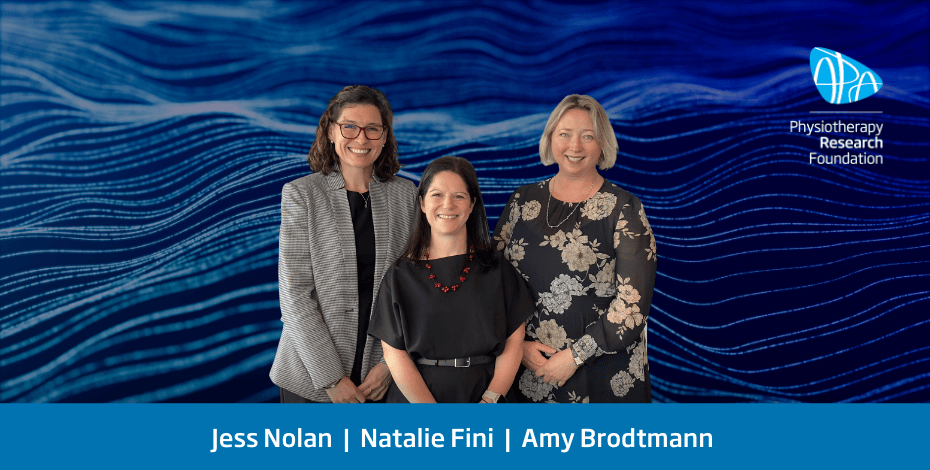
In this episode, Nat Fini, Amy Brodtmann and Jess Nolan discuss the World Stroke Organisation guidelines as well as some of the latest research into stroke rehab, particularly focusing on lateropulsion, a significant limitation seen early after stroke.
Physios play a front-line role in stroke recovery and a particularly important role in getting people up & moving after stroke. The recent World Stroke Organisation guideline synthesis recommends targeting physical activity across the stroke recovery spectrum.
This podcast is a Physiotherapy Research Foundation (PRF) initiative.
Watch the full podcast episode on YouTube.
Nat
My name’s Natalie Fini, and I'm a senior lecturer at the University of Melbourne. And we're doing a podcast today about stroke recovery. And I have two fabulous guests here today.
Jess
Thanks, Nat. I'm Jess Nolan from Curtin University in Australia. Western Australia.
Amy
And my name is Amy Brodtmann. I'm a neurologist in Melbourne, and I'm at Monash University.
Nat
Fantastic. So, we all know that stroke is the leading cause of worldwide disability, and physiotherapists play a frontline role in stroke recovery and a particularly important role in that early mobilisation and getting people up, moving, up and out of bed after stroke. Jess, I know that you have done a lot of work with a condition that's quite interesting and quite hard to explain. And that's called lateropulsion. And I'd love you to tell us a bit more about it.
Jess
Lateropulsion is when someone feels upright when they're leaning toward their more affected side. So their hemiplegic side. So they actually use their less affected side to push themselves over. So that condition used to be called pusher behaviour or pusher syndrome. But lateropulsion is now the recommended term to describe that. So it's of course a problem for rehab because people are pushing themselves over. So it makes it hard to sit, transfer, walk and to do rehab really. So that needs to be a number one priority in rehab.
Nat
And for physios, when they're first getting someone up, I mean, I've treated a lot of people with lateropulsion in the past, and so I know there's a few tips and tricks and things we need to know when getting people with lateropulsion up and moving. What are your key takeaways for that?
Jess
I think the one of the things with lateropulsion for getting them up and moving is that we still need to do it. So just because someone has lateropulsion doesn't mean that we should say, they stay in bed because it's too hard or that we don't do it. We need to be doing it more. Helping someone by first of all, helping them realign themselves, is really important. So that means, the most effective way of doing that is putting yourself or a target or something safe on the side that they push away from. And then the person can feel safe to lean toward that target on the side that they push away from. And encouraging upright midline as much as possible. So I think, you know, whether that means, hopefully, someone won't rely on a hoist forever, but hoisting someone out of bed and allowing them to experience upright and midline orientation as much as possible and as early as possible is really important.
Nat
Yeah, so getting them to experience that vertical.
Jess
That's right.
Nat
Yeah. And I guess for physios it's important, for a junior physio, for example, not to try and do this on their own and to get a second pair of hands or the appropriate hoists or whatever.
Jess
Absolutely. So particularly if someone's got severe lateropulsion, which would be where they push in sitting or lying. You usually need two people to do that. So you'd need someone on the side that they push away from so that you're bringing them, giving them a target that's safe to lean towards. But also you probably need someone on that side that they push towards, for safety. So definitely, like, we need a couple of people to start.
Nat
Yeah, great. And what has your research found in terms of what does it mean for somebody’s recovery if they’ve got lateropulsion?
Jess
So first of all, lateropulsion can resolve. So, again, it doesn’t mean that someone Doesn’t have potential to recover. And actually, we know that people with lateropulsion can make meaningful and significant change but they need access to enough rehab. So we do know that they likely need access to longer rehab than someone without lateropulsion. So that’s in inpatient and outpatient rehabilitation. They need extended rehabilitation but they can make significant changes. We know that people with lateropulsion are at greater risk of falling. They're less likely to go home if they don't have enough time in rehab, but they can make changes and sometimes completely resolve with enough rehab. So usually that's about three or four weeks extra in inpatient rehabilitation.
Nat
Yeah. And that's, I guess, a part of the challenge with our current health system is, advocating for that extra time in inpatient rehab. But it's so important for us to know about this so we can say, have the evidence to say these people can recover enough to go home if we give them the right amount of rehab.
Jess
That's right. I think particularly people with severe lateropulsion, I worry that some aren't even getting access to rehab in the first place. So I think they first of all need access to rehab. But second of all, they need access to enough rehab. So it’s both that we need to let them in the door in the first place, and then keep them long enough to make the changes they need.
Nat
And I guess even for those patients that might not get to be home independently, but even if it means that someone can transfer with just one person helping them, as opposed to a hoist transfer, that means so much for their quality of life when they go to residential care, for example.
Jess
Yeah, absolutely. It's huge. And one of the studies we presented today talked about the people that went home tended to at least maintain their function, whereas people who were discharged to residential care tended to deteriorate in the longer term. So I think if we can help people make those changes enough so that they can go home with help, they can then access more rehab after they're discharged. And, you know, of course, there are other factors that come into play there. But if people can go home and access more rehab, they're more likely to do better in the long term. For sure.
Amy
Nat, can I ask Jess some questions?
Nat
Yeah, go for it.
Amy
Do we understand the neural basis for it? Is it a larger stroke or more severe stroke or due to sarcopenia? I mean, why do some people have this and others don't?
Jess
Good question. So about half of stroke survivors have it. So it is really prevalent. The neural basis, it's not that well understood. So as part of my PhD, we did a Delphi study that looked at, well, we were aiming to reach consensus on best-practice management, but we also looked at research priorities for lateropulsion management. And one of the top priorities was understanding the mechanism behind lateropulsion, which we still don't entirely understand. So, when I went through uni, we were taught that lateropulsion was due to lateral medullary syndrome. So the brainstem stroke. And that the supratentorial strokes cause pusher syndrome. And that they were two different things. And we still haven't teased out whether they're the same condition but a spectrum of severities or whether they're two different conditions. So that was again part of that Delphi process. We realised when we met about it, we weren’t all talking about the same thing. So part of it was we were aiming to reach agreement on the definition and a term to describe lateropulsion. So we agreed on the definition,which is what I told you, that someone would use their less affected side to push over to the more affected side. We did not reach consensus on the term. So we had some agreement, the minimum, some agreement that we would accept as agreement. So we had 50% agreement, that lateropulsion is the accepted term, but we had from round one, 10 different terms suggested. So it's still up in the air a little bit. So the mechanism, I think, whether it's different from infratentorial stroke and supratentorial stroke, I'm still not sure. We know the severity is different and it's less severe with infratentorial stroke than with supratentorial stroke. But not sure if it's the same condition or not. Looking at brain lesion site, particularly with supratentorial stroke, it's kind of all over the place. So still it's not from one specific area. One of the studies I did with my PhD was looking at neuroimaging associated with lateropulsion. So the thalamus was important. And otherwise we found white matter and haemorrhagic stroke to be relevant in lateropulsion. And one of the suggestions was that that's connection. So it's connection between thalamus and cortex that's likely to cause a problem there. Size of stroke in some studies was relevant. It wasn't relevant in our study. So still not sure. Still working on it, but I think it's more complex than just saying it's one lesion location. It's a combination of factors, I think.
Nat
Super interesting. So we can't, before we’ve walked in and seen the patient we can't tell if they're going to have lateropulsion from looking at their scans.
Jess
Not really.
Nat
We have to go in and see the patient and assess their mobility for ourselves.
Jess
Yeah, that's right. I mean, some it's so obvious where you lay eyes on them and you can see that they've got lateropulsion. But, you know, sometimes you do need to assess it if it's not so severe that you can see it just the first time you eyeball them.
Nat
Great. And so, we know that rehab is so important for people with lateropulsion. And let's now talk about stroke rehabilitation in general. It's so important for our patients to be able to access stroke rehab, whether that's in an inpatient facility or in the community, but just to get access to some therapy. It's super important. And there's been a little bit going on in the World Stroke Organisation about this. And, Jess, I believe you've been doing some work in this space.
Jess
Yeah. So I've been I'm part of the World Stroke Organisation Future Leaders program. And then from that I had the opportunity to work with a team. We're working on a study, looking at stroke rehab practice in India and Brazil, in low and middle income countries. And we realised when we were trying to map what's happening in India and Brazil, we needed to find out what we're actually mapping against. What are we measuring. So we started looking at different criteria and different international guidelines. And then also found out that there were other groups of people doing this. So we've all joined forces. So from Australia, Liz Lynch is also involved in this. But it's an international team. We've compiled international stroke rehab guidelines. And now we're working with the World Stroke Organisation Rehab implementation Committee and starting a rehab certification. So the acute certification has been going on for a few years. And now we've started piloting these criteria for rehab. So we've done the the pilot of these criteria in 15 low and middle income countries. They've just finished. The 15th ones in Malaysia, just finished. I got to go to Vietnam in August to pilot the criteria in Vietnam and look at what's happening in stroke rehab. So I think it's really exciting because we do, I mean, we have the evidence there, it's being applied differently and we don't know who's got access to what quality of rehab, what kind of rehab. So I think that having a standard certification program, it'll be a game changer, I think, for stroke rehab and access to rehab.
Nat
How amazing to get to see stroke rehab around different places around the world. And, you know, we're probably placed pretty well here in Australia, but we can still be doing better, I'd imagine.
Jess
Yeah. I think so. It's been really interesting to see what challenges and what opportunities people have. We have also looked at the criteria and different Expectations based on a country's resources. But, for example, in Vietnam, I was amazed by the work that they're doing. At the hospital that I went to in Ho Chi Minh City had a very truly interdisciplinary team and the amount of rehab they were giving, so the access to rehab, people could come and participate in physio, OT and speech pathology five days a week and have each discipline every day. And that was just part of their standard practice. And the family was always involved in therapy and they were doing that. So there are some things that they were doing there better than we…
Nat
Yeah.
Jess
We do here.
Nat
We don't have that here. You know, once people leave hospital, there's no way they're getting five days a week.
Jess
And it's just, it was so different. So to see the way that they're making things work and with different resources and different systems, I think was really interesting. So I'm having a good time with that project.
Nat
Yeah. That sounds really cool. One of the big things we do as part of rehabilitation and then beyond and after traditional rehab is, it's so important for us to make sure people with stroke are physically active because we know being physically active, it's so important for all of us. But it's even more important for people after stroke for secondary stroke prevention. We need to be making sure that people with stroke are exercising and finding some sort of exercise that they can keep doing in the long term. But Amy, you have just completed a really, really exciting project that was all about getting people up and moving after stroke. Can you tell us about the PISCES-ZODIAC trial?
Amy
Sure. So this was a study that we've been doing for eight years. Feels like a lifetime. And so it was the Post Ischemic Stroke Cardiovascular Exercise Study. Very pragmatic title. But essentially in prior observational studies which have shown that after stroke, people are at high risk of dementia, high risk of cognitive impairment, high risk of brain degeneration. And that's something we don't think about. You know, we think about cognitive impairment and how it impacts on recovery. You know, if they can’t engage in your, you know, in your activities and they can't really get the best outcomes. We know that. We know it impacts on quality of life, but we don't think about what happens down the track. I always think that, what we are as health professionals is actually brain health ambassadors. We're all trying to kind of make sure that they as well, as fit, and that's really important for your brain. So we found in our study, our cohort study, that yes, they lost more brain volume. Yes, they had an increased risk of cognitive impairment. But we looked at people's physical activity in this original cohort study and found that those people who spent more time active had better cognition. And those people who met the moderate to vigorous physical activity guidelines, which there weren't that many, but if they did, they had less accumulation of white matter hyperintensities. So really important data. And we also looked at their brain volume loss following stroke, and there’s a window in the first three months where you lose a lot of brain particularly in the thalami, and in the hippocampi, which are the memory gates. Really important for memory. Not where we store our memories, but they open and close to allow us to remember. So we thought, why don't we deliver an intervention at that two months? So before they've lost too much brain, once they're home, so they're not interfering with what's happening when they're seeing you in rehab. And so we designed an eight-week intervention, very much designed to cardiac rehabilitation. So anyone who's had a major adverse cardiac event, a MACE, gets cardiac rehab. Everyone gets that. If you have breast cancer, you get rehab. If you've got lung disease, you get exercise. Don't get it with a stroke. You don't get any exercise prescription. You get lots of brilliant rehab, but you don't necessarily get any exercise. We just say be active. So we compared cardiorespiratory exercise versus a balance and stretching group. We had to have an active control because we were recruiting people into the study, saying, you're coming into an exercise study. If we had them doing nothing, They would be immediately unblinded. So for the first part, the PISCES we brought them in three times a week for eight weeks. And our budget was mainly on, you know, transport. And we exercised them for an hour, matching intensity, matching time spent with exercise staff. The exercise intervention was designed by Liam Johnson, who's an exercise physiologist, and we had exercise professionals, physiotherapists and exercise physiologists deliver the intervention, and then…
Nat
Amy, can I ask, what was the intervention? Was it treadmill or bike?
Amy
Yeah. So it was treadmill at the start. For the cardio respiratory plus resistance training.
Nat
So both cardiorespiratory and resistance training?
Amy
Yes. So it was both. So it was a mixed HIIT and moderate intensity continuous. So we had both.
Nat
So you had some peak, some high-intensity training. Yep, high-intensity training. And we got, you'll hear the results, well, you know the results. But we did get them to, some of them, we got to be able to get to quite high intensity. Plus they had resistance. So that was sort of 70-80% of the 3RM. Knowing that obviously the energy required to exercise after stroke is much higher, and we still really need to understand that physiology more, you know, just setting, what the VO2 peak was going to be because we did do V02 peak at the start. And then the pandemic happened and you couldn't use anything that would aerialise. So we couldn't do VO2 peak. So we had to change to a modified heart rate.
Nat
So this is for the exercise testing?
Amy
This is for the exercise testing. Yeah. So then we thought, and then that project was on hold, when the pandemic came, because we couldn't bring people back for 24 sessions. So we pivoted and we made it a home-delivered intervention. So I got a contract with Little Red Trucks and a removalist where we could store the exercise gear, and we learned how to do home interventions. Jannette Blennerhassett taught all of our staff about how to do safety at home. Bless her. And we did the intervention. We delivered in the truck, the machine, if they needed it and that was when it was a bike. So we went from treadmill to bike because the treadmill at home is just not safe. Yeah, you need to have someone there. We gave them an iPad, it had a data plan and we taught them. We gave them Zoom links, we diarised it all. We found a place where they could do their exercise. And, then the rest of the intervention was done remotely.
Nat
Just on a pragmatic trial perspective.
Amy
Yes.
Nat
Because you were no longer paying for transport for people to come in and out of hospital all those times, did you use that money to pay for the bikes and the transfer of the bikes?
Amy
100%.
Nat
Yeah. Right.
Amy
Yeah.
Nat
Well, that's really clever that you were able to think of that pivot. I can't even imagine how stressful that would have been.
Amy
Yeah. And again, credit where credit's due. I was losing my mind. And Stanley Hung, who was a PhD student with me, who again, some of you might know, he's a physiotherapist who's back in Canada now. I said, can we do it remotely? And, in a meeting and everyone said, no, no, no. And Stan said, well, we could. So yes, that's what we did. So we used the budget to have a contract with a removal truck, basically.
Nat
And just, because I know there'll be physios listening and they'll be quite interested. So how did you do all of the, like, did you work out what heart rate they should be working at and then had them monitoring their heart rate?
Amy
Yep. We taught them to do their blood pressure before and after as well, for safety. And so we changed the criteria a bit. So we had to rewrite the protocols. So there's two protocols for this study. Two published protocols. And we needed a study partner because we figured it was not safe for someone to exercise at home on their own. So obviously, for the first part, PISCES, they didn't need anyone. The second part, we did have a study partner. It was during the pandemic. It was fairly easy.
Nat
Because everyone’s at home.
Amy
Everyone was at home. So yes, disaster leads to creativity and it was creative. So that's the ZODIAC. Zoom Delivered Intervention Against Cognitive decline. So we were able to then look at which arm the participants were in. So in our pre-specified analyses, we could look and compare. Is the intervention better or worse if it's home or in-person delivered? So that was a little silver lining that we weren't expecting. So what we found was, because I'm an imaging person and because I had these data showing the brain volume loss, a primary outcome was brain volume. But my big interest is cognition. Are they going to lose their, you know, are they going to develop cognitive impairment? Are they going to decline over this time? So we had two outcome measures, brain-volume change before and after the intervention. And then cognition at 12 months. And what we found is that both interventions preserve brain volume almost the same. So there's very little difference in the brain-volume change. Our hypothesis was that cardiorespiratory exercise would be better.
Nat
Yeah.
Amy
So it was a negative study in that sense. But when we looked at the actual brain- volume loss, because sadly our brains are shrinking as we age, was comparable to the stroke-free controls in that cohort study that I mentioned at the start. So it looks like any exercise, any increase in exercise, is of benefit, protects the brain. But what was really interesting is at 12 months, the cardiorespiratory exercise people, there was evidence of preservation of cognition on a couple of tests, on a global test and also on a timed test. The Trails B, which is a test of executive and processing speed. So the cardiorespiratory exercise looks like it's better for cognition, but both exercise. And I think that's really interesting because it suggests well, one, we know how sedentary people are after stroke. So here we were probably doing something. And the balance and stretching was 20 minutes of static sort of stretches for all major muscle groups, but it was 30 minutes of balance and stretching. And in hindsight, we know how incredibly good that is for the brain. You know, with something that we're all doing and we're doing a lot in, you know, you physiotherapists are doing it all the time and some data came out during the study showing how incredibly beneficial it was. So perhaps we were, you know, giving equal benefit with our control.
Nat
Yeah. So I mean that's a great advertisement for the benefits of exercise after stroke. Something's better than nothing.
Amy
Yeah.
Nat
But maybe that cardiorespiratory is better for cognition in the long term. So that's super interesting. I don't know if you've done any work on looking at how much the participants enjoyed doing the exercise. So like, you know, what, were they on the bike for half an hour or something?
Amy
Yeah, they were on the bike for about 30 minutes. And then, so there's a warm up, they probably could be a little bit longer towards the end. Obviously they were building up, because some people had never exercised before. And then they had about 20 minutes of the resistance work as well. We haven't obviously published that because we just got the primary outcome paper out in August. We’re looking at fidelity and we're looking at quality of life. Just the feedback that we got was they loved being in the intervention. I think people liked the balance and stretching more. So in general, they seem to like that. And then it was interesting because we thought, oh gosh, will they know? But more people in the balance and stretching interventions said to our staff, this is just anecdotal, I know I'm in the active arm. And they were like, oh, that's good. So we need to look at that. Because obviously, I mean, some people just truly hate exercise. And these are these were people who, you know, we randomised them, they knew at the start that they would be randomised and they would have to get what they get.
Nat
Yeah. It's really interesting. Some of the work I've been doing has been looking at people choosing their type of physical activity they do. And it is interesting to see the choices that people make. Some people really love that cardiorespiratory exercise. But I must say for most, just going out for a walk is what they would choose to do.
Amy
Nat, do you want to talk about that a little? Because I've seen some of your talks, but I've obviously missed some this session. What have you found with that? What do people like?
Nat
Well, the study’s ongoing. So, yeah, this is the Fit 4 Me After Stroke trial that we're running, and we co-designed an intervention that was essentially all about people choosing the type of exercise they do, with the thought that, if we want people to engage in long-term physical activity, has to be something that they're invested in and that they want to do. So just, you know, anecdotally, it's walking is the main form of physical activity that people choose to do. There are some who are real gym people. And there are some who, bike riding, like there's been there's been all sorts of things, dance classes. But overall the main thing is walking. And that's led then to us co-designing another intervention that's around walking, walking groups. So that's what we're looking at now for people to get peer support, and the social component as well. So we'll see what comes of that.
Jess
What outcomes are you measuring then?
Nat
So I'm doing a very interesting trial design. So it’s a very early phase trial. We're looking at a composite outcome but from a physical activity perspective. It's steps per day. So how many steps? What's the change in steps per day that people can do?
Amy
And what are you using to measure?
Nat
Yeah, we’re using...
Amy
That's a nightmare.
Nat
It is a nightmare.
Amy
You know, for CANVAS we used SenseWear.
Nat
I used the SenseWear in my PhD. I loved it.
Amy
I still love SenseWear. And we've done beautiful work. Elie Gottlieb did some gorgeous work looking at sleep and showing that it's really good for almost all aspects of sleep as well.
Nat
I love the SenseWear, but they’re out of, they don’t get made anymore so I have some at home. So no, we're using actigraphs we’re also measuring moderate to vigorous physical activity. But we're using Fitbits for step count because we've just gone pragmatic. Okay. Yeah. Okay, so we've had a really great chat today about what physiotherapy and exercise can do for people after stroke and how important it is to get people up and vertical and moving after stroke, and then how we can get them keeping active in the longer term. And we've got a lot of options for people after stroke. And I think one of the main things is to not limit people and to talk to them about what kind of exercise they did maybe before stroke. And it's always possible to get people back to some form of the same thing and getting them involved in something they're interested in is more likely to keep up a long-term habit. So, yeah, let's just work hard to keep our patients as physically active as possible so we can improve their brain health and hopefully prevent any further strokes.
Get to know our interviewees
Dr Natalie Fini MACP
Dr Natalie Fini MACP is an NHMRC Emerging Leadership Fellow and Senior Lecturer in Physiotherapy at the University of Melbourne (UoM). Natalie was the convenor for the APASC25 conference. She is a titled APA Neurological Physiotherapist with over 20 years of experience, a past APA National Neurology Group Chair (2019-22) and previous co-ordinator of neurology teaching for the Doctor of Physiotherapy (UoM, 2017-23). Natalie's research interests are in physical activity after stroke, co-design and early-phase trial design. Natalie also sits on the executive of the International Stroke Recovery and Rehabilitation Alliance.
Professor Amy Brodtmann
Professor Amy Brodtmann is a cognitive neurologist, with a research background in stroke, neuroimaging and dementia. Amy received her medical degree from the University of Melbourne before completing specialty training in neurology at Austin Health and the Royal Melbourne Hospital. Her PhD was completed in 2004 in functional magnetic resonance imaging, stroke and normal aging. She travelled to Chicago to do post-doctoral work at the Cognitive Neurology and Alzheimer’s Disease Centre, a recognized centre of excellence in frontotemporal dementia.
Dr Jessica Nolan AMCP
Dr Jessica Nolan AMCP is a Senior Lecturer (Teaching and Research) at Curtin University in Perth, Western Australia and an APA Titled Research Physiotherapist. Jessica worked as a physiotherapy clinician on a stroke rehabilitation unit in WA for many years, before starting research. She completed her PhD focusing on lateropulsion in December, 2023. She continues to progress research focusing on improving outcomes for people with lateropulsion after stroke, and wants to improve access to best-practice rehabilitation for all stroke survivors in Australia. She is a current member of the World Stroke Organisation Future Leaders Program, World Stroke Organisation Rehabilitation Implementation Committee, Secretary of the Australia and New Zealand Stroke Organisation Emerging Stroke Clinician Scientist Committee, and a member of the International Stroke Rehabilitation and Recovery Alliance Early Career group and the Stroke Foundation Living Guidelines Physiotherapy Working Party.