
Classifying chronic pain to aid treatment approaches
Chronic pain is a debilitating condition associated with many musculoskeletal conditions with numerous contributing factors that can be physiological or environmental. By understanding the different kinds of pain, and the factors affecting pain, clinicians can individually tailor their approach to treating it.
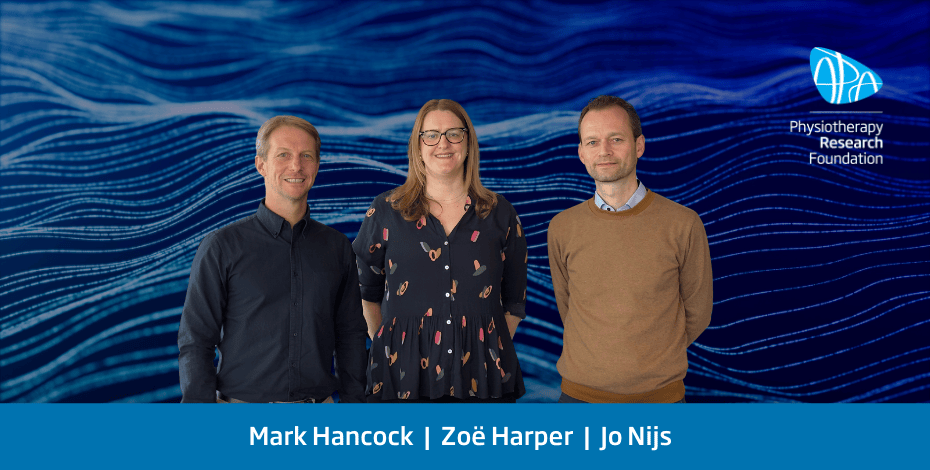
In this episode, Zoë Harper, Jo Nijs and Mark Hancock discuss the different classifications of pain and how physios can treat them, including prescriptions of exercise and physical activity, education and psychological approaches.
This podcast is a Physiotherapy Research Foundation (PRF) initiative.
Watch the full podcast episode on YouTube.
Zoe
My name is Zoe Harper. I'm the national chair of the Pain Group here at the Australian Physiotherapy Association. I also work clinically as a senior clinician and physiotherapist at the Barbara Walker Centre for Pain Management at Saint Vincent's Hospital, Australia.
Mark
I'm Mark Hancock. I'm a physio, obviously, by background. I work at Macquarie University in Sydney. Yeah, most of my research is looking at back pain across a range of, you know, diagnosis and treatment studies.
Jo
And I'm Jo Nijs, and I’m trained as a physiotherapist, manual therapist, mainly doing academic work at the University of Brussels, studying chronic pain in a variety of, chronic pain conditions. And I have a small clinical position in my private practice where I only see the chronic pain patients.
Zoe
Well, thank you both for coming along today. It's a real privilege to have you both in the room so that we can pick your brains about what's happening in the pain physiotherapy space. And I think there'll be a lot of content that's applicable to people working in other fields of practice as well. So thank you both for being here. I might jump straight into the questions. So how would you describe the difference between central sensitisation and nociplastic pain?
Jo
I guess nociplastic pain is the label that we now give to patients who fit into that box differentiating those patients with chronic pain, who do not fit into the box of neuropathic pain or nociceptive pain. Having said that, there's a clear mixed population as well. For instance, the knee osteoarthritis population also showing features of nociplastic pain. That's a clear example of a mixed nociceptive/nociplastic type of pain. And where gum central sensitisation and well, central sensitisation is one of the underlying mechanisms driving the nociplastic pain phenotype, if you want to label it that way. So central sensitisation is more of a mechanism while nociplastic pain is a label that you can give to a patient.
Zoe
So are there other underlying mechanisms that would contribute to nociplastic pain?
Jo
Sure. Peripheral sensitisation is one of them. I would argue that probably the main driver is inflammation, systemic inflammation, neuroinflammation, but that's probably also one of the main drivers of neuropathic pain. So that says already a lot about how much there is to learn and how well, how much we don't know yet in terms of also whether these are true, clinically distinct subcategories of the population or whether it's kind of a thing that we created to make sense of what we see in the clinic.
Zoe
Are you able to explain a little bit around the mechanisms involved with central sensitisation itself and maybe what we think some of the processes are with that?
Jo
Referring back to what I was just saying, it's probably like, systemic inflammation which potentially can be picked up, for instance, by the vagal afferents, which is one route through which inflammation can also lead potentially to what's neuroinflammation. We know this has been observed in a variety of chronic pain conditions such as migraine, non-specific low back pain, fibromyalgia, that there is, to some extent, also low-grade neuroinflammation. Observe them and we understand from the preclinical work that that is driving the mechanism of central sensitisation. That, of course, goes hand in hand with lots of psychological factors that are also driving the hypersensitivity, such as, catastrophic thinking, hypervigilance, anxiety, depression, you name it. Of course, all those factors also are somehow linked to many of the lifestyle factors. In what direction I should link them to, that's still an open question, but for sure they are linked to one another. And when I say lifestyle factors, I primarily think of sleep problems, stress intolerance, physical inactivity, poor dietary habits, poor social contacts, those major lifestyle factors.
Zoe
Yep. How do you feel physios are placed to, I guess, treat those lifestyle factors and see them as co-morbidities with nociplastic pain?
Jo
I wouldn’t say perfectly, because I don't think there's a single profession within the healthcare system which is perfectly placed to actually treat all those complexities and different lifestyle factors, but I'm biased, obviously, trained as a physio myself, but I couldn't think of another profession who's better suited, better equipped to actually address many of those factors that are known to be of importance to this population. So I, for sure, would argue that we as physios can do a lot of good things for people in chronic pain.
Zoe
Fantastic. What is your or can you tell us what your recent research is looking at in regards to these lifestyle factors and what the evidence is showing us, particularly around sleep and stress?
Jo
Well, in terms of sleep, we know that, more and more research backs up the idea that sleep is one of the key drivers, perpetuating factors of of chronic pain in general. Not so much only in the nociplastic box, but in chronic pain in general. And we know that when it's a problem in patients, which is only in about one out of two chronic pain patients. So the good news is that, one in two chronic pain patients is not having a sleep problem. We know that that's also the less disabled group of the population. So that says a lot about the importance of the sleep problem. But more and more evidence is coming our way that sleep is able to improve in patients with chronic pain. And this is in line with the body of research out there, showing that the first-line treatment for sleep problem and problems in the general population is, in fact, the cognitive behavioural therapy for insomnia. It's not the sleep drugs, not at all, because they don't work in the long term. They can benefit patients in the short term, for instance, after a traumatic experience. But they're not designed and they're not intended to actually treat chronic insomnia, which is typically present as the number one sleep disorder in chronic pain patients. And we now are gaining more and more evidence to show that, we as physios also, but also other professions, can actually be trained to deliver cognitive behavioural therapy for insomnia, as an effective treatment component for improving sleep in patients with chronic pain. So far the evidence says that that is not spectacularly improving pain symptoms in these patients, but at least it gives them much better sleep quality and quantity, which of course is important also to initiate your exercise therapy program, for instance, to get back to the core business of our physiotherapy profession. So I think that's important. And of course, it doesn't have to imply that we as physiotherapists are the only profession who can deliver it. Originally it's a treatment that is designed, created and tested in the field of clinical psychology. But there are many trials available outside the field of chronic pain, showing that that intervention can be delivered in an effective way by trained nurses, trained occupational therapists. And that illustrates that this is an intervention that is not only limited to the field of psychology and can be embraced by our physiotherapy profession because there's a clear need, because there are not enough sleep experts that are able to manage the many people with sleep problems on this planet.
Zoe
Anything that you can speak to, I guess, in regards to the physio role with stress management and where we fit.
Jo
Yeah, it’s similar to the sleep story, I would say. The important role there to play for us as physios is that we have to be aware that, if a patient with chronic pain has also stress intolerance, which is probably even more prevalent than the sleep problems in the chronic pain population but if they are taking initiative themselves to see a physiotherapist, it's less likely that they are open minded to talk and engage in a stress-management program with the physiotherapist because they wouldn't expect to deliver or to receive stress management from a physiotherapist. It's more likely that if they consider stress to be key to their problem, that they would approach a clinical psychologist. So that's important also for the first phase of any stress intervention that you would deliver to the patient, in terms of that, you need to engage them in the stress-management program. And there, of course, education comes in as a powerful way of engaging them. And then you can rely off the understanding of the stress response systems. And typically there, physios are good at probably better than psychologists to understand the stress physiology. And I always tell my patients, well, stress is primarily a biological thing, And then I relate it to the endocrine system and then relate it to adrenaline. And every single patient has heard of adrenaline, but they don't link it to, like, biological mechanisms. They consider stress to be a purely psychological feature. And when I explain to them that it's a brain-orchestrated, neurophysiological mechanism, which implies the release of stress hormones, etc., and autonomic regulation, then of course it's possible for them to embrace it as part of their, what they consider to be, primarily a biomedical problem. And that's the way to engage them in the psychological approach to a primarily biological problem. That's how we frame it to our patients.
Zoe
And I feel like if we do that education piece well, around what is the neurobiology of stress and what's actually happening in the body that could be quite a validating experience for the patient as well, because I can imagine if we did that without the educational piece, they may leave saying, oh, this physio just says I'm stressed and it's all in my head. And that can really contribute to treatment failures and really affect therapeutic alliance.
Jo
Absolutely.
Zoe
So I think if we if we can do that well, then we can get some really good wins on the table.
Jo
Yep,
Zoe
Yep. Fantastic. I guess this is a question for both of you, but what do you see is the challenge for physios at the moment in pain management?
Jo
I think there are many challenges because of course there's so much evidence coming our way. Where do we need to focus on? What's the thing we need to prioritise? Of course it's a challenge for everyone involved, including for the educators, because, of course, when you look at the people who are now becoming a physiotherapist, of course they had a totally different training than what we had 20 years ago or more. And in that respect, of course, there's a big implementation challenge, I would say, for everyone involved in scientific advances of the advancement of the profession. So that's probably one of the main challenges. And that's not probably not directly answering your question, but I think that's the general problem that we are faced with because, relatively speaking, physiotherapy is still a very young profession and there's so much research coming our way. And how do we implement it? And I think there's brilliant examples from the work that Mark is doing that it's possible to implement a lot of good science which is out there, but still for the individual physiotherapist, I would say it's also still challenging to prioritise, even though the very diverse programs, apparently, when you look at the way it's branded, if I can call it that way, have so many similarities, and that's also a very positive thing. I would say that, the more we evolve in scientific understanding of chronic pain in general, but also in terms of the treatment, that the different schools, if you can label it that way, are saying very overlapping, very similar things. And that's it's heading into the same direction. So that's a positive thing. Also in terms of implementation, obviously.
Zoe
And Mark?
Mark
Yeah. Well, I guess, maybe not exactly answering your question, but just picking up on that, I think that's really exciting that, you know, we are getting more and more evidence of these approaches that have at the heart of them so much similarity. So, I guess, if we bring that back to what does that mean for physios? I guess it's getting the skill and confidence to deliver these types of interventions. And I guess a lot of our work with clinicians talks about them knowing they want to do this, knowing they need to do this, but maybe not feeling really confident to deal with these aspects. And, I guess, our training of clinicians, which we've done quite a bit of in the RESTORE trial and other trials we're currently running, I guess, reinforces that, that this is challenging. You know, I think they have the building blocks to do it well, but it's different to actually deliver it. Yeah. And so, yeah, I guess upskilling, training, but also in some of the new areas, you know, the areas of stress and sleep and stuff, and we do address lifestyle factors. And I suppose the other thing that underpins all of this is deciding what each person needs. So, so we're very focussed on kind of individualised approach, you know. And that's tricky, you know. And I think, one, that's a difficult skill, but one of the real practical challenges is time. So to do this takes time. And that's something we hear from lots of clinicians. You know, I'd like to do this, I want to do this. I don't feel like I have time. And I absolutely get that. But when you look at things like CFT trials and we’re treating people five or six times, I'm going to argue it's way better use of our time than lots of short sessions where we never really get to the causes and never understand what's happening.
Zoe
Have either of you got any, I guess, any tips or key takeaways in terms of that individualised care and, I guess, how physios can approach that in the clinic? What are the questions we should be asking? What are the things that we should be looking out for that would then direct where we go with treatment?
Mark
Yeah. Look, I'm, I'm happy to start with that. I mean many of the Australian physios would be aware of, like, the radar graph that we use, for example, in some of the CFT training and, I guess, things like that identify the broad range of things that we need to consider. And I'd argue, and I look back at the way I've practised in the past, that we probably just don't even ask questions about half of those things. So just going there, you know, my experience more and more is patients really like the fact that you're exploring all the factors that are contributing to them. I think there's an underlying anxiety for some physios, you know, about asking about stress and different factors. But I think it's those honest, open questions, actually asking people what they think is causing their pain, asking them how it is impacting their lives, you know, etc.. So, yeah, I think, you know, exploring those issues.
Jo
Listening to your patients. I think that summarises all the important stuff that Mark was mentioning. And I think that's the way to move forward and to individualise the treatments and that creates the therapeutic alliance with your patients.
Zoe
Thank you. So when it comes to exercise, what are the things that we should be considering when we're prescribing exercise or talking to our patients about exercise and movement?
Mark
Yeah I'm happy to kick that off. I think again, it's based on that really deep assessment of the person, understanding why and how your exercise might be useful. And it might have no role. But I think we understand quite well these days that, in many cases, it's probably not working through the traditional biomechanical ways we might have thought about exercise. But I am also interested in us shifting too far. And, you know, I think there's absolutely patients where weakness and stiffness and physical factors can be really important. And I think that's a misunderstanding of some of these new approaches that that's never relevant. So again, I think that's a misinterpretation of the new evidence. So I think it's working out how, but I think the evidence more and more suggests that, probably exercise is working through building confidence for people, you know, in getting, yeah, just teaching them to relax, getting their brain to switch off to some of those signals. You know, so it's definitely working through neurophysiological and confidence mechanisms.
Zoe
Yeah. And Jo, you spoke yesterday about the role that exercise plays in actually being an anti-inflammatory mediator, so to speak. Can you tell us a little bit more about that?
Jo
Yeah, especially in the field of osteoarthritis, for instance, there's enough evidence to say that, exercise therapy programs in the long term have small anti-inflammatory effects. In that respect, it fits well into the idea that physical activity and exercise therapy is one of those lifestyle factors that can improve the condition and also the underlying mechanisms. That also fits well into a general lifestyle approach because, of course, if you want to enable patients to engage in, especially in a graded exercise therapy program, for sure they need to be able to recover from exercise bouts. And for that they need to have a normal sleep pattern. So that's one argument to say, if there’s a sleep problem, we should try to improve that before actually getting to the, especially the severe grading phase, of the treatment. And of course, in terms of what is actually explaining the effects of exercise therapy for patients with chronic pain is potentially also linked to improving their stress tolerance because, of course, creating exercise is actually also improving their stress tolerance. And that links it also to the stress bit. In terms of linking it to another lifestyle factor, of course, the diet is important that they get the right fuel, if we can put it that way, to allow them to grade physical activity levels. What wasn't mentioned yet is, of course, which is very important are the beliefs, the cognitions that are important to address prior to commencing in an exercise therapy program. And I think there is also a big part of the success of the exercise therapy program or physical activity program, because I've seen so many patients that are fully engaging in the pain science education, but are then getting stuck when they apply it in their daily life. And then of course, the exercise therapy or physical activity bit of the program is then teaching them how to apply what they understand from the pain science education in their daily life. And that's another big challenge that many patients are faced with. But it's also part of the success of the program, I would say.
Zoe
Absolutely.
Mark
And I guess I just pick up an add to that that, you know, we talk a lot about evidence these days. You know, to change beliefs is maybe one of the hardest skills. And I don't think we're trained in that. And it's really hit me over the last few years that, like Jo was talking about, we can educate people about things, but it's when it becomes real for them. And that's almost where I see the biggest value of some of the exercise that it's they prove to themselves that they’re back strong, that it's safe to move, etc.. So I think you just can't separate education and movement, exercise, whatever you want to call it these days, I think, to really give people that true confidence that they need.
Zoe
And I suppose that comes down to the experiential learning
Mark
Absolutely.
Zoe
And creating a new understanding of yourself of, oh I can do this now rather than, I can't do this or this is going to cause a pain flare. I'm going to feel worse after. We can we can use the movement and activity in that way to challenge those beliefs and fears.
Mark
Yeah, absolutely. And, you know, you kind of are saying, you know, what are the challenges for physios? I don't think we've been taught to use exercise for experiential learning. You know, your words. And I think again, that's such a great skill. So when we do skill training it's really around that and around communication. They're probably the two skills that we feel we need to upskill to then help people kind of on this journey. Yeah.
Zoe
So what do you feel we can do then to facilitate that experiential learning in the clinic? How can physios approach that?
Jo
The best way to do that is to start practising and then to be relying hopefully also on a colleague who's more experienced in doing that and to get feedback also during their first patients that are there, that they are treating that way. Because, of course, you might get confused as a clinician. You know how it works and how you should deliver it at a certain point in time. You have kind of the treatment protocol in your head, but then you apply it and, of course, the patient is challenging you because yeah, you might say this is beneficial for me, but I do experience the flare up, especially in the beginning of the exercise program. And then, of course, you have to be strong in your shoes as a physio to be able to not get blown away by what the patient is sharing with you. And then you might get confused and you might reconsider. And as soon as the patient is realising that you are in doubt about whether this approach is the right way to go, then I think therapeutic alliance is gone. So you have to be quite confident then in terms of expectation management is something you need to bring in there as a clinician and you need to discuss the pain flares before they will be experienced by the patient. So you need to prepare the patient for that. And you need to discuss it. What will you do when you experience more pain during the exercise session? Or if the exercise session goes fluently without any painful experiences, but the hours or the day afterwards you experience more pain, what will you do and how will you interpret it? That's very important as a physio to discuss with the patients before they start doing the exercise therapy program, because that's when they learn, the patient, to apply the knowledge about pain science in daily life, when they are doing the exercises.
Mark
Yeah. Look, I think that's beautiful. It echoes so much of what we've experienced. And maybe I just pull that into two parts that I'm thinking about. So in the assessment part, I think from watching lots of physios learn to do this, that's the hardest thing, is that people experience pain and they don't trust themselves basically. And they back off. And then we reinforce all those beliefs instead of trying to help and change them. So that doesn't mean it's always pushing through. But it's not panicking and it's trying different things and exploring, you know, and having that confidence. But I love that idea about down the track. And we talk a lot about preparing for flares. You know, Pete loves to talk about every flare is an opportunity to learn. But it's about preparing people for that. And not just kind of waiting for it to happen. So I think they're really important.
Zoe
How do you feel strategies like graded activity fit with that approach of just gently pushing things along and challenging people and building their stress tolerance and building their confidence?
Mark
Yeah. I like the idea of graded activity. I'd argue that what we do has elements of that. But it's not just that. And if that makes sense. There's different people who probably need to move differently. And again, I think that's an easy misunderstanding, you know, I think there's maybe a misconception that some of what we do is everybody needs to relax and breathe and bend, and that's just not the case. Some people need to do the complete opposite. So, yeah, so I think exploring, you know, movement, you know, in all its different ways is really important and not kind of going in with a mindset that there's one way to do it.
Jo
Yeah, I agree. And if I can build on that in terms of individualising the exercise bit of the program, it's also about combining different approaches in one single patient, because we know also from scientific studies that the behavioural graded activity approach that you mentioned is actually working well for the feared activities, but not for the high-feared activity. So when the threat level becomes too high for the patient in terms of, there’s no way that I will engage back in playing tennis or whatever is the high-fear activity that the patient is faced with, it's not possible to get the patient back to playing tennis, with graded activity. Then you actually need the real exposure in vivo approach to actually allow the patient to return to those kind of high fear activities. Having said that, there are a number of activities where patients meeting physios are actually experiencing difficulties, but they do not have fear of movement for that particular activity. And that's the persistence behaviour. And of course, it's no use for grading those activities where they show persistence behaviour. So that's how we individualise the exercise, physical activity bit of the program in each individual patient based on how they feel and behave in daily life.
Zoe
And by persistence behaviour, would that be perhaps the people who are more prone to overdoing and boom-busting?
Jo
Yeah, but it's not about putting patients in different boxes. It's each individual patient to our experience has some persistence behaviour in there. And it's about different motivational drivers that makes them prioritise, for instance, occupational activities for financial purposes that they continue to do those professional activities even though they're typically overdoing themselves. So their body is not really coping well with doing those activities, but they prioritise their activities and they delete other, often more fun activities from their daily life because they consider them dangerous for their lower back or whatever is disturbing them. So they make all kinds of choices. And that's why you have to dig deep enough, as a physio, because, for instance, the highest fear activities often have been cut from their life for, like, months, sometimes even years ago, and they’ve even forgotten about them and they don't have any expectations to engage in those activities anymore, even though they love to do it. But they consider it biomedically impossible to get back to playing tennis, for instance. Which doesn't make sense when you look at the pain signs in many occasions. And then, of course, you can get the large effects with your exercise therapy program if you can can get the patients back to playing tennis.
Mark
Yeah. And I guess, just picking up on that, it just amazes me how many people, when you ask them what they can't do or what hurts, tell you something that they haven't done for years. And I love seeing those people now because they're kind of easy really. You know, if you've got the confidence to get them back to those things. But one kind of little tangent, I guess, I want to just raise is the idea of, you know, graded exposure, which I think some people just think of as we almost give up on pain and we just push into it. And I think, again, that's a misunderstanding, I would argue, and I think often we can find ways of changing the way people move, sometimes doing more, but differently that is substantially less uncomfortable, painful, whatever you want to call it. And that's really powerful too, right? So that, you know, when people do experience that, if they move differently, they can get, you know, it's much more comfortable. That's a really, you know, strongly motivating factor because it just worries me sometimes that we, you know, I hear in students, etc., that we’re just focusing on function, not pain, for example, and our evidence doesn't support that. You know, we're getting as good as effects and as are you guys really, I think, on pain and function.
Zoe
Do you see a transferability across, say, different movement activities or different tasks or different types of physical exercise, say, for the person wanting to get back to tennis or with the WalkBack trial that then, as they're perhaps changing their beliefs and becoming more confident, how does that then translate to other things that they want to do?
Mark
I think it does, because I think it becomes about movement and their whole confidence in their body changes. But even for example, CFT, we do very much target the activities that matter. I mean, that's the F or the function. So I think picking things that really matter. But yeah, WalkBack’s fascinating. Because, you know, in some ways it feels so different. But yet I see so much similarity. You know, they're both about coaching. They're about empowering people. They're combining exercise and education intentionally. And it's just so nice. You know, you talked about flares and stuff and the thing that almost makes me the happiest in the WalkBack is, you know, the participants talk so much about, look, I don't know if it reduced my recurrences. We know that it did in a trial, but for their own experience, they don't know, but they say, but when I got a recurrence, I knew what to do. Didn't worry me. In fact, sometimes I realised I probably backed off on my exercise, so I'm going to pick it up. So instead of I've got pain, I'm going to rest, they’re going, I've got pain, I know I do better when I move, and I think that translates, as you said, across a range of activities.
Jo
Yeah, I agree, and that's very much in line with the experiences that we have in terms of, you pick the priority activities from the intake with the patient, and then as soon as they progress with those activities, they can do it themselves to extrapolate to other kinds of activities that they want to engage in. And then our role is probably, already, no longer needed as a physio because then they can do it themselves.
Mark
And if it's okay, I loved yesterday that you talked about social and we think of, that it's different. But you know what, that's activity as well. And it really resonated. So as I heard you talking about that, that you know in some of the patients we've seen, the target has been social, to actually go back out with your friends and do whatever, you know. And so again, I think that's a part that we've really forgotten, the social element. But there's a lot of overlap between all of these.
Zoe
Absolutely.
Jo
Yeah, I agree, we're always talking about the biopsychosocial model, but we hardly doing anything with the social.
Zoe
You forget it at the end.
Jo
Yeah. And we know about it. But we always consider it not part of our profession. But then I'm always wondering, where does it belong then? And then the net result is that not a single profession is really dealing with this within our health care system. So it's up to us, but also other healthcare professionals to actually address this. And we can do a lot of good stuff for people with our physiotherapy treatment by bringing in other, by asking the patient just to bring in their partner or one of their parents or, one of their children, even, well, in paediatric pain and the treatment of adolescents with pain, for sure that's common practice, but it's not in care for adults with chronic pain. And it should be because it's also a lot of fun for us as physios when they bring in their partner or somebody else close to them, it creates a special atmosphere in the sessions and it's, yeah, it's a boost also for us as a clinician, I would say.
Mark
And Jo, right at the beginning of all this, you talked about the role of physio and what we can do. And I think this is a beautiful example again where, because we build that relationship with people through physical things or whatever it is, I would just argue they're much more open to these messages from us. So, you know, yes, we're biased as you said, but I think we are the right people to combine all these things together. And I see patients take on those types of messages from physios very happily and I just can see the disconnect if they're getting that from three or four different therapists. So I think we have a real nice opportunity.
Zoe
Absolutely. Are there any tips or any things that we should be doing if, say, our patient is bringing in a family member or partner into the session? Assuming we don't want them to just sit in the corner and observe, we want to involve them in the session and engage them with what we're doing, how can we do that?
Jo
Well, it starts off by explaining to the patient that it's up to the patient to decide. It's not us pushing it, it's suggesting, proposing it to them and it's up to them to decide whether they want to bring somebody and who they want to bring in. And then as soon as there is somebody together with them in the clinic, it's important to ask also to that person to share its narrative about living with the person in chronic pain. And that's often, well, very important to allow that person to also feel valued in the session and to create somehow a therapeutic alliance with that person as well. But also it can be an eye opener for the patient itself, because a patient is typically them, in that chronic phase, is really focussed on its own situation, obviously because of all the problems they are faced with. But then the patient can also learn how it also affects the life of the others in their family or whatever situation or the relationship is with that person. So asking that person to share its narrative is very important.
Zoe
Any thoughts from you, Mark?
Mark
Yeah. Look, just echoing that, I think the only thing I’d add maybe the why, like, you know, it's back to that individualised care, you know, it's not for everybody but there's people when you interview, talk, spend time with them, it's clear that stuff, you know, they're getting mixed messages from home, you know, whatever. But I think it's also an obvious opportunity to raise that, whilst I think we're both really strong supporters of, you know, physiotherapists working into these areas, we also need to know when it's outside.
Zoe
Yes
Mark
You know, but I even think there we have a really great role in referral. I think, you know, people will be more open to referral from us than maybe from other people because, I think, by that time, you know, you've spent time with them, you've built rapport. Yeah, and you’ve just, kind of, I suppose, discussing that as an extension and saying, you know, look, you know, I think you'll do better with extra support in these spaces. And I think that's important.
Jo
Yeah, if their family physician tells them to see a dietitian without giving any explanation about why that could be important, it can be taken the wrong way by the patient, and the patient will not be motivated at all to see a dietitian because he's not overweight or whatever, or even if they're overweight, they might take it the wrong way, even much quicker. But anyway, if the physiotherapist then explains this as part of the explaining pain part and really gets down to why this can be a crucial element of the multimodal treatment approach, then the patient might be motivated more easily to actually see that dietitian and to get also the nutritional treatment.
Mark
And particularly if the health practitioners can talk, right?
Zoe/Jo
Yes.
Mark
I mean, that's one of the real challenges. But I think we can do that, you know, and I think it's up to us, you know, again, probably something we don't typically think of. We think, you know, the GP coordinates everything. And I think it's being willing to take on that coordination role, and communicate well because that's obviously the risk is people getting very different messages from different people.
Zoe
Absolutely. And this kind of clinical work is really hard to do in isolation, as only one clinician involved. Having a team of people around is so essential and so helpful. So in the future, do you think that we'll see nociplastic pain being treated with more physical approaches or more psychological approaches?
Jo
As far as we know right now, it's more, like, I wouldn't call them pure psychological approaches, but I would say behavioural approaches. That's a bit broader, I would say. We know that, I would argue in any patients receiving more physical treatments, the effects of the physical treatments are more likely to be in the psychological field, like the placebo effect and therapeutic-alliance affected, the context-related effects, non-specific effects as they used to be labelled so, I don't see much value for improving care for chronic pain patients with pure physical interventions. And I think, Mark knows much more about this in terms of low value care, especially in the field of low back pain, which is still a big problem also in our country. And the evidence is pretty straightforward. But again, it's probably Mark who should be saying this because he's much more knowledgeable about this than I am.
Mark
I'm not sure whether you said physical or exercise with psychological.
Zoe
True. Yeah.
Mark
But I am such a passionate believer of they work together. And I've said to many people, I don't think I'll ever do a trial of just one without the other. You know, it's kind of back to that point I talked about before that, you know, the physical/exercise, I think is the way or a critical part of behaviour change and belief change and stuff. So I like them together.
Zoe
I like them both together as well. So, Mark, probably a question for you. What's the role of imaging in predicting outcomes for people with chronic low back pain?
Mark
Look, we've done a reasonable amount of work in this space. And I'll preface everything with, I'm amazed at how poor the quality of the research in this space is. It misses some really fundamental elements, really key things, like, we just dichotomise things. They exist, they don't exist. We don't look at severity, we don't look at combinations of things. But I think it's pretty clear that, you know, certain imaging findings are weakly prognostic. But generally that's as good as it gets. But I don't think that's surprising. And I also worry whether it's physical measures or imaging measures or psychological measures. I feel like there's a common narrative, which is there's a really weak relationship, so it's not important. That doesn't make any sense to me. We talk about this biopsychosocial thing, and we know that there's so many different people, so why would we expect any one thing to be strongly related? So, you know, at the moment I think it's clear that it's not the best target for giving people a diagnosis. It's not the best target for treatment. But is it telling us something? Yes. And we acknowledge again, if you look at something like a radar graph, I think it gets lost that pathology is one of the elements. You know, there's people with nociceptive pain. There's people with more pathology-driving things. Can we do much about it at the moment? Probably not. But I don't think we should just ignore it or even pretend it doesn't exist. And you know, it's a bit of a tangent, but I've definitely seen patients who have been assessed in the kind of approaches we've been talking about, who've then spoken to me later about feeling dismissed because people haven't actually looked at images and dealt with them. So I think sometimes our aim to downplay them actually backfires on us if we don't actually talk about those things. And maybe if I keep going with that, I think, you know, it worries me sometimes that we’re almost too desperate to kind of say there is not a nociceptive signal happening. Whatever language you want to use. And I actually think it's way easier and way more fruitful, you know, most of the time - this is just my personal beliefs - to talk about dialling up and down stuff, not to kind of convince people that there isn't anything. And I guess that's when you get into this, it's all in my head, which is not really helpful for anybody.
Zoe
Absolutely. Anything you wanted to add, Jo?
Jo
Yep. Perhaps that backs up the neurophysiology, because, of course, when you talk about nociception, even when there is no threatening or damage or tissue damage whatsoever, the nociceptive system is always active, even to inform the brain that everything is okay. And there is always action potentials running through those neurons. So there's always nociception. Of course, that doesn't mean that there isn't any damage. And you know, so neurophysiologically, that's in line with what Mark was saying. But there's a lot of misunderstanding about those terms as well that fuels sometimes, unproductive debates as well.
Mark/Zoe
Yep.
Zoe
So how can we as physios help people to understand their scans, their investigations, their test results? What can we do?
Mark
It's a big question. I think it's a range of things. I think, you know, knowing the literature and being able to talk about that and talk about the things we often do, which is that these, for example, exist in people, who don't have pain. Really carefully examining people because I think when it's appropriate to downplay, dismiss, whatever language you want to use, those imaging findings, I talked earlier about evidence, you know, and when you can talk about how the clinical examination doesn't match that, you know, we've been talking about the power of a neurological examination, you know, and being able to really convince somebody or talk to somebody that, I assessed you really closely and your power’s normal, reflexes and, you know, and linking that to the scan. So I think it's going there. It's also validating people's beliefs. You know, I love to say to people, I completely understand why you would start from this point. We live in a society where we would expect to be able to see this. We know that the professional athlete walks off the field and gets that imaging. So, yeah, I think it's dealing with it. It's time. It's back to that issue we talked about before. I think people are really open to these ideas. But again, these are the new skills we need as therapists. It's not maybe some of the manual skills. Not to say they're not important, but they're complicated conversations to have. But I do think people are really receptive to those ideas. But again, there's not one approach that works for every patient. So it's individualising that. And as I said, sometimes accepting you won't win that argument straight away. But, you know, the conversation can switch. You know, even if your disc is part of the reason that you're experiencing this pain, you know what? It actually really likes loading. It does really well with loading, you know, so you've got to pick which direction. And that's really hard. Yeah.
Zoe
Yeah.
Mark
But fun with different patients.
Zoe
And I think sometimes the hope messaging that, yes, there might be tissue pathology, but our spines can heal.
Mark
Absolutely.
Zoe
Can go a long way as well.
Mark
And there's, you know, there's enough literature starting to come out about actually loading, you know, and healthier discs and all sorts of things. So I think you can, for some people that's really the key, you know. Yeah.
Jo
And for the clinicians I would advise them to start from the beliefs, the perceptions that the patient has. And if they consider that the pathology is really important to explain their neck pain or low back pain or whatever, then build on that. Don't try to change their minds, but ask them, are you open minded to learn more in addition to what you already know about your low back? Then don't argue with them. Build on it and try to increase their understanding of their complex problem rather than going into a discussion with them. Because the main thing is the therapeutic alliance and the main thing is improving their functioning and the way they deal with the problem. It's not about being right or wrong.
Zoe
And I think that almost links in with them coming back to thinking about what pain phenotype’s involved, in that, in a lot of cases, we're going to see mixed pain pattern. There's going to be some nociceptive features. There's going to be some nociplastic features. I don't think it's rarely one or the other.
Mark
And we don't know if it's 10% or 20%. And I love that idea of you don't have to pick that battle and you don't have to go there. I've never used that language, but I like that language is starting where they are. I guess we call it validating. But, you know, I think that's really important.
Zoe
That's the end of my 16 questions. Well done. Well, thank you both so much for your time. It's been a pleasure to chat with you both this afternoon. I hope you both enjoy the rest of conference.
Mark
Thank you.
Jo
Thank you. My pleasure to be here.
Get to know our interviewees
Zoë Harper MACP
Zoë Harper is a Titled Pain and Musculoskeletal physiotherapist with considerable experience working in public health interdisciplinary pain clinics. Zoë is the Clinical Coordinator and Senior Clinician Physiotherapist at the Barbara Walker Centre for Pain Management at St Vincent’s Hospital Melbourne. Zoë completed a Masters degree in Musculoskeletal Physiotherapy at La Trobe University in 2019. She is currently the vice-chair of the National Pain Group of the Australian Physiotherapy Association. Zoe is the physiotherapy representative on the relationships committee for the Australian Pain Society and sits on the clinical advisory committee for Pain Australia.
Professor Jo Nijs
Professor Jo Nijs holds a PhD in rehabilitation science and physiotherapy, and is a professor at the Vrije Universiteit Brussel (Brussels, Belgium), physiotherapist/manual therapist at the University Hospital Brussels, and holder of the Chair ‘Exercise immunology and chronic fatigue in health and disease’ funded by the Berekuyl Academy, the Netherlands. Jo is the Scientific Chair of the executive committee of the Pain, Mind and Movement Special Interest Group of the International Association for the Study of Pain (IASP) and Expert Panel member for Health Science division of the Flemish Research Foundation (FWO). Jo runs the Pain in Motion international research group (www.paininmotion.be). His research and clinical interests are patients with chronic pain and pain-movement interactions, with special emphasis on the central nervous system. The primary aim of his research is improving care for patients with chronic pain.
Professor Mark Hancock APAM
Professor Mark Hancock APAM is a professor of Physiotherapy in the Faculty of Medicine and Health Science, Macquarie University. Mark has over 20 years of clinical experience as a musculoskeletal physiotherapist working in a primary care setting, and now works primarily as an academic/researcher. His research focuses on the diagnosis and management of back pain. Mark completed his PhD at the University of Sydney in 2007. He has published over 200 peer reviewed papers in leading medical journals and discipline specific journals and received over $11 million in funding to support his research. His work has been accompanied by editorials and received wide media attention. Professor Hancock is a member of the associate editorial board for the Cochrane Back Review Group and Journal of Physiotherapy board member.