
Exploring Indigenous cultural protocols
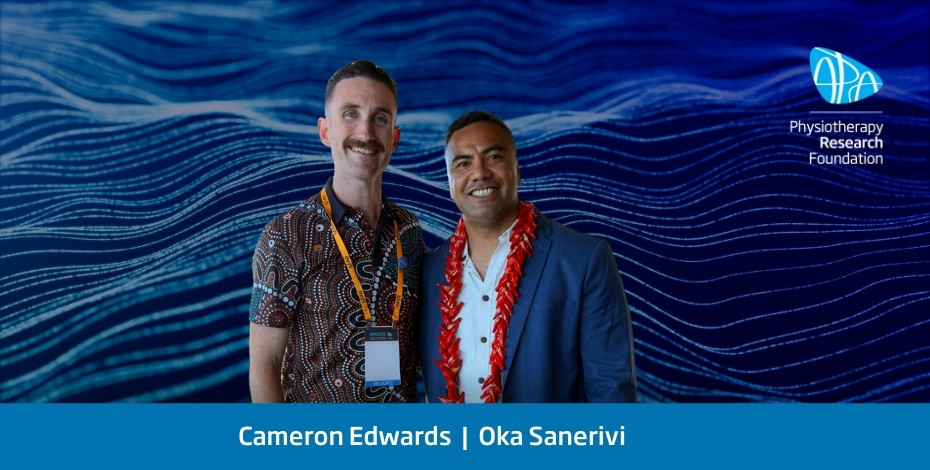
In this episode, Cameron Edwards, chair of the APA’s Aboriginal and Torres Strait Islander Health Committee talks to Samoan physiotherapist Oka Sanerivi about culturally safe practice. This can look different depending on the particular culture, but at its heart is based on recognising and understanding culture and factors that influence how people of a culture interact with health care services and providers.
This podcast is a Physiotherapy Research Foundation (PRF) initiative.
Watch the full podcast episode on YouTube.
Cam
Yaraadha gaba. Or g’day in Kamilaroi. I think this is our first time meeting face to face today, Oka, and so I'll get you to do an introduction in a minute. But, I really wanted to acknowledge and pay respect to the Kaurna people, this country, this beautiful country we're on, here in Adelaide. Pay my respects to their past, present and emerging Elders and leaders, and also any of them who identify as First Nations. Look, the Kaurna people have led a revival of their language, and we both know how important language is to communicate culture, to communicate values between generations and communicate understanding of the world to our young ones and to the future leaders and also to our peers as physiotherapists, etc.. And so, the Kaurna people revitalising their language have claimed back their culture and I really want to pay respect to that because it's led the example for a lot of other mobs, a lot of other nations around Australia to take back their language, to investigate and to invest in their cultures in a way where we can rebuild, despite that dispossession and the historical traumas that our mobs across Australia have been impacted by colonisation with.
So I wanted to start with that acknowledgment and really pay respect to the country that we’re on down here in Adelaide and the Kaurna people. Oka, before we begin, I've just come from a 15-minute presentation and golly, it could have been an hour and a half the way that you were speaking. I was just so enraptured and just, like, focused on every word that you were saying. It was beautiful. And I think we want to touch on a little bit of that today around cultural safety, its meaning for our peoples and for First Nations people around the Pacific and here in Australia, and explore kind of the similarities and differences, but also your expertise in the area. So I reckon what we do for our listeners is just begin with an introduction of yourself in whatever way you feel comfortable and a bit of a history with your interaction with this cultural safety concept.
Oka
Awesome. Yeah, thanks, Cam.
[Tongan language]
Hi, my name is Lilo Oka Sanerivi. Samoan-Tongan. Dad is from Matautu, Lefaga on Upolu, and Fusi, Safotulafai in Savai’i in Samoa. And Mum hails from the village of Ha’ateiho in the Kingdom of Tonga, but she was born and raised in Fiji, which is where they met. Dad was meant to be studying at University of South Pacific. He got distracted. They ran away to get married. That's a whole another PhD in itself. But then they were kind of lead over to New Zealand, and commissioned by the Congregational Christian Church of Samoa to look after a community of migrants who were coming to provide a labour force, during the economic boom in New Zealand at the time. And so they were tasked with looking after this community of kind of bus drivers, cleaners, factory workers. And that was a community that I was raised in, and they taught me the Samoan language, the Samoan customs, the way that we relate to each other.
You know, what you mentioned of the importance of language, man, I absolutely support and echo. And that has shaped my life, you know, and you would have heard in that presentation, shaped my physiotherapy career more than I probably realised at the time. And I just want to echo your acknowledgments, Cam, about the importance of the kind of people and the hospitality to us all here. It's such a beautiful place - my first time to Adelaide. But also acknowledge you, brother, and your work in promoting our people's, you know, causes, and places where our voices aren’t, there aren't many of us in these spaces, but, they are important spaces to be in. So I just want to acknowledge your courage and your dedication in that space, too, and it's a privilege to connect with, you know, kindred spirits.
Cam
Yeah.
Oka
Yeah.
Cam
I have to say, you know, you speak of my courage, but just like the Welcome to Country this morning talking about ancestors and talking about forerunners before us, whenever that comes about, ‘You know, Cam, you're doing a good job in this area or this area or we really like this initiative.’ I always find it uncomfortable in some senses, because I recognise that I didn't have to endure the civil rights fights of those before me. And I'm in a really privileged place in our profession, at least in Australia and within the APA, a really privileged place where there's an appetite for change and an appetite for support for my recommendations and my committee's recommendations. And so I always like to pay respect to the previous chairs and especially the First Nations chairs, that went before me, Marilyn Morgan, Mick Reynolds, who you connected with today as well, and Katie Potter, Kathryn Potter.
And so today, I think we're speaking a little bit about that cultural safety idea. And you know, it's a bit funny that there's not an agreed upon national definition within Australia about what cultural safety really means. But inherently as First Nations people, we kind of understand what it feels like. We understand that it's not defined by the person who's providing the experience, the therapy, etc., but it really is about, those cultural values that you've mentioned this morning. And I was hoping that, you know, I mean, I could sit back here for the next 15 minutes and hear you again, regurgitate exactly what you just spoke about, but in your experience, what do you think is that interrelationship or the importance of cultural safety in health care?
Oka
The importance is that it's critical, you know. I think we've been having multiple conversations this morning. There is no healthcare without trust, without relationships, without confidence. And you know who our practitioner is and what they bring in terms of their skills and expertise to help us in our time of need, particularly in our vulnerabilities of illness and injury, disease processes. And that trust is cultivated in social ways and culture. You know, I think there's an increasing recognition that every interaction is cultured in some way, there is no such thing as acultural or not having a culture. In fact, the ones that kind of describe having no culture are actually the ones that have the most dominant culture because it's so pervasive everywhere. The fact that we're having this chat in England's language, not my language, not yours, our ancestors’ language. And so that shapes, like you said earlier, shapes our worldview, shapes our interactions, it shapes what's privileged.
So, distinguished professor Linda Tuhiwai Smith, she talks about framing and in that framing, we can determine what's in the foreground, what's in the background and what’s omitted. And so with that language, you know, I think what my work and your work is trying to do is to recentre our people's voices in the foreground, because we've been, actually, we've been out of the picture for history since, you know, sort of colonisation and so forth. And where that links with physio is that physio was born out of England in the 19th century, and it's successfully preserved that language, that way of thinking, looking at our body as a machine, looking at sort of separate entities, not talking about spirituality, whereas our peoples are deeply spiritual. We're deeply connected to the cosmos, to land, to other life forms.
And so cultural safety is ultimately about upholding the dignity of the people before us, that seek our services, and so as you said, it's determined by them. They determine whether the interaction has been safe or not. And the way that we conduct this in terms of the pragmatics is simply by asking, you know, what does it look like? And that's from, you know, ethnic backgrounds like yours and mine, but also what does it mean for gender and sexuality, for disability, for, you know, all sorts of types of difference because culture is so changeable, you know, like age differences and generational differences, those experiences, people who were born in Australia or New Zealand where I'm based, or those who were born elsewhere and migrated here, those experiences shape how they understand health and wellbeing, how they understand what a physio is and what we deliver. And so it's being able to uphold the dignity of that person in whatever way that looks like.
But the critical piece, which is often overlooked, is that it starts with ourselves, you know, as practitioners and that critical reflection of, what do I bring to the interaction? What's my culture? How does it dominate this interaction? How does it influence who holds the power? You know, sometimes we say, we're patient centred, yet we determine the time of their appointment, how long it lasts for, where it takes place, what tools we're utilising in it, etc. So it's just scratching a bit further underneath the surface to take a look at ourselves, and best position ourselves in a humble way to receive and learn from what the needs are of the people in front of us.
Cam
I want to jump on to two things that you said, one was at the start and one was at the end there about that patient-centred care idea. And I think within our courses and within our frameworks, that mean that we're accredited physiotherapists, we learn these ideas of, you know, some better than others, about soft skills, about, you know, it is a buzz word, patient-centred care, and it kind of ties in with right at the beginning when you were mentioning about cultural safety, this idea of trust and a common thing that I hear is, well, I treat everyone the same, or, I'm kind to everyone, why should I pay certain extra attention or respect to First Nations peoples, whether or not they be in Aotearoa or in Australia or Samoa? What do you say to people who perhaps have that mindset that doesn't account for certain historical traumas, dispossession experiences and things like that?
Oka
The ultimate aim of cultural safety is equitable health outcomes, so health equity. And health equity recognises that people have different needs. You know, there's some communities in our society that experience disadvantage more than others. And so cultural safety recognises that we then need to provide different services to each of those people. So we can’t provide the same services, and in fact, in my research, what we discovered is that that one-size-fits-all approach doesn't serve our people and that's well documented. You know, we look at, mortality, you know, age of mortality, the life expectancy, we haven't really made a shift despite all of the health advancements, despite all the money thrown into it. And one of the key, you know, barriers to that is this trust, this cultural engagement. I mean, on the positive side, too, is that some of our listeners too might have had this experience is once you gain their trust, you're in, man, like you are…
Cam
Family.
Oka
You're their village physio, you know, like anyone that they think of, they'll send to you, you'll have to build a bigger waiting room, you know, all of this stuff. And I think physios generally want to get to that level of trust in and depth of relationship. But there are certain postures and I think, you know, around having an open mind, you know. A plenary speaker this morning spoke so beautifully about what she learnt from her life events in terms of being adaptable and changing, and we've got to have that approach as physios. And the more experienced I've become, the more I recognise that I need to remain flexible and open minded and teachable by our patients from our communities.
Cam
You mentioned a word I really loved there - posture - about posturing ourselves as therapists or as, pending the circumstances, as healers in community. Not necessarily traditional healers, which I want to touch on shortly, especially given what you just spoke about, I thought that was really powerful, the comparison between traditional and Western medicine. You mentioned posture, what are, to frame this, I was just speaking to someone prior to this about how mob talks, exactly what you said, where if we have a positive or a negative experience with a healthcare professional, institution, clinic, whatever it might be, mob talks. And if it's a negative experience, no one is going to come there. And I think that's where we've actually experienced a lot of the healthcare gap that exists for First Nations people in Australia. It's because those institutions previously were the ones stealing children, were the ones making birthing mothers stay outside rather than come into the wards for care. And there was this immense racism that has that intergenerational trauma effect where words are passed down for generations, words are passed down and become cultural ideals or understandings of us versus them in some cases. But there are very many instances that I'm aware of where that trust has been rebuilt by healthcare professionals or institutions, and it comes through that posturing.
Oka
Yes.
Cam
Can you talk to us a little bit about what you find are some effective postures that we as physiotherapists can take to rebuild that trust? You mentioned some earlier, but even if you want to reiterate them or expand upon them, I'd really love to hear your perspective on that.
Oka
And “posture’s” such a good word as physio. I love it on so many levels.
Cam
Our posture.
Oka
There’s a concept in the Pacific Called the Vā. And the Vā is the relation of space between you and I. And it's not empty space, but it's space that's rich with meaning and context and that unites us, that's dynamic and always changing, and so we’ve always got to tend to it. And this Vā, this space, is governed by cultural, you know, ancient cultural principles of love, of reciprocity, of service, of humility, of covenantal relationships, it's a special relationship between brother and sister, and also like a gerontocracy. So a care for our elders. It's our responsibility to care for them right until they're no longer with us. And so these values shape that posture. You know, they shape how we walk into a room and shapes who eats first. It shapes how I introduce myself. And those sorts of things, you can't fake, you know. And our communities they've got, they're always got their radar on.
Cam
They’re intuitive, they know. We were just talking about that as well, the radar.
Oka
You're just here for, you know, your research, or you're just here for you.
Cam
You’re not genuine.
Oka
Yeah, yeah, yeah. But when it is genuine, they tell. And you don't necessarily need to be a master of the language to do that. You don't need to be the most experienced physiotherapist to do that. That is again, an attitude, a posture, a humility, really. And I just got to say, like, especially at a physio conference, these are things that we don't talk about in physio very much.
Cam
100%
Oka
You know, but we need to because we all know it's critical. It's critical to that human connection.
Cam
It's fascinating. You're talking about that genuineness. That's easy to tell. Like First Nations cultures across the world, I would almost confidently say are the most forgiving cultures. Like, you think about what historical, again, atrocities, it doesn't take very much googling to see what’s occurred. You can look at a massacre map in Australia, and if that doesn't move you, then you need to do an emotional self-check. Just the gracious attitude of when someone does genuinely come with the posture and the reciprocity and the love that you've just spoken about, how welcome they are into communities. And we talk about bridging the gap and all of this, and often First Nations people and our health care and our wellbeing, we often are taking the first step into the gap and saying, this is how we'd like to, you know, be cared for, this is what our values are. And it just takes that deep listener. It just takes that genuine, you know, health care practitioner to maybe do things a little bit differently, maybe return to what I would call the nature of health care is that, number one, it's health. Thinking about how that's defined for our patients. It might not be your medicolegal definition of health of, you know, it's purely, like you mentioned, biological, it’s these happening. There's so much more to the word “health” for our communities. And then care. That exact word that you're talking about before that's so valuable for our communities. Care. Love. If we just demonstrated health and care, it's incredible what could happen.
I fear that, and I want to lead into a discussion, or you letting people know a little bit about what you found were the valuable parts of health care in Samoa and your research, because, I'm currently reading a book and maybe it's controversial, but, it's by an orthopaedic surgeon, Ian Harris, on ‘Surgery, the Ultimate Placebo’. And it's this idea that a lot of the time, Western medicine points at traditional medicine or alternative medicine, then it says, oh, you haven't passed the RCT. You haven't passed a systematic review yet. So you're not, you know, part of our mainstream health care. And yet at the same time, there is so many surgeries that we do that haven't passed those rigours either. There's so many things that become culturally embedded in our health care, simply because we have a fear of what the patients will do, or a fear of litigation. So we just provide care that they want or think is going to benefit them, or that they think we think is going to benefit them through our education that, you know, perhaps we haven't been updating over time, and, you know, we learned 20 years ago or whatever. Talk to me about what the values were when, in your research, the Samoans were asked about health care, about what came to their minds and what was truly valuable?
Oka
Yeah, there’s so much in what you’ve just said that my mind’s popping off in different directions, I don’t know where to take it. But ultimately, when I asked, well, what does best practice physical therapies look like? Everybody, like 100% of the participants, pointed to the traditional healers. And they said they provide culturally safe physical therapies 100% of the time. And they do that because they speak in our language, and our language is a vehicle of safety and reassurance. We can access them any time of day or night, we just have to turn up. We don't have to pay in cash, but we can provide gifts in kind. There is an expectation of reciprocity, and so we just provide gifts that we can, so food most often or fine mats, or whatever you can bring together. It welcomes the whole family, the whole family can turn up in support and ask questions.
And they always utilise therapeutic touch which is something that our profession is kind of stepping away from and veering away from. But they use therapeutic touch, and in that process it does two things, they talk through their diagnostic process as the feeling and massaging. And that informs the person and their family, And also it relieves any anxiety or vulnerability that they might feel due to the illness, and often due to not knowing what's going on with their body. And so that just provides that sense of calm and healing can then take place. And lastly, they utilise oils and balms and materials from our surrounding environment, our natural environment. And that speaks to our ecological sense of health and wellbeing.
So when we talk about care in that sense, and, you know, going back about the root word for physiotherapy, I think in Greek comes from nature, like nature-based therapy or healing. And so our Indigenous communities, First Nations communities, they look back at that nature-based genesis of healing and rehabilitation that has been with our communities for millennia. And so that's why they're so trusted, and so both in Samoa and we found it's well published, that both in the diaspora as well in Australia and New Zealand, the US, Hawaii, there are traditional healers there that people will go to, either in the first instance before seeing their GP or simultaneously, while they're seeing the Western health practitioners or going through the hospital services, they're seeing these practitioners at the same time. So that's how powerful those values are, those postures are, their cultural connection, that safety that we can cultivate in our care.
Cam
I hope my mum doesn't listen to this, but recently we've been having a discussion and…
Oka
Someone call Cam’s mum.
Cam
Call Cam’s mum, tell her to dial in. I don't think she'll mind me sharing it in this context, but recently, you know, I work within the Western system, I work for government health. What I've found is increasingly she has been promoting or at least in, you know, in the family group chat, putting up videos of more alternative, you know, potentially debunked in some instances. But, it is reaching out and looking for almost that kind of traditional healer skill set. And what I find fascinating about it is that it fills a gap, like what you said in that, we're moving away from touch, we're moving away from, providing adequate time, energy and resources or even space for our patients. It's not only First Nations patients, but increasingly our community is losing trust in that system because it's not providing that listening ear.
I think there was an interesting piece of research that looked at litigation on doctors, and they found that if they spent a couple minutes extra, regardless of the good advice or bad advice, they were less likely to get litigated against because the patient felt heard, understood, like they had time. So you can be the best doctor, best physio in the world, and you spend five minutes with someone or even do these modalities quickly - the touch - but again, not with that genuine concentration, that genuine attention to this person. These people are losing trust in that system. And so I feel like that that's a good avenue in which traditional healers are actually able to fill a space that we have not been doing very well, but again, it's a way that we can learn from them. And you mentioned that at the end of your talk, a way that physiotherapists can actually almost mold into that new face of traditional healing. And I thought that was a fascinating concept. I also wanted to ask, if you're happy to share it, a little bit about your framework that you designed. How that came about in terms of the research methodology, but also the impact that it had and how you melded the, you know, traditional framework and then how we as physiotherapists practise or should practise in that culturally safe way.
Oka
I mean, firstly, we could have a whole podcast about a family chat, you know, the group chats.
Cam
Family group chats.
Oka
The pros and cons of those.
Cam
They’re spicy.
Oka
But the other thing I want to underscore is, you know, when we think about physio treatment, we rush to the movement, hands on intervention and often skip the dialogue, which should, and it often is, the therapeutic engagement, you know, like, what you mentioned around that litigation case. But also, and it leads to the methodology that I use, and in the Pacific we call it Talanoa and Talanoa is this relational dialogic space, we just share what's top of mind, what's important and what's not, you know, even, because it often links and weaves into the important narratives. And so I utilised Talanoa and another methodology called Fa'afaletui, which is one of consensus group making. And I interviewed Samoan physiotherapists and Samoan families, Samoan Elders, traditional healers and health officials. And I did that in Aotearoa, New Zealand and then replicated that in Samoa. And I asked the question of how does some Samoan cultural knowledge enhance physiotherapy?
And so that lead to five key themes, which were: Aiga Tamāliiaga. So aiga is family and that health is a collective process, and so illness is also a collective process too. But it poses the question of how our services, how our system’s designed to accompany and facilitate that concept of family. Secondly, the concept of Teu le Vā, that I mentioned earlier around protecting the relational space. Thirdly, around traditional healing as being a mainstay of Samoan health paradigms. Fourthly, around holistic wellbeing and that spirituality has to be acknowledged in our health services. And then lastly around health systems. Health systems need to be designed in ways that enable these interactions to occur.
And so those five, so I'll probably I'll share the Fau’olo image so I can speak to. But those five key themes in the Fau’olo framework, the Southern Cross stars and they point us to the Fau’olo framework which is based on the taualuga. The taualuga is the ceremonial celebratory dance, it's the dance that ends all dances. And at the centre of the dance is the taupou. The taupou’s often the maiden of the village, but her role is, you know, she's in a public, in a vulnerable position, but her role’s to complete her ancestral dance from beginning to end, unimpeded. To the top left, we've got the Matai, the chiefs who represent that genealogy, and also the decision making in our families. To the far right we have a mātua, parents, representing families and also the parentage of traditional healing practices. So the top right, we have important characters called aiuli, and their role is to go before the taupou, so before she enters the place. They clear the physical and the metaphysical environment. They protect the taupou at all times, so they're often like brothers or cousins or uncles. And then they dance as vigorously and skilfully as possible to bring light to the collective sense of the occasion. And then to the bottom left, we've got these characters, the young men who would run between a fire source and the place where the dance would take place. And their role was to run busily in the background and the more efficiently they could do that, the longer the dance could be visible for.
And in between them is that Vā, the relational space between each of the characters. It's dynamic, it's changing, but it's filled with context and meaning. And the other unseen element is, that we mentioned at the start, is language. Like the taualuga is only ever performed to Samoan music. So underscores the criticality of our languages and as a vehicle for cultural safety. So when we translate that into our physio context, our contemporary health context, the taupou at the centre is our patient. You know, we talk about patient-centred care, they are the centre, they’re in the public and vulnerable position by injury or illness. But their role is simply to return to our family role or community role. We've got the chiefs and the parents present, and then we got those aiuli. And that's you and I, physios or healthcare workers who go back to that patient-centred, like, they're not the centre of the attention, but they're a critical part of that supportive network. They go before the taupou, clear the physical and metaphysical environment. They protect the taupou at all times and then they work to the best of their expertise to bring light to the collective sense of health and wellbeing. In the bottom left, we've got these characters who work busily in the background, you know, unseen in the clinical environment. But they set the design, they set the curriculum, they set the system that enables that safe interaction to occur. And that's like you said so yourself, you know in your health system roles, that's policy makers, you know those are our physio educators, lecturers, our clinic managers. So those who set the systems. So that’s the framework and that provides that sense of a dynamic interaction, this one that we have periodic interactions with the patients, but we're not the key star of the show. We’re an important part of that support, we’re there to make them shine, and to return to their roles in our communities and society.
Cam
I love so many things about that framework and obviously the fact that again, it's not you as the clinician, your expertise, your education, your hubris in one sense to think that you can solve all the issues, being the centre of attention, but that again, we do put that patient there and that their goals, their aspirations, their family contributions and responsibilities that they want to return to, are actually the priority. And the other thing is that everyone has a role and a responsibility and that it's clearly defined and outlined in that picture. And I just thought that that was very powerful, in terms of where we sit as a profession, and especially within cultural interactions, with our First Nations patients or clients.
But I also loved that relational space and what you talked about just at the beginning of that framework around the education or the preamble, before you get to that clinical questioning and etc., that there's this yarning space. I personally don't think I did very well when at uni we were posed with many ethical questions about like, you know, would you attend the party of a kid who is palliative if he invited you? I was like, yes, without a doubt, like, you know, that's a responsibility. But like, we can sometimes get caught up in our professional conduct antsiness and I understand that there is a place for, okay, there's a lot a clear line to be drawn there, but sometimes I fear that we might lose the relational side of things that builds everything we've been talking about, that builds cultural safety, that builds trust from our patients and our clients and our communities at large, who, you know, we really need to, as we say, you know, bridge that gap by taking an extra step in these instances because there has been so many historical reasons to distrust the system.
And I just love that, that relational space in your framework, you know, relates exactly to again, I draw lots of similar ties when I speak about, you know, how Australian physios should seek to interact with our First Nations people. And I think Ivan Lin does a fantastic job at outlining what clinical yarning can look like as well. And upfront, it looks like sharing, of yourself, you know, not purely being the physio with power, but sharing power, sharing experience for similarities, for that humanity, like what was discussed this morning. I find that really powerful, and I encourage everyone to, you know, access your work and to access this picture, this modelling because I draw so many similarities between it. Although, you know, you only looked at mob from Samoa or from Aotearoa, like, I do see that if we were to do a very similar study that you would get similar outcomes as well in terms of those values that a place, you know, for a lot of First Nations cultures around the world, it's not individualistic…
Oka
That’s right.
Cam
It's collective. It's connection to, you know, community, but also to land, to the ecosystems, and to spirituality as well, like you mentioned.
Oka
And it's also like, the participants kind of taught me this lesson that it's not romantic, you know, either. Like, yeah, we talk about family. They are the mainstay of our health and well-being. But family are complex too. You know, like...
Cam
Family group chats.
Oka
Family group chats, yes man. I love this, there's a meme around like, you ask me how my family is and do I give them the Disney version or the Jerry Springer version?
Cam
I love that.
Oka
But we hold that tension.
Cam
Yes.
Oka
And I think, but in and of itself, we are collective people. You know, we're collectively orientated. And so to be in that type of culture, we've got to have some rules around how we engage and how we make up when things bust up, you know, and that relationality is really important. There is a saying in Samoa that says, ‘ae tumau faavae e sui faiga ae tumau faavae.’ ‘Faavae’ is foundations, so it means that, the way that we practice some things may change, but the foundations remain the same. And I think that's the permissibility of having principles, is that it can allow for that kind of context. A context might change how, you know, I would engage with you could be different with how I engage with Gillian Webb, you know, or one of our Elders and kind of legends in the profession. So the context changes, but the respect is there, the humility there, there's foundations there, so I think that probably, I hope that’d be helpful for some of our listeners too, you know, that can feel a bit overwhelmed about, you know, where do I start? How do I do this? Like, start with those that kind of mirror work, looking at ourselves in the postures that we come with. And if we can really camp ourselves within those principles, that's a great place to start, and we can start talking about the context.
Cam
Well, I'm glad you talked about that as eloquently as you just did, because a lot of the questions that I often get is that I'm expected to speak on behalf of over 200 language groups across Australia. And, you know, while I'm here, what should I do? Where should I go? And what I often have to say is we're not homogenous cultures, and even across the Pacific, we're not homogenous. There are certain cultural attributes or ways of working and being and doing and celebrations of cultures and festivals, etc. that are just totally unique, and relationships with land and community that are totally unique. But foundational principles are what guide us and help us to be able to communicate where potentially language is a barrier. Where potentially your past experience is a barrier or your cultural understanding is a barrier. Those foundational experiences and principles that you've outlined during this podcast, I think should be a huge takeaway for our listeners.
Oka
Yeah.
Cam
Part of me was like considering, how do we, you know, wrap this conversation up? What kind of question could I leave the listeners with? Well, first of all, I have to say I'm glad that we got to discuss some of your previous session and talk because I really hope that the impact of your work doesn't sit just within a 15-minute talk in a room during this conference, but that this podcast’s reach allows your voice and your research and your deep understanding of cultures around the Pacific to actually impact the listeners and make them think about their context as well.
I want to ask one final question, and that is, if someone was to approach you and ask a question, what do you need? Or what do you feel, as a First Nations physiotherapist, what do you think are the main priorities for physiotherapy as a profession?
Oka
Great question. The thought came up earlier in our conversation around allyship. You know, I think what you mentioned earlier about the Kaurna people's leadership and language revitalisation is due to their courage and foresight and advocacy. But it's also because of that allyship…
Cam
Absolutely.
Oka
That, you know, people who've also advocated who don't identify as being Kaurna. And so similarly, that's been the experience in Aotearoa, New Zealand with the language revitalisation there, and I think all indigenous movements. And so that would be my ask for our physio profession is that we need your allyship. We need your commitment to support us. We talked about earlier, there's so few of us in this space and physiotherapy, let alone in positions of influence like we are stepping into. And so we need our allies there to be the voice when we can't be in the room. To pose the questions. Also to give us the opportunities to speak for our peoples and our needs. Because I was thinking earlier, like yeah, we want money, like we need these, we need resources to give life to some of these dreams and visions and meaningful, sustainable change. But more than that, we need your support, your shoulder, because this is all our responsibility. And I also wanted to say earlier that this benefits all of us. This enriches the physiotherapy profession globally. And if I can, I just want to, I don't know where this podcast will go…
Cam
Let's pretend it's going everywhere. Global, viral.
Oka
I just, for our First Nations or Indigenous or Aboriginal and Torres Strait Islander physios or physio students coming through, I just want to say like, there is space for you and we need you. There is space in the profession. And I want to say to the profession, there is space for so much more diversity, you know, so much more insights and knowledge that enriches our way of delivering physiotherapy, that it needs to look differently to meet the needs of the communities that need it most. And that is why I focused on Samoan physiotherapists and families because we didn't want to be homogenised. We didn't want to be in this umbrella of Pacific. In the same way, we don't want Asia to be this umbrella or Aboriginal and Torres Strait Islander. There is a push for having our distinct voices being heard in authentic ways, and that only benefits our profession.
Cam
That is a beautiful way to wrap up and I don't really think that I should add to it, but I do, I do want to just say that you're exactly right around that space. There's space for students, there’s space for early-career graduates. But there needs to continue to become space at that leadership level, at the systemic level, at the organisational level as well, to affect change. And if that space isn’t afforded, then perhaps the space needs to be afforded in a place of deep listening, care and in action of people who perhaps aren’t at the table. You know, who might not have a seat on boards or committees, etc., but that they're welcomed into the room to provide that different paradigm, that different perspective, the one that's really going to actually have community, grassroots, change and to evolve, again, our profession, our way of thinking, but most of all, the healthcare of our communities and the wellbeing of our communities.
Oka
Yeah, man.
Cam
Oka, I want to thank you so much for spending some time with me, for spending space, this relational space, it's just been so wonderful, developing this relationship over today. And I look forward to everything it evolves to in the future.
Oka
We're family now, man. So thank you, and thanks for the opportunity. And yeah, shout out to APA. You've been big supporters of us in the PNZ and in the Pacific. So thank you.
Cam
Gaba ninda.
Get to know our interviewees
Cameron Edwards
Cameron Edwards is the current Chair of the APA’s Aboriginal and Torres Strait Islander Health Committee. A proud Kamilaroi man, he currently works at Westmead Children’s Hospital in NSW in Burns and Mental Health. He has enjoyed rotating through approximately fifteen clinical areas within NSW Health, working with both adult and paediatric populations. Cameron was awarded the inaugural NSW health Aboriginal Allied Health Professional of the Year in 2021, as well as the APA NSW Branch Award—Contribution to the APA by a Recent Graduate in 2022. Cameron seeks opportunities to advocate for, and give a voice to, Aboriginal and Torres Strait Islander People’s, as demonstrated through his hosting of the Deadly Physios.
Dr Oka Sanerivi
Dr Oka Sanerivi is a Samoan, Tongan physiotherapy clinician, governor, researcher and expert in Pacific cultural safety in healthcare, with over 14 years of clinical experience including as a paediatric physiotherapist. Oka received his PhD in Physiotherapy from the University of Otago, becoming the first Pacific person to be awarded a PhD in Physiotherapy. His doctoral research titled ‘Le taualuga o tausiga (the epitome of care): In Search of Samoan Cultural Safety in Physiotherapy’, was inspired by his clinical work as part of an emergency medical response team during the Samoan Measles outbreak in 2019. The study explored how physiotherapists in New Zealand could best engage and uphold the dignity of Samoan and Pacific families in their care.
Oka holds the positions as a Senior Research Fellow at the Va’a o Tautai: Centre for Pacific Health at the University of Otago, as well as an Honorary Senior Research Fellow at the Mātai Medical Research Institute in Tairāwhiti. Oka has held several governance roles including as an Executive Committee Member for Physiotherapy New Zealand, the Chair of the Pasifika Physiotherapy Association and currently as Deputy Chairperson for the Physiotherapy Board of New Zealand. He is committed to integrating the best of Pacific indigenous knowledges with transformational scientific findings to benefit public health and wellbeing outcomes.