
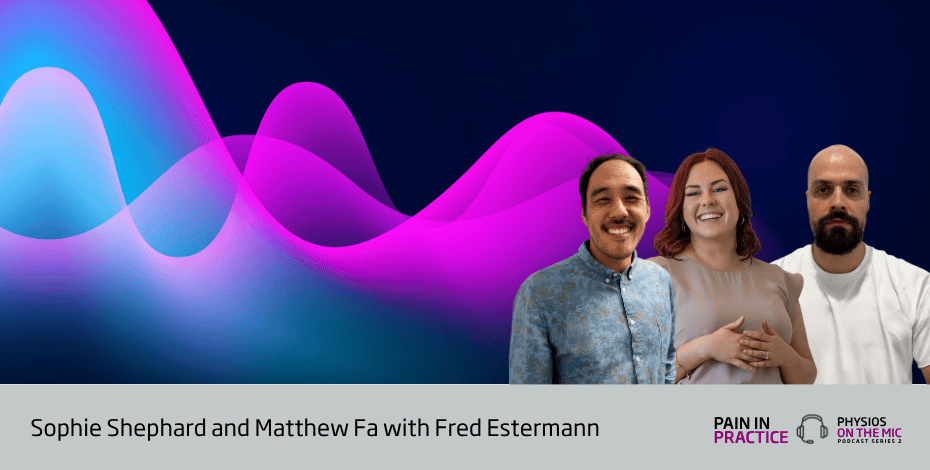
Pain in Practice: Emergency with Fred Estermann
What happens when chronic pain walks into an acute care environment? In this episode, fast-paced medicine meets long-term complexity as Fred Estermann discusses the tensions, limitations and opportunities of managing persistent pain in emergency and hospital settings.
Watch the full podcast episode on YouTube or listen to all the episodes.
Matt
Today in the podcast, we're joined by Frederico Estermann, a passionate and highly experienced physiotherapist who brings a wealth of knowledge, from multiple settings in the hospital, including time spent in chronic pain clinics. He now works in the emergency department, amongst other places in a big tertiary hospital, where he continues to apply his understanding of pain management in high-pressure environments. When he's not helping patients, he likes to spend his time cycling and spending time with his two children. We're really looking forward to unpacking this and hearing what you have to say, Fred. I'm very excited about this. And thank you for coming on the podcast today.
Fred
Thanks for having me. Much appreciate it.
Soph
So, Fred, look, I know that you and Matt know each other a little bit, but, I guess for my benefit and for everyone listening, too, I guess, would you mind telling us a little bit about your journey into physio and maybe what sort of drew you into the profession to start with?
Fred
I did exercise science first as an undergrad. I enjoyed exercising, had been through some injuries before and sort of trying to learn a bit more about those injuries. I started reading about physiotherapy and, I thought that would be an interesting career to have. Yeah, but one thing sort of leads to another and this is what I'm doing today, I think for the past maybe six years or so. So not that experienced as Matt painted, but I have seen a few things, you know, in the last six years.
Matt
So why the pivot then, why not just stay with exercise only? What was the very unique thing about physio?
Fred
To be honest, there wasn't much to it. You know, it was really a degree where you were, as some people say, like a glorified personal trainer. Yeah, it’s true. A lot of people, I think, that get into it, they have this idea that they want to work with athletes, you know, and be like a sports trainer, strength and conditioning coach in a high, you know, in a big sports team, athletic team, etc.. But those jobs, there's not that many of those jobs around. It's quite hard to get into it. I did a little, maybe six weeks or so, working with some of the guys in one of the the AFL teams here in Sydney. It wasn't what I thought it was going to be. I wanted to make a bit more of a difference in people's lives. Yeah, training someone, it can impact their lives, but I've thought that if I'm dealing with someone who is injured, who is, you know, maybe in a more precarious position, I might have a bit more fulfilment from my work. And so that led me, was one of the things anyways, that led me to physiotherapy.
Matt
Yeah.
Soph
Yeah, great. And so I guess since you've come into physio specifically, we've heard a little bit about your work so far, but I guess at what point did you sort of start to get a bit more of an interest in the pain space, I guess. And I guess what has that looked like in terms of how your physio career has evolved over time?
Fred
That was actually, well, I was in uni, doing the master’s in physio. I came across, I don't remember how I came across, but I listened to a podcast actually, with Lorimer Moseley. The things that he was saying, I thought they were, like, really, really important because it basically changed my perspective into everything that I was doing as a physio. But it wasn't something that was being taught in my curriculum. You know, we had one, sort of, two-hour lecture on pain, but it didn't really have much of an impact on people. I think most people actually came out of it quite confused. And sort of not really understanding what pain was, sort of thinking, oh, so is it just something in my head? And when I listened to Lorimer sort of talking, another door opened and I thought it was really important because basically everything that we do as physios, so maybe not everything, but a lot of what we do involves pain. Right. And I don't think, as a physio or even like, as a health clinician in general, you don't work a day in your life without hearing or dealing with someone who is in pain. So I thought that understanding how that actually worked was really important.
I think this is sort of what opened the doors to pain for me. When I finished studying, I ended up doing what we call in here allocation where basically you go and work in a public hospital for a year, better get exposed to different areas. So I did that. And at the end of that year, there was a job that was opened in a pain clinic. It was just one day a week. And I applied to that because, again, like, I had some interest in pain and it was a job. And I ended up getting the job. And so I worked in there for another year or so until I became full time. I think I was there in total for maybe two and a half years or something along those lines. Yeah, that's sort of how it sort of progressed, I guess, my journey in chronic pain.
Matt
And then you've kind of moved out of that space now as well?
Fred
Yeah. That's right. So while I was at the pain clinic, I still kept working in the acute wards in the hospital. And that was like weekend work that I used to do. For some reason, I had this interest in emergency medicine. I always thought it was something that I was going to enjoy. I tried applying for that. I wanted a role in that for almost two years and just sort of kept trying, trying again until eventually there was this job that opened up and I got the job and then I made the switch. And I think to me, it just sort of fits more with my personality. You know, emergency physiotherapy, if you will. I like the style of work a bit more. I'm not sort of sitting down in the same office every day, it’s way more dynamic. I don't know what my day is going to be like. So I actually enjoy that side of the work. Yeah, I've been doing that for three years now, roughly.
Soph
Amazing. And do you mind me asking a little bit more about, I guess, what does your day to day look like now? Because it sounds quite different to maybe what you would, or an even probably what a lot of physios out there listening, probably do on a day to day. So what would a typical day at work look like for you? What sort of presentations or conditions are you seeing? What, you know, what comes across your desk?
Fred
Pain, and I guess, more like the outpatient-type physiotherapy, and what you get in a private practice. Normally you have a schedule in front of you and that might change a little bit. Maybe there's new patients coming in or cancellations etc.. You have a bit more of an idea of what your day is going to be like. You can prepare a bit. Obviously in emergency, that's not the case. So I'm based in ED and I don't really leave there unless there's, you know, someone needs help in the wards or something.
But basically we pick up patients that have been triaged that we think are appropriate for us to be seen, and then we can treat them, diagnose, you know, order scans and refer elsewhere, if required. So you basically, you do the same work as a doctor would do in some ways, but a bit more specialised and obviously not that broad. You only see a certain category of patients. Those patients, most of them are, like, orthopaedic type of presentations. So it can be something very simple, like, say, for example, an ankle sprain or like a wrist sprain, to fractures and open fractures. And, you know, people that have been in car accidents and that sort of stuff. And then in between there, there is some chronic pain as well. And we help a bit with that side of things. But mainly is orthopaedic injuries and fracture management.
Matt
Well, I think you said it earlier, Fred, that most people will see a physio because they have pain. Now you’re working in like the urgent care and emergency and acute setting, how does your knowledge from, I guess, working in a chronic pain clinic to now working in a very rapid, fast-moving, acute-style clinic, how does your knowledge of chronic pain influence that or does it or has it changed over time? What’s it look like?
Fred
It's tricky. I think my understanding of pain is still the same, you know, and so when I'm seeing patients, I'm seeing patients through that lens of understanding pain, you know, it's not just chronic pain, but acute pain and, you know, just capital P pain, if you will. But treating chronic pain is different. I have the privilege really of treating patients, chronic pain patients in a multidisciplinary, sort of, environment, you understand the value of that. When you have time to talk to these patients and trying to manage things, you understand the the value of that as well. And we don't really have that in emergency. And that's not really the goal.
So if I'm thinking about, like, an example is probably the most classic patient that we see where chronic pain is involved is back pain. You know, someone with a flare-up of back pain. You know, there's the typical patient who might have had back pain for a few years, you know, on and off and has a few flare-ups and they might come to emergency when they're having these, like, the worst flare-up that they've had. And normally there is a bit of a concern that there is an injury associated with it. You know, they even sort of tend to be diagnosed, which what I think is the wrong way of saying, but acute on chronic, right, rather than a flare-up, it's not really a new injury. It's just the same injury, just being flared up. But the patient, they tend to have that idea in their heads that there's something wrong with them and they need an MRI or they need a neurosurgeon to see them, you know, something along those lines. And that's where I can use a bit more of my, you know, pain background.
Soph
I think it's interesting hearing you talk about that because I think, I mean, I've personally always worked in the private practice setting, community and so probably see, I guess, the other side of it where, you know, I've had patients who have had to present to ED because their pain has been uncontrollable and that's sort of the only avenue they've had. And they've often, sort of, I guess had the challenges associated with that where it's often very limited in terms of what can be done within that setting, because, you know, ED isn't particularly well set up to support people in that sort of situation.
But I guess coming back to what you touched on before about, you know, you use that lens of pain, you know, pain with a capital P to kind of view everything through. And I'm interested in terms of, I guess, maybe the ways in which you see some of these sort of ideas or principles translate even into some of these more acute presentations that you might see. Are there any, I guess, some examples you can think of ways in which that deeper understanding of pain has sort of informed how you do work with patients with acute pain presentations?
Fred
There is this idea that if it's painful, don't do it, right? So if someone has a sprained ankle and they might hear, you know, you only start weight bearing when it’s not painful or maybe your shoulder, whatever injury you've got in your shoulder and you ask to do some gentle shoulder range of motion, and that same advice comes through, don't do it if it's painful, but I usually will say if it's a bit uncomfortable, that's fine. Obviously if it's really sore, then you’re pushing too far. Or if you do something and a couple hours later or the next day you're quite sore, then maybe you went a bit too far. Just back off. But a bit of discomfort, it's normal, doesn't mean that you're creating more damage. So trying to decouple a little bit that idea that pain equals injury or damage. But it's really hard to go beyond that. You know, when you when you have a bit more of an understanding of pain and you want to really tell them that, you know, pain is here and this is the amount of stress they actually need to, you know, create injury, but you're not quite there. In emergency, for example, it's too complex, even if you're in a pain clinic-type setting where you have hours with a patient, it can still be quite hard to deliver that message, you know. So yeah, it is not quite the space. But then again, like, not everyone needs to know that, right? Not everyone needs to understand exactly how pain works. But maybe, again, if you know, okay, if I'm just feeling a bit sore that's fine. Doesn't mean that I'm putting myself in a worse position then, yeah, I'll keep doing that, you know. Or that guy told me it was actually good for me to move my fingers even though my wrist is broken. So I should keep doing it. Something along those lines. Nothing too complex and refined.
Matt
Well, that sounds pretty powerful, though. I don't know if things always need to be complex or.
Fred
Yeah, yeah. 100%.
Matt
Yeah, like, the simple things that are the best. I feel like it's what we want. We want people to feel confident in their own bodies and to keep moving.
Fred
Yeah, yeah, yeah.
Matt
It sounds like your previous experience has influenced in how you approach the communication and the education. Does it influence anything to do with, like, you referring on or how you would help manage someone with a flare-up of their pain in urgent care or ED?
Fred
Yeah. What I try to do, again, like, this is based on my experience, but the patient that I think will be a good candidate, for example, to being in a pain clinic, then I will try to refer that patient to the pain clinic. It's not always straightforward, but I would maybe put in a discharge letter that goes to the GP that, you know, the patient might benefit from being in a pain clinic, and I might even sort of try and look where the patient lives, etc.. and you know, indicate a certain service that they can be referred to. But normally, at least from a pain clinic point of view, you still need a doctor, usually a GP, to be referring so they can accept that referral, which is a bit of a shame. But other than that, my other referrals are usually for orthopaedic surgeons and fracture clinics or hand clinics, not stuff that is really, you know, chronic pain-related.
Soph
Do you ever find, because I know that a big thing that we're often talking about, particularly when people might be, say, more risk of developing chronic pain, is this sort of early identification and connection with supports. And I guess I'm interested in some of the more acute presentations that you might see. Do you ever sort of get a, I guess, glimpses into that and sort of are there any opportunities that you generally have? I guess it sort of comes hand-in-hand a little bit with some of those referrals, but to be able to sort of flag those people who might need a little bit of support, you know, earlier on and sort of try to facilitate that? Is that something that you sort of, I guess, you have the capacity or the ability to do within your setting, or is that something that you do?
Fred
Yeah. Again it’s trying to find who is receptive to it and who is not. I find it more often than not, people are not very receptive, especially in emergency, because usually you’re coming in, and when there is sort of chronic pain involved, and the person is coming in because one, they think that something really bad is going on and they need a lot of medical input to sort themselves out or they want more drugs. And so it's hard in those cases for you to come in and try to sell an alternative treatment, you know, like chronic pain. But when I find that that patient is receptive to it, especially sort of early on, one of the things that I do is I refer them to the ACI pain network. They have that series of videos. It's explained in a very simple way. They’re pretty thorough videos as well. I think, you know, telling you about how, if you're not sleeping well, your pain can be worse, if you're not eating very well or your relationships or work, all these things that, you know, when you don't really have an understanding of pain, what do you mean, if I have a poor night of sleep, why is my back going to be more painful? You know, there's no more damage. Probably just my mattress is not good. You know, something along those lines. Those videos are pretty powerful in that sense.
And I do try to refer people. I feel like that's an easy way in. And it also gives patients, if they do think that that's something they want to pursue, it gives them a way to keep going. Okay, maybe I can look for, you know, I can talk to my GP about this. They have a way to continue following up on that path. But other than, sort of, pain clinics and the sort of ACI, there's not a lot else that I refer to. And yes, some individual cases, I might throw something here and there, but in general, that's what I do.
Matt
It sounds like how you're operating, you're just operating at such a high level where, you know, you're identifying people who are ready for change and influencing that and directing them to the right places, or if someone's not really ready for change, you're just trying to manage their expectations.
Fred
Yeah, yeah.
Matt
Be realistic and referring appropriately.
Fred
But you're right, it’s a bit of an art, isn't it? And I think we've all seen that patient that you think, man, you would really benefit from this treatment, you know, this alternative, and the patient doesn't want it. You know, it's my fifth back surgery that's going to fix me, it’s not your exercises or, you know, not meditation or whatever it might be. If they’re inclined to believe that, I mean, I've sat in front of those patients for hours and hours and hours and I got nowhere.
Soph
It's challenging, but I think, one of the things you spoke to really nicely, though, that I think is really important when we're talking about your context, particularly, is that we're all sort of doing what we can with the tools we have available to us in our context. And like you flagged, you know, in many ways the emergency department probably isn't the most conducive environment to that because by its nature, you're sort of, you're going to be seeing people who are probably likely quite highly distressed, having a really horrible day. And that's not really a great place to be in for any sort of, I guess, conceptual change or learning or anything, because at that point it really is like, how can we solve this problem and what's the best, you know, the quickest way that we can do that. I don't think that's necessarily a shortcoming on you. I think that's just a reflection of the challenge of working in that particular setting that isn't really that well equipped to sort of be managing chronic pain effectively.
One thing, though, that really jumped out at me from what you were mentioning before, that I'm interested in, you talked about, the idea that, obviously your exposure to some of Lorimer's work has been, you know, quite influential. And you've spoken about, you know, I guess, the role of pain education and how that can be helpful in supporting people to move forward. And I totally agree. But I, I really liked your comment that, you know, not necessarily everyone needs an in-depth, you know, pain education tool. Not everyone needs to know the ins and outs of pain because I think sometimes that's a bit that gets missed when we're talking about pain education. In, you know, pain physiotherapy specifically is that there's sometimes this idea that, you know, when we give pain education, there's like one way that that looks and we're giving someone this huge big spiel every time and sitting them down and talking at them for 45 minutes and, you know, explaining pain at them. But what you highlighted really nicely, I think, it’s that fit-for-purpose education. And what does this person actually really need to know to sort of help support them at that point in time? Yeah, I'm interested maybe in, I guess, the modifications of that. You spoke about it a little bit that how do you approach that? And I think particularly even when we think about, like, the language we're using because I mean, you know, obviously some people would be coming in and you do have some acute, you know, musculoskeletal sort of pathology that sort of we're needing to accommodate and factor in with that clinical reasoning, how do you sort of balance the, I guess, the education that you're giving but then also some of those tensions we might have with language and with pathology when the, you know, I guess the circumstances people might be in are kind of different.
Fred
I don't think I can give you a formula. I feel like it's really like an art and is based on experience. I don't know if it was my first, but it was definitely one of the first patients that I tried to explain pain. Yeah, I probably had maybe six months of, you know, being a physio at that time. And this guy came in, it was an outpatients in this hospital that I worked. And it was back pain. And I think he had maybe three or four spinal operations before. He had booked another operation, you know, he was really hopeful that that was the one that was going to fix him. And I thought, this is the guy, I’m going to explain pain to this man and I'm going to change his life. You know? Watch it. And I started giving him, you know, the explanation and really trying to make it in a good way where he could understand, etc.. And maybe about 20 minutes into it, he stood up and he left and he didn't look back and he never came back. It was pretty bad. I went and sort of had a look at his file, and he had done similar things before, so it made me feel a little bit better. But it was a bit of an eye opener in terms of like, okay, not everyone wants to listen to this, you know, even though it might be what they want to hear and not everyone wants to listen to it. But going back to your question, I think it's a learning curve, right? You give a little bit and you see how the person reacts and maybe you give a bit more or you take a little bit back and then you see how they react and you just sort of keep playing. It's really an art. And I think you have to keep trying and you have to keep improving as you go. If you have a little sort of formula, not a formula per se, but a structure that you follow, that’s a good thing. But then you have to be flexible in terms of how you approach that structure, which things that you're linking and again, like, what are you leaving out what you're adding in, depending on the person that you're seeing. I know it's very vague, but I really don’t think I have, like, a perfect formula.
The other thing I think that has been a bit of a privilege for me. I was talking to Matt the other day about this, but is just working with psychologists, and then you can see how they deliver a certain message. I sat in multiple sessions, joint sessions, so myself, a psychologist and a patient, and it was a common patient between, you know, me and a psychologist. And so I know what the psychologist’s trying to get at, but to see how they approach it is really, it's quite fascinating. And again, there isn't really a formula. I think it's is a lot of experience that will take you there.
Soph
Definitely. It's so relational. And so individualised. And I think that sometimes that's the bit that we miss is that education, like anything else, it is a skill and it's something that comes with practice and getting more comfortable with feeling uncomfortable and not being quite sure and feeling your way along. It's definitely something that I've noticed in my own practice, that's definitely been the case. It just is that repeated exposure and throwing yourself in the deep end and working out each time, how can I do this a bit better? And, yeah, it's really lovely to hear you reflect that back and totally get no straightforward formulas. I wish there was. It’d make our lives more easy.
Fred
100%. Yeah.
Matt
We're dealing with people. So I mean, people aren’t formulaic. As you say, it is the art and of how you approach something. You could say the perfect things, but it's not perfect to them unless you really put it into their story and it sounds like you do that quite well. I wanted to ask, you know, we’ve talked about patients a little, but do you feel like your skills, do you think that brings some influence to your colleagues as well? Could be physio colleagues, other doctors, nursing staff, what have you.
Fred
In emergency I think it’s a bit tricky because, the goal of everyone in there is basically see is there something serious with this patient that's in front of me? If there is, can I do something about it? If I can't do anything about it, can I refer to one of the inpatient teams that can do something about it? And if there isn't anything serious, I'm referring him to the GP, is kind of what you do. I don't have much space to demonstrate my knowledge to pain or my approach to pain. I think when I was in outpatients that was a bit different, so working with other physios. You know, some people took a bit of an ear to it and they were a bit more interested in sort of what, you know, what was I telling the patient and why was I using certain approaches to manage that patient. But not so much in emergency.
But to be fair, I feel like we, at least, for example, when I was in the pain clinic or other places, I had a bit of an idea that, you know, when one of our patients went to emergency, they will get that treatment, whereby you get some Endone, you get a script of Endone, and then they tell you to go home. Right? But I feel like it’s much better than that, actually. I’m actually interested in what you have to say, Soph, because you said that, you know, you did see a few patients that have been to ED before, and then, you know, after that they came to you, and see what they say about it. In general, I think we are providing, like, a pretty good service. There isn't really a whole lot of opioids being dispensed to this population. There's definitely anti-inflammatories, sometimes, you know, a bit of tapentadol or something like that, but not really much in terms of opioids. And they don't really go home with much opioids either. And there isn't really any sort of reinforcements. People are saying, yeah, your back is no good, your shoulder is no good. You need to get that sorted out. We can't sort it out for you, but you really need to get it sorted out. Go and see a neurosurgeon. That's very rare. I think when that is there, it’s actually appropriate. Not that anyone is saying your back is messed up, but if someone refers to a neurosurgeon, for example, it's usually because it's appropriate, you know, not that the patient needs an operation, but to have that discussion with the neurosurgeon, it's not necessarily a bad thing.
Soph
It's great to hear that it's come, you know, further and you know, certainly really great to have your perspective on it as well because, I mean, it's tricky to know. I see people from all over, and so lots of different hospitals, it might be very different, even hospital to hospital, department to department as to the, I guess, the attitudes or the, I guess, the culture or knowledge within, you know, that particular department might play a huge role. Maybe and this could be interesting to get your take on it, too, but probably the thing that I hear the most from people in terms of, I guess, more of the negative experiences, and this is just when I'm hearing about negative experiences, so it's quite likely that I've had a lot of patients who have gone, and it's been fine, and I just don't hear about it because it's not been an issue. So it's not to say that this is always the experience, but...
Fred
Yeah, yeah.
Soph
I've heard from patients that one of the challenges can be, I guess, almost the perception of them as a person with chronic pain when they do turn to emergency, almost this, assumption that they are, I guess, particularly if there's someone who might not necessarily have any sort of, acute sort of injury or there might not be anything obvious on scans, they can sometimes feel like they're accused of, like, making it up or drug seeking or, you know, some of these more harmful stereotypes that sometimes we have because people don't understand the complexity of pain particularly well. That's often the thing that I have heard from patients in the past. I would hope that that's not widespread and that that's not common. But, it's certainly something I hear a bit in my working with patients. Is that sometimes something, maybe not even within the emergency department itself, but I guess in your encounters, do you ever sort of see that the understanding of pain sometimes can be a bit of a challenge for that sort of experience for people?
Fred
In terms of, for example, if you think of drug seeking, it's definitely a thing. But I don't think a majority of people who are doing that, it's not necessarily because they have chronic pain. I think it's more because they want the drugs. They might have pain as well, but they're not asking for the drugs because they can't cope with their pain anymore. There are some cases where people, you know, legitimately have chronic pain and they own, like, a massive stack of analgesics. This big, sort of, regimen, and they might have run out of something and the pain specialist is on leave or something like that, and they might come in. I think the management from EDs is pretty good in general. You’re not really stereotyping people too much. I think there is an understanding that chronic pain is a real thing, but maybe what some of these patients feel like is that, you know, they didn't get all the attention that they wanted, and I can see the perspective of the clinician who is seeing that patient because next door there is, you know, a poly-trauma patient who, you know, they actually have serious injuries, maybe someone with a cardiac arrest, it needs to be in hospital because otherwise they would die. And then there is a chronic pain patient who is in pain. But maybe there isn't an actual injury per se, you know. And so for the emergency clinician there's not much that you can do for that patient. And so you kind of, like, look, man, I acknowledge your problems. But I'm not the guy for you. And I think maybe that's probably why the patients may feel sort of let down because there's kind of like a last resort place to go, you know, like, I'm really bad. I don't want to be in this place, but I don't have an alternative. So I'm going, I'm going to call an ambulance.
Soph
I think it really speaks to the need for, you know, appropriate, I guess, funding and support in the community for people with pain and that, you know, it’s certainly been the topic of much discussion in recent years about, you know, is this something that's appropriately funded? And I know there's a lot of push to try and improve that across the board, but definitely, still a ways to go, unfortunately.
Fred
Yeah. Yeah. It's not simple. If it was, you know, we wouldn't be having this podcast.
Soph
Yeah, we'd be out of a job. I'd be out of a job. You'd be you'd probably be okay.
Fred
That's right. Yeah, yeah. It's not simple.
Matt
Yeah. And I think, you know, I guess it's been a bit of a theme that, this has all been complex, but it sounds like what you've done is you've, you know, weaved something complex to make it as simple as you can to reach people suffering from chronic pain. And I guess if you could leave something with, I guess, our listeners, if they only listen to this part, what would you want them to take away?
Fred
I think just understand pain. As a health clinician, you should know why someone is in pain. Maybe the patient doesn't need to know many of the details, but you probably should. Maybe not to the cellular level, but you should at least know that, you know, injury doesn't equal pain. And go and do a bit of reading basically, and then apply all of that new knowledge, see how you can apply it, you know, in your day-to-day clinical work, sort of, being responsible about it and not leaving it to the next person. You know, we’ve all seen that that patient who has been referred to here and there and there and there and then back here and then there again, etc. And no one is actually dealing with the patient. So maybe be a bit responsible and understand pain and just see, sort of, you know, the little things that you can apply, because that'll make a difference. When the patient had their first injury and, you know, whatever that thing that started causing the pain, if the right clinician was there at the get-go, maybe things wouldn't have escalated to where they are now. I guess that would be maybe something I can leave.
Soph
It's brilliant. Thank you so much for sharing that. I think that's a great takeaway and really emphasises that need for us to be informed, but also then to adapt to our context and our setting and really look for ways we can start to tailor it to the person that we're working with or people that we're working with. So I think that's a great message to end on. I just want to thank you so much for your time today and for agreeing to come on the podcast. We really have had just such a lovely time chatting with you and really appreciate you taking your time to share your experiences and your insights.
Fred
No, thank you. Thank you very much for having me. Yes, it's a pleasure.
Matt
I just want to say, if people are lost and it sounds like both you and I, Fred, were lost for a little while. We found some literature. I mean, the APA is here to support people. So, yeah, contact your national group if you're not sure. There's people there who are willing to help people explore and understand chronic pain as well.
Fred
Yeah. For sure.
Soph
Fantastic. Thank you so much, Fred.
Fred
No, thank you.
Soph
For anyone else who's keen to hear a bit more, we'll have additional episodes, up and a couple more guests joining us, all from different walks of life and settings. So, if you're interested and want to hear more stories and insights, definitely check those out on whatever podcast platform you're listening to. But just like to say thank you to everyone for tuning in, and we'll catch you next time on Pain in Practice.
Get to know our interviewee
Frederico Estermann APAM
Fred is a passionate and highly experienced physiotherapist who brings a wealth of knowledge from both acute and sub-acute hospital settings, including time spent in chronic pain clinics. Originally from Brazil, he now works in the emergency department, where he continues to apply his deep understanding of pain management in high-pressure environments.