
Patient engagement in pulmonary rehabilitation
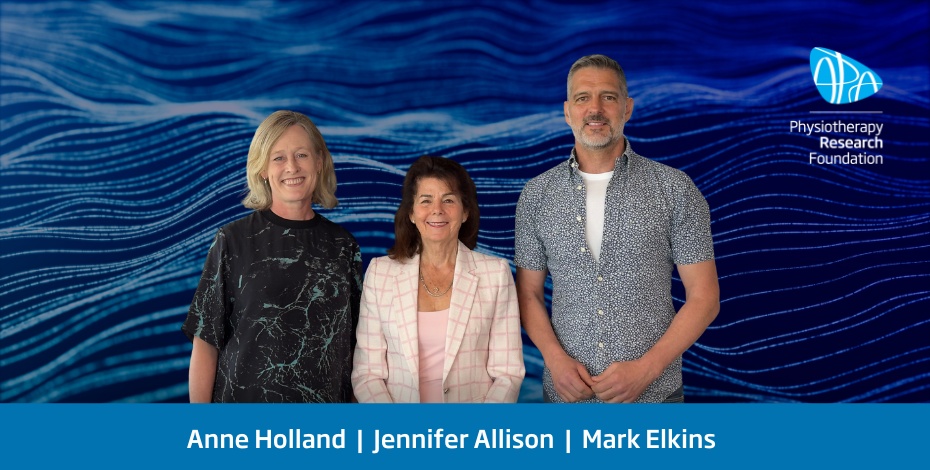
In this episode, Mark Elkins, Jennifer Alison and Anne Holland discuss ways in which cardiopulmonary rehabilitation has changed over the years and how it might look in years to come, particularly in regards to care delivered in clinics, in the community or at home. New evidence is driving new approaches to pulmonary rehabilitation, which has become an important tool for managing both chronic pulmonary conditions (including bronchiectasis or COPD) and acute pulmonary care (for example, in patients on ventilation in ICU).
This podcast is a Physiotherapy Research Foundation (PRF) initiative.
Watch the full podcast episode on YouTube.
Mark
So welcome to this podcast on pulmonary rehab recorded at the APA Scientific Conference 2025. My name is Mark Elkins. I'm the editor of Journal of Physiotherapy. And I'm joined by two luminaries in this area. So I'll leave them to introduce themselves and start with Jenny Allison.
Jenny
Oh Hi, everyone. I'm Jenny Allison. I was a professor of respiratory physiotherapy at Sydney University. Now I am an emeritus professor there and a professor of allied health in Sydney Local Health District. And I'm very passionate about pulmonary rehab. And a lot of my research area has been in pulmonary rehab and in clinical practice in pulmonary rehabilitation.
Anne
My name is Anne Holland. I'm professor of physiotherapy for Alfred Health and Monash University in Melbourne. And similarly a lot of my research is focussed on pulmonary rehab and particularly access to pulmonary rehab.
Mark
Thank you both very much for joining me. So I just want to launch in with a question which is, we've had gold standard evidence for decades that pulmonary rehab improves quality of life and dyspnoea and survival and yet global uptake really remains pretty low. We have a lot of research now into alternative models, community, home-based models, digital delivery. Do you think now that we have sufficient evidence that those other models should be implemented and are health systems actually ready to adopt these kinds of remote or hybrid or home-based models? What do you think, Jenny?
Jenny
Yes, look, I think you can go on developing evidence for a long time, but I think the studies have been well done. The outcomes have been very much that these other models are the modes of delivery that we've all evaluated in different ways to try and improve access to pulmonary rehab have been similar to the outcomes to centre-based rehab. And so I think the key thing about these models is just to ensure that they have the components of what we regard as essential for pulmonary rehab. So whether they're distance models or not, I really think we still have to make sure that we have centre-based assessments, before and after the program. But the delivery within the program, I think we do have plenty of evidence to say that it will work. But, and I do believe that if we had opened it up, if we can open it up more to patients, then if they can have some choices, it's more likely that they might stay the course and finish and complete their pulmonary rehab. I think it's a really big issue in terms of health dollar as to what models the health districts are prepared to support.
Anne
Yeah, I agree, Jenny, I think we've certainly demonstrated that tele rehab in its various forms is safe. There's certainly no increase in adverse events in any of the trials which is important to underpin rollout, I think, and as you've said, the efficacy data are there. I think there's a variety of tele rehab models that have been tested. And in terms of implementation, I think different health services will have different preferences and priorities for those. You know, if there will be some settings in which a relatively equipment-free, low-cost model will be more appropriate and others where, you know, they're much more tripped up, video conference, remote-monitoring model will be possible. So I think that's an advantage as well of the literature that we have, that we have a variety of models for different circumstances. I think in terms of how health services implement these changes, I just reflect that, you know, we were coming to the end of tele rehab trial, when Covid hit. And so we were fortunate to be able to roll straight out into clinical practice at our site at that point. But for many years, people have been saying to me, well, this is never going to roll out in clinical practice because you've got to do things like pay for equipment to be delivered and picked up and things like that, and that problem disappeared overnight when Covid hit. So I think, you know, there will be new ways of thinking about delivering services. But we've shown, I think, that that that can be implemented.
Jenny
And I just want to add one thing. I think that, it does depend on the health district. And we've got a really big issue in Australia of rural and remote access and some of those health districts that have a lot of rural and remote sites, it really is so difficult to provide pulmonary rehabilitation equitably. And I think these new models are one way that we can help to level the playing field about equity of access to best-practice care, even if it does require a centre-based assessment, the patient doesn't have to keep travelling throughout the program to come to the centre. So I think it really is very important for equity.
Mark
I just want to move on to another issue, which is in a lot of ways, pulmonary rehab is like a behaviour-change intervention. We're trying to get people to sort of adopt exercise and physical activity as a long-term lifestyle change. Do you think we research the psychological and social dimensions of engagement in pulmonary rehab enough? Do we under-research those aspects? What do you think, Anne?
Anne
I think pulmonary rehab certainly meets the definition of a complex intervention that's got lots of different parts and lots of stuff going on. And one of them is behaviour change, I think. It's sort of embedded into the definition of pulmonary rehab that that's something that we aim to achieve. But, I agree, in practice, perhaps we don't focus on it as much as we have some of those, I'm going to say, easier aspects, such as, supervised exercise training. This I think, has become more important, though, as we move towards remote-delivery models. So, for instance, the home-based model that is our low-cost, telephone-supported model, motivational interviewing is at the heart of that because we don't have direct supervision of exercise training. So all of our physiotherapists who deliver that model go through formal, motivated, patient-interviewing training before they're allowed to deliver it. So I think we are coming to understand how important this is. But it's been a journey to get there. And I think within physiotherapy we won't have all of the answers and expertise for the behaviour-change aspect. So we're going to have to collaborate more widely with people who do have that knowledge.
Jenny
Yeah, I would agree with that. And I also think that we've had a bit of a change. I think way back we really concentrated on the physical outcomes of pulmonary rehab. We were very set on, you know, six-minute walk distance and those sorts of outcomes. I think now in many trials we add qualitative research. And I think that's made a difference to our understanding of the barriers and facilitators to our patients as to whether they'll take up the intervention. And especially interviewing patients who either don't attend or started and don't finish. We're learning a lot more now, and I think we're a bit more focussed on really addressing those issues than we ever were when we were very set on just, you know, the quantitative outcomes that we have been in the past. So I'm hoping it is a bit of a change, but it's a very important area, yeah.
Mark
Yeah. Just with my journal editor’s hat on, I suppose, I did an editorial on behaviour-change articles with Sarah Hug, who is a student of Kylie Hill’s in Perth, and I learnt an awful lot about behaviour change from working with her. And one point that she made to me was that the word supervision is often included in as part of an intervention, and sometimes that might mean monitoring and/or goal setting and/or feedback and it's sometimes there are specific behaviour-change interventions sort of under that banner. And sometimes there's other things. And it just made me realise maybe we need to be a little bit more specific about, you know, documenting what might be a formal behaviour-change intervention when we're writing studies. As outcome measures for pulmonary rehab, the profession has relied on six-minute walk test and quality of life tools for decades. Do you think outcome measures reflect what matters most to patients? Do you think we should be getting into physical activity monitoring or wearables or other fancy technology in, either research or in clinical practice? What do you think? It wouldn't change anything because of the established benefits on exercise capacity and quality of life, or would it just complicate clinical practice?
Jenny
Yeah, look, I think it's a balancing act, really. I think it works for some people. When, you know, just taking your theme of behaviour change, I mean, sometimes those wearables can help with behaviour change because people get the feedback immediately. And I think particularly when they finish a program to then have something that they can monitor themselves can be really helpful. I mean, we did find that when we measured the amount of physical activity during a pulmonary rehab program, that the physical activity went up, but it was only really on the days that people actually had to get a bus or, you know, walk and come to rehab, as well as the amount of rehab they did in that day. And I think then afterwards we showed that that went back to their pre levels, even though they had improved their six-minute walk distance. And we know that physical activity is important in general health anyway. So we really do want to try and get that behaviour change and translate it. So I think it depends on the patient, number one. And I think it depends on whether that is a helpful intervention or a helpful tool, I suppose, to achieve that behaviour change. I don't think it's for everyone, but I think it could be helpful. The tests, like six-minute walk test, have got a lot of well-evaluated, you know, outcomes to know whether you know about mortality and other things. So it's still, I would never stop doing that as an outcome measure. But we could add the physical activity monitoring in the longer, towards the end of the programme and for ongoing maintenance.
Anne
Okay. Yeah I agree. I think one of the advantages of including physical-activity monitoring in research has been that we've understood that actually we don't change physical activity after pulmonary rehab most of the time. So as an outcome measure, I think we'd find ourselves very disappointed if we decided that was the outcome measure that we were going to adopt for pulmonary rehabilitation, because that we might not be getting the effects that we want, which again, you know, goes back to the point around behaviour change and perhaps we're not achieving as much behaviour change as we would like to think and need to pay some more attention to that. I do think, that, you know, step counters, for instance, can be useful, motivational tools for patients. But many have them on their phones already and are able to feed that back to us. In terms of what matters to patients, I think, you know, step count will matter to some patients and not others, as Jenny has said. The outcomes of pulmonary rehab that we know that people value are still, I think quality of life and symptom outcome. So I think we do need to keep on making sure that we measure those things and we're achieving what we set out to.
Mark
I guess changing tack now, years ago, there was a debate at one of our conferences about whether we should have a bunch of rehabilitation programs for distinct clinical conditions, or whether we should just have generic rehabilitation, and from memory, generic rehab seemed to address the high prevalence of co-morbidities well. But opposing that was that many physiotherapists wouldn't have the broad expertise required. How do each of you feel about that issue now?
Anne
And that's a great question. So I'm going to come at it from the perspective of currently leading a trial that's been funded by the MRFF in Australia called the PERFORM trial which is a trial of multimorbidity rehabilitation. So we're actually running two RCTs in parallel. One is comparing multimorbidity rehab in a model that's co-designed with people who are living with long term conditions to cardiac rehab for people who would be eligible for those. And the other one is comparing it to usual care. So no exercise rehab in people who wouldn't be eligible for cardiopulmonary. So I guess that tells you that I have an interest in this, that, you know, I think there is certainly a growing need for exercise-based rehabilitation across a range of chronic conditions. And we now know that exercise is good for most chronic conditions and, you know, has important benefits for patients. And we probably can't keep on inventing single-disease rehab programs forever. That health system is just not going to be able to deliver that. So, we were very fortunate to be able to pair with Sally Singh's research group in the UK, and Rod Taylor, who leads cardiac rehab research there, they are the originators of the PERFORM trial. They developed the model, have done some feasibility testing, and they're rolling it out in a 20-site trial in the UK. And we'll have nine sites in Australia.
Mark
Wow.
Anne
So, hopefully in a few years I can give you a better answer. I would say my initial reflection on clinician capabilities is, we've done some surveys about that at the start of the trial. And the clinicians tell us that they actually do feel confident to do that. Will be interesting to see what they say after they've, you know, spent two years delivering the intervention, whether that has changed or not. But I would say that actually the biggest challenge we've had so far is thinking about referral pathways that are non-traditional. So we know for cardiac and pulmonary rehab where to get the patients, you know, they get referred, maybe not enough, but there is a referral pathway that's in existence. And the biggest thing that I've had from clinicians is they've said to me, well, where are these patients? You know, where are these patients with multimorbidity? And I think, well, they're everywhere, but we just don't have that established mechanism to feed them into rehab because we have not had those programs available yet.
Jenny
Yeah, it'll be really interesting to see the result of that trial, but I suppose I've got a slightly different angle in the case that I think that, you know, if you're working in more rural sites, there's no choice if you're going to provide, it has to be multimorbidity. But I do think we still need the specialist sites that are single. I suppose single, I mean, all our patients are multimorbidity, basically, but with the focus on, say, in pulmonary rehab on the types of chronic lung disease patients we get, because that helps to move the area forward and you get centres of excellence. And my view is that we need these centres of excellence to focus on that. But that there should be this opportunity for a hub and spoke model where there will be a lot of patients that will need to be doing rehab in general and that they can access these more specialist areas for that more specific information, because, you know, we know with personalised medicine or individualised, we really do need to hone in on the treatable traits of the individual and I suppose that's maybe what your trial will do. But to be expertise across a lot of those things, really deeply expert might be hard. So I think there's a balance here between that multimorbidity, all-comers and and some specialist areas that are very focussed. So I'm in two minds about it to be honest.
Mark
Do you think there's any risk of COPD in a mixed program, COPD patients being kind of the sickest and the slowest, the most short of breath and potentially reinforcing the I’m very sick narrative and I can't exercise? Or do you think there are also severe patients in the other conditions that wouldn't necessarily discourage COPD patients in a mixed group?
Anne
I think what we will see in these programs if they’re rolled out, is that we will have patients who are frail, who have multiple long-term conditions. So I think, my feeling would be that there will be a range of people with similar physical capabilities to people with COPD or heart failure, that’s the other one, I guess, with a range of different chronic conditions. I think at the moment we're just not seeing those people, because they don't have a pathway in.
Jenny
It's a really interesting point you make, though, Mark, about the sickness side of things, and we just finished a trial with one of our PhD students about pulmonary rehabilitation in primary care, with physios and EPs. And one of the interesting things in the qualitative studies, the patients feel normal because they're going to a physiotherapist who sees other patients with musculoskeletal conditions and healthy people, and they don't feel like they've got the sickness model. So again, I think your point is quite good in a way that trying to change the environment where our patients are, may be incredibly helpful to their psyche of being a person with a condition who could be well, rather than, oh, I'm sick and look how terrible everybody is around me. So I think it is an important point as to where people go for their program.
Mark
Going back to that engagement issue that we talked about before, how much do you think this is lack of access and how much is lack of motivation, interest, self-efficacy or belief in the effectiveness of pulmonary rehab? I'm thinking of lines in papers again, raising Kylie Hill in Perth, where I think the WA government funds pulmonary rehab better than a lot of jurisdictions and those papers say even when these programs are widely available and government funded, uptake and completion remains surprisingly low. So how much do you think is lack of access and how much is lack of oomph?
Jenny
I think it's a bit of both, but really just going back to my previous point, you know, where do you have to go to access these programs? So for a lot of patients, it’s difficult and a pain in the neck to try and get there If they don't have support or transport, etc.. And what we found in patients going to their local physiotherapist or exercise physiologist, they really love it because they see people from their own district that are there. They can get a parking spot because it's the local physio. They get engaged with other people in their local community and can go on with their maintenance with those people. And so I think that we sort of missed the boat in engagement. I mean, when you walk into a big gymnasium, like, you know, some of the gyms that we use in the hospital, it's pretty daunting. And you've got to be a fairly motivated person to really walk in there, first of all, and then to stay the course unless you get well greeted by a really lovely, engaged clinician, which I hope most pulmonary rehab clinicians are, but if you don't get that atmosphere, people feel threatened. And I think it's hard. So I think maybe again, going back to environment, that might be important. I mean, you know, I've done some work with Aboriginal community-controlled health services, and Aboriginal people do not like going to mainstream programs because they really feel culturally unsafe. It doesn't feel comfortable. You walk into an Aboriginal community-controlled health service and there’s this wonderful atmosphere of everyone's pretty much Aboriginal, well greeted, well known, and just comfortable, relaxed. And it does make a difference to engagement. So I think creating the engagement environment will make a difference to people coming, number one, and also how much they know about it before they get there. So sometimes they're too frightened to come because no one's told them very much about it. So I think it's a bit of an issue, really, to educate the community about what this is.
Anne
Yeah, I agree, I think there is an engagement issue. I think it is a complex problem with, you know, many contributors. I guess one of the areas that I don't feel like we've been able to really address is the system barriers that we have here in Australia, but in other places in the world as well. Just imagine a time where health services or general practices didn't get paid if they hadn't referred their patient with COPD to pulmonary rehab. You know, that might drive some behaviour change if that was the case. And we are seeing jurisdictions that are moving towards those sorts of, you know, value-based care models. So the UK has had a program of national audit for years. They know exactly how many people are being referred to pulmonary rehab and how many people finish. And that gets reported back and reported publicly. And they're now moving towards, you know, really making sure that they are delivering guideline-based care, you know, with some financial carrots and sticks around that. So I think we need to look at all of the different levers that we have. Some of them I think will have to be system levers. But of course, there's going to be engagement levers as well that we need.
Mark
Do you think there's any role for case management or is it just too expensive?
Jenny
I think it adds a level of complexity that's not always necessary. I just think the more layers you put in, the more difficult it is for patients to know who to talk to. And I'm not all that keen on that model, but I know it does work in some instances, but it just adds another, I think, for patients it's confusing as to who they need to talk to. I mean, just going back to your driver thing, you know, we do have the new clinical care standard for COPD from the Australian Commission on Safety and Quality in Health Care, which we're hoping will be a driver because the quality statement five says that all people with COPD should be referred to pulmonary rehab. And if you have an exacerbation, you should commence pulmonary rehab within four weeks post hospital discharge. And that's based on very strong evidence that it makes a 52% reduction in readmissions. So that standard is there and will hopefully be a bit of a driver for local health districts to ensure at least if somebody is admitted they get referred. And this new group, Australian New Zealand Respiratory Audit program are trying to mimic a fair bit of what you said about in the UK, is starting an audit program now on COPD admission. So at least out of that we'll get some information about whether patients are even referred when they have been admitted to hospitals. So we'll see.
Mark
Last question. The balance of recent evidence points to a higher risk of chronic respiratory disease among people who vape nicotine. On the other hand, a few well-done longitudinal studies find weaker or even no independent effect after very strict control for past smoking. So I’m wondering first how you interpret that evidence. And I know many pulmonary rehab programs struggled to get GPs to even do spirometry and refer on people who really need it. So maybe it's ridiculous to ask if any vapers have been referred yet, but I'm thinking of people like Simon Chapman and Nicola Roxon who sort of said we really should have clamped down harder on vaping and now it's rampant. So is vaping an issue for long-term lung damage? And if it is, are we doing enough about it?
Anne
It's a great question and I'm glad you asked it so I think the first thing I would say is that, many of the companies that are promoting and selling e-cigarettes are the same that promoted and are selling tobacco and we know that they can't be trusted. So I think we should very firmly start with the attitude that these people do not have our best interests at heart and go from there. In terms of longer-term effects, you know, e-cigarettes have not been around really long enough for us to understand that. But we've got the same problem we have with cigarettes, it’s that we don't know what's in them and that it's incredibly variable, which makes those sort of long- term effects even harder to sort out. What we do know is that, since there's been widespread uptake of e-cigarettes, particularly around young people, we have had the first uptick in cigarette smoking in young people in Australia for many, many, many years. So I think the evidence is firm that e-cigarettes are a gateway to smoking cigarettes. So we know the harms of cigarettes, and I think, you know, we need to be doing everything we can and we do in Australia to prevent, cigarette smoking and its long-term health consequences. So, I think, you know, we still probably don't really have the data on direct lung damage from e-cigarette use, but we certainly have a very good indication that, you know, this is a pathway into cigarette smoking. And we know exactly what that causes.
Jenny
And I do think there certainly are case studies of evidence that vaping, because just like you said, Anne, there's a lot of chemicals in those vapes. And, you know, I'm just a great believer the lungs are such a beautiful thing. Why do you want to suck in more stuff than happens to be in the atmosphere? Because, you know, if you're sucking those chemicals in, it is going to do some damage. There's some evidence of inflammation, lung inflammation. And I did ask around pulmonary rehabs in Sydney and we're not getting any referrals really with that or except one of them, one of them did say that they did have one referral of a young woman who got a really nasty inflammatory pneumonia. And they really had put that down to the fact that she was vaping. So I think that it's there, we know from some data in the United States, particularly, that there's some young people, who ended up with quite severe lung damage, in intensive care. So I think any chemical that you suck down into your lungs, not going to be good. And as you said, we'll know in the long term how bad it really is, but even there are some acute injuries happening already, I think. So I think I’ll go with Nicola Roxon. You know, she was great, you know, for stopping smoking. And so I have great admiration and I'm hoping that they can get it under control because it's certainly isn't at the moment.
Mark
Well thank you both so much. It's wonderful to get your insights on all those topics. And, we'll wrap it up there. Thank you.
Jenny
Thanks, Mark.
Anne
Thank you.
Get to know our interviewees
Associate Professor Mark Elkins APAM
Associate Professor Mark Elkins APAM is a Clinical Associate Professor at The University of Sydney's School of Medicine and Health. Mark serves as the Scientific Editor for the Journal of Physiotherapy and is a member of the Steering Committee for the Physiotherapy Evidence Database (PEDro), which includes over 62,000 evaluations of physiotherapy interventions. Formerly the chair of the International Society of Physiotherapy Journal Editors, he mentors clinical staff across five Sydney hospitals. His contributions include one textbook, 17 book chapters, and 206 peer-reviewed publications, focusing on respiratory disease interventions and enhancing the quality of clinical research in physiotherapy.
Professor Jennifer Alison APAM
Professor Jennifer Alison APAM was Professor of Respiratory Physiotherapy, Faculty of Medicine and Health, University of Sydney and Professor of Allied Health, Sydney Local Health District until November 2024. Jenny has over 220 peer-reviewed publications and 84 grants as chief investigator. Her main research area is pulmonary rehabilitation for people with chronic lung disease. She was awarded the Thoracic Society of Australia and New Zealand 50th Anniversary Medal for Education and Training (2017) and was made a Fellow of the European Respiratory Society (2020) and Thoracic Society of Australia and New Zealand (2015) for exceptional contributions to the field of respiratory health, and received the American Thoracic Society Pulmonary Rehabilitation Assembly Award for services to pulmonary rehabilitation (2019) and Lung Foundation Australia Inaugural Lung Health Legends Award (2020).
Professor Anne Holland APAM
Professor Anne Holland APAM is Professor of Physiotherapy and Head of Respiratory Research at Monash University in Melbourne, Australia and an NHMRC Leadership Fellow. Anne leads a research program that aims to improve the lives of people with chronic lung disease using non-pharmacological treatments, including novel models of pulmonary rehabilitation to improve access and uptake. Her clinical trials of telerehabilitation have twice been recognised in NHMRC’s ’10 of the Best’ research projects that support the improvement of human health. Professor Holland’s research has been cited over 37,000 times, including citations in 32 clinical practice guidelines published by peak bodies for respiratory health around the world.