
The role of exercise in falls prevention
Australia’s national guidelines for falls prevention have recently been updated and one of the key interventions aimed at preventing falls in residential aged care and in the community is exercise/physical activity.
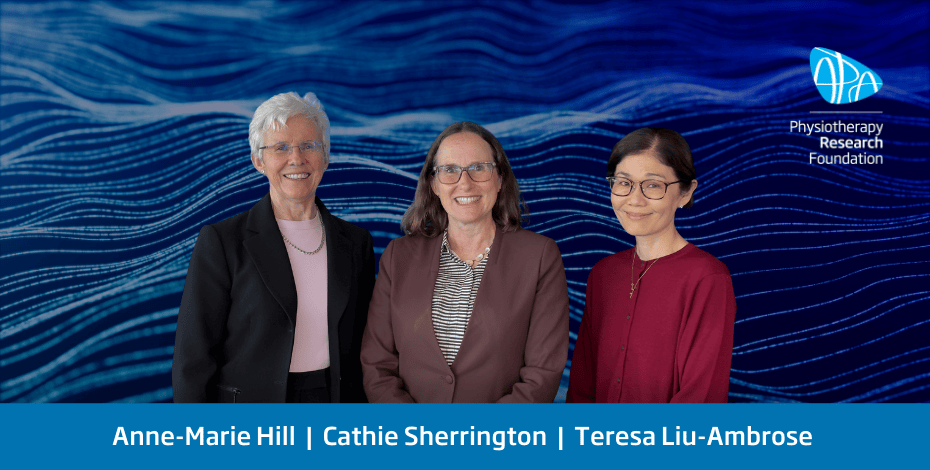
In this episode, Cathie Sherrington, Teresa Liu-Ambrose and Anne-Marie Hill discuss the benefits of exercise as we age and how staying active can help in falls prevention. They explore the primary role of physios with falls prevention, and the emerging part that technology can play.
This podcast is a Physiotherapy Research Foundation (PRF) initiative.
Watch the full podcast episode on YouTube.
Cathie
Hello and welcome. I'm Professor Cathie Sherrington from the University of Sydney and the Sydney and South Western Sydney Local Health Districts. I'm here today with two world leaders in the prevention of falls and enhancement of mobility in older people.
Anne-Marie
Thanks, Cathie. Well, everyone, I'm Professor Anne-Marie Hill. I'm at the University of Western Australia and also do work with falls prevention nationally with Cathie and through our local network. So really excited to talk all things falls prevention.
Cathie
Welcome Anne-Marie. And our invited speaker from the gerontology group at this APA conference.
Teresa
Hi, everybody. I'm Teresa Liu-Ambrose. I'm a professor at the University of British Columbia in Vancouver, BC. That's in Canada. It's really a pleasure to be here today.
Cathie
Welcome, everyone. We're very happy to have the opportunity to have this conversation. I'm going to actually start by summarising the aspects of the new Australian Falls Prevention Guidelines that are of most relevance to physiotherapists. And so these are guidelines, released just a couple of months ago, from the Australian Commission of Safety and Quality in Health Care. And this is very exciting to have these guidelines released because it's the first time they've been updated since 2009. And the guidelines have three separate documents. So first, for community settings, for residential care, and also for hospital settings. We’ll just focus on the community and residential care today. So in the community, really the role of exercise and physical function is highlighted across the spectrum. So the guidelines talk about the benefits of exercise, really across the life course, to prepare for healthy ageing, with a particular focus on activities that enhance balance and strength. For those people who are at an increased risk of falls, so particularly people who have had a fall already, the guidelines talk about the need for more tailored exercise. And that's where the input from a physiotherapist or other health professional is crucial. And again, the focus is on exercises that challenge balance and strength. And the guidelines also call out that there's benefits of exercise for people with cognitive impairment as well. They also say that there's a role of exercise for those people at a higher risk of falls in conjunction with other multifactorial interventions that involve assessment of other risk factors for falls. So that's where considering the vision, the medications, the foot pain, other issues are important as well as exercise. In residential care, the guidelines actually call out for the first time that there's evidence that exercise as a single intervention can prevent falls in residential care, but that the exercise actually needs to be ongoing. The guidelines highlight that if the exercise is stopped, then the benefits will be lost. That's really a key issue for working out how we actually provide that in a safe and effective way. And so, we'll start the discussion now about really what some of the benefits of staying active are for people as they age. First to Anne-Marie.
Anne-Marie
Cathie, I think it is such a good news story because the benefits of doing strength and balance exercise is well established, of course, as you know, for falls prevention. But I think people can underestimate the tremendous benefits it has for your overall health and wellbeing. So we have very good evidence that if you do a regular program of strength, balance and some walking or other types of aerobic activity, you can maintain your independence at home. You will be stronger, more able to do tasks. You'll be able to look after yourself, and you'll be able to undertake more activities: travelling, moving around when you freely desire. So I think the benefits of exercise are really amazing. And that's not even counting the kinds of benefits that we think of, like, you know, your heart health. We know that you can lower your blood pressure by doing exercise. So all those physiological benefits, along with the benefits of just being independent and ageing well, it's really such a good news story if we can only spread that around.
Cathie
Absolutely. Very well said. Did you want to add anything, Teresa?
Teresa
Sure. I also just want to highlight that by being physically active, you have a better chance of reducing your risk of developing dementia in late life. And as well, there's good evidence to suggest that when you engage in regular exercise, you can actually, improve your cognitive abilities or even, again, prevent some conditions within the brain that's really common with ageing. And so that collectively also contributes to your capacity to be functionally independent, because by preserving your cognitive capacities, you can continue to do what you love.
Cathie
Absolutely. Well said. It can be challenging to engage people in exercise. So I wanted to sort of discuss, some tips for, you know, effective strategies from your own experience or from research about how to actually engage people in physical activity. Might go to you first this time, Teresa.
Teresa
Sure. I think it can be challenging, but it certainly is not impossible. And I think as physical therapists are really well positioned to help individuals to become more active by tailoring to their individual needs, as well as physical capacities, we’re well positioned to work with individuals with complex medical needs and address, you know, their existing conditions while ensuring they can still exercise safely and progress through those exercises. I think, sometimes social support is a big incentive, whereby I say if they can have the opportunity to exercise in a group setting, that often creates a social network that they didn't have previously, and that in itself really motivates them to continue. I think sometimes engaging with your family members are helpful because then they have a support system and they can work collectively together to ensure that, you know, the exercise goals can be achieved.
Anne-Marie
Yes, I think that's really good news again, Teresa, that, you know, with those kind of facilitators, we can hopefully increase the numbers of older people that are doing exercise and physical activity in general, really, because we do know that, you know, there are significant numbers, probably up to 30-40% of people who are inactive. And as people age, that percentage of people who are inactive can grow. So at the very time you're getting older and you want to be keeping fit, sometimes people are reducing and doing less. So that's not good. And I think, one of a key kind of facilitators for doing that is simply for people to have that social and group support, as you mentioned, and also individually, to build up their own positive view of ageing, because we know that, when we do research, that often, older people will comment themselves and say, well, I think I'm too old to exercise or I have an injury, and so now I feel I'm too old, I can't get better. And so being able to just combat that and say, there's really good evidence that you can build your strength at any age and, you know, you're never too old to give anything a go. I think that's something that as health professionals, we are very equipped to do because we can confidently say to people, I've had other people your age and older achieve these goals. And so I'm very confident that you can as well. And I think that's where that social support comes in. And we want to see larger numbers of older people just enjoying themselves and taking part in all sorts of activities, whether it's sport or dancing or getting out on the river, swimming. But doing those kinds of things is going to be very important to get that real positive view of ‘can do’. I can do it.
Cathie
I think that's so important. And that's a tip, I think, yeah, a good tip in terms of being able to, you know, use examples of other people who it's worked for, you know, really that sort of role modelling, and physios can certainly facilitate that. I mean, you've both mentioned, sort of tailoring and the challenges that people might face being active, when they're a little bit older. And in fact, there's research actually, my colleague, Associate Professor Leanne Hassett, actually did a large analysis of the AusPlay data, which looks at physical activity across the life course, and actually found that people who had disabilities or mobility problems were actually less likely to be active as they were older. So I wondered if you could both comment on really the particular role of physiotherapists in particularly supporting people with mobility challenges to be more active as they're older.
Anne-Marie
One of the sometimes gaps we have is that, sometimes a patient will mention to me, well, my knees are sore, so I can't exercise or, you know, I'm very short of breath, so I can't exercise. And yet, as a therapist, we know that that's actually the complete opposite, because we know that if we can build a certain sort of exercise, we can help that knee pain, we can reduce that pain. We know that if we do certain sorts of aerobic exercise, we can reduce your shortness of breath. So where I think physios really are well positioned is to help the large numbers of older people who live with chronic health conditions to say, hey, there is a suitable program for you and we can adjust and design a program that fits you and can be graduated. We can start with five minutes a day. We can start with five exercises, taking five minutes and build up. And so building that confidence and ability. And then there becomes that nice cycle where people go, wow, I'm improving and I can take that further. And I do think, particularly for people who have longstanding mobility issues, they may have had disability as a child, that's obviously they’re living with that, is particularly important that they are given some specialist help to, how can I keep doing what I like to do, but I may still have some kind of ability that I have to work on to get around. So yeah, very important.
Teresa
Just to really reiterate that again, as physical therapists, we are very much experts in tailoring exercise to individuals. And I think it's important to really highlight to everybody that exercise is not ‘one size fits all’. So, you know, exercise is not about having to run for 20 minutes or go to the gym and lift weights, like, it's, you know, it's really at the individual levels. So for somebody it could be literally doing five sit-to-stands. And that is the exercise that they are going to be doing for now. And that could slowly build up over time. And so I think that's really critical. And when we interact with individuals, and we're talking about exercise is that it really kind of depends on the individual and the context. And it's not, you know, what we see in TV, what we envision, what exercise is meant to be. It's really, again, what is the most suitable for that individual. So I think when working with individuals with cognitive impairment, again, just to say that, for the most part, you know, they have very good capacity. It could be that, you know, maybe that their memory that may be not as good. And so it is about providing more consistent reminders and also when working with them and providing instructions, just being much more mindful that repetition is important and also different ways of instructing. So it's not just about verbal instructions, but making sure that there's potentially visual cues as well as, again, having them copy you doing the same exercises. So just thinking about ways to instruct and again, being consistent and repetitive until that they're quite confident in performing the exercise. And again, I always do advocate that if they have a family member or care provider that is with them, it's always good to engage with them as well so that they can support their, you know, journey in engaging the exercises.
Cathie
So we talked about the role of exercise in falls prevention. And that that's, you know, really very strongly supported by evidence. And so, as I said at the beginning, in terms of the guidelines, the role of exercise for falls prevention in the general community, for those people at some increased risk, and then for those people at a higher risk as part of a multifaceted program. But I wanted to talk a little bit about, you know what we don't yet know. So what's your thinking on kind of the next directions for research into falls prevention? I might go to you first, Teresa.
Teresa
Sure. So I think, we do know that exercise is quite effective in reducing falls. I think where we can still better understand, is how does it, you know, reduce falls. So again, we do appreciate that exercise has a direct effect on physical function. But we also now recognise that exercise could have an effect on cognitive abilities as well as brain health. And so perhaps, a better understanding of the effect or the pathway by which exercise may reduce falls through those mechanisms could allow us to better tailor exercise in the future. By understanding how it works, we can refine the prescription in the future.
Anne-Marie
I think one thing that we haven't done well as yet is work out how to, in a sense, get our research across, because I think there is still some misinformation and lack of awareness of the messages and it would be tremendous if we have more of an overall public health message going across that helps us to ensure that, if you're an older person in a very small rural town or if you're an older person who maybe is homebound and doesn't get out much, you know, you have some various disabilities, that you're still hearing the messages and you're given more pathways. You know, I think we need to investigate more pathways to be sure we can reach older people. So, of course, you know, we want to use the power of social media now, but do we want the older person to have to, you know, look through hundreds of millions of clips to decide what exercise they do. It would be tremendous if we could do a bit more telehealth with some of those older people, and we can direct them online to some great programs that suit them and tailor them for them. And, you know, we'd like to see, of course, messages reach older people from culturally diverse backgrounds so that the messages are appropriate for them. And there's various offerings, you know, to implement. So I think, we have research on one hand, but more research on how to get the message out there would be really helpful.
Teresa
I absolutely agree.
Cathie
Yeah, I fully agree as well. So you know, we know how to prevent falls in sort of relatively small groups of people. But I'm not sure we really do know how to effectively prevent falls at scale. And I think that really does need investment in large programs, and as you say, awareness, you know, online exercises, things like that. But then, you know, we need to understand the effectiveness and also the cost effectiveness of those type of approaches. And let's move now to the role of technology. So we might go first to you, Anne-Marie, on, you know, how could technology potentially help?
Anne-Marie
I think there has been some good technological advances, in small trials, and older people taking up some technologies, like using smartphones to be able to contact people easily. If you do have a fall, for example, it's good use of technology. Having a smartwatch where, if you fall over in the garden you can make a call to a family member to say there's been an accident and can you get some assistance. So now some of those technologies I think are tremendous. And we know that home safety is really important. You know, 50% of falls happen in the home, as we know. And I still think there's a bigger role for smart houses. And although we know these things, for example, we can have sensor lights, we can have doorways that are going to open the door automatically, self-flushing toilets, we can have all those things, but we don't seem to have taken on board an attitude of, can we try to see how we can roll this out and will it help falls prevention? We're still going into homes and retrofitting a metal rail, whereas if we built some more homes that started off with all the smart technology, then, they'd suit an older person who had even very high needs because they'd be safe to live in, and of course, handy and safe for all of us in that sense. I think that's a something that we haven't followed through enough yet.
Teresa
Yeah, I think, there's a lot of potential combining technology, which right now is collecting a lot of data and machine learning. So, as an example, in terms of, like, prevention, it's very plausible, and I know there's researchers working on this, is to how we can better detect near-fall. So not so much a person who has fallen and therefore need to be notified, but that, you know, by wearing a smartwatch or some type of wearable that over time can we detect a pattern by which these individuals, they haven't fallen, but they actually are experiencing, you know, more frequent episodes of near-falls. And if we can identify them, then perhaps we can intervene earlier. I think technology can also really help us, again, better understand sort of the mind-body connection whereby, you know, are there early changes within the brain. So through advanced neuroimaging that we can better understand who might be more predisposed to, I guess, mobility disorders or falls in the future. So again, more early detection, using technology.
Cathie
I think that all makes perfect sense. I guess I just wanted to add a few other uses that I've seen. So one is this sort of telehealth. So our colleague and APA president, Dr Rik Dawson, undertook this study that involved the telehealth physio. So that was, you know, a live physio session, but made possible through those digital devices. And that program also involved videos that people exercised along with. So it's a way of kind of bringing that expert physio into the home. And in the live sessions, the exact level of the exercise was tailored. Other colleagues, a colleague at Neura, Kim Delbaere, has developed the Standing Tall app and device. So, that’ actually, kind of, uses technology to individualise some sort of balance, challenging and strengthening exercises. Another colleague at Neura, Dr Daina Sturnieks, has actually used a stepping mat. And so that was a sort of exagame, that was interfaced with a kind of game that, you know, encouraged people to sort of step quickly. And that was very effective in preventing falls. So I think there are a few kind of different technological options, as you say, Anne-Marie, as well as needing to understand the role of those sort of feedback devices, those fall-detection devices as well. So yeah, you know, there's a lot of potential for advances in the future that hopefully can help us to deliver those effective programs at scale. And probably just give a plug as well for the Safe Exercise at Home website that Anne Marie and myself and various other Australian physiotherapists, and we really were led by Professor Cathy Said at the University of Melbourne. So this brought together physiotherapists to create a free website, that was actually endorsed by the APA, that gave some simple information to the general public about how to do some home exercise, and some other tips, and also some videos to exercise, along with there. So yeah, we're probably just about out of time. Did either of you want to add any final comments? Anything we haven't covered?
Anne-Marie
I think finally, Cathie, I'd just like to mention that we know that about 50% of our physios work in private practice and possibly, you know, it's around the 50/50 mark hospital versus private practice. And I think that we’ll, as time goes on, need that kind of participation by physios from many areas including private practice. And so looking at how we can provide brief interventions that lend themselves to the local physio down the road doing a falls-prevention intervention as part of their work, that to me is going to be an important way to spread the message. And our private practitioner colleagues, you know, are well-equipped in terms of their ability to provide that tailored work. And I think, you know, working to put more direct input in that area is something that we can be looking at in our health system.
Cathie
I think that's fantastic. You know, the size of the problem, and, you know, from a private practice point of view, the size of the market, and the effectiveness of physio interventions in this area, you know, I fully agree, it's, you know, really an area to be further explored.
Anne-Marie
Yes. Well, thank you both very much for joining me in this discussion. And let's hope all the listeners out there either are able to change their own behaviour, encourage others around them, or, you know, be able to offer these types of interventions to the clients that they're working with. Thank you very much for listening.
Anne-Marie
Thanks, everyone. Thanks, Cathie. Thanks, Teresa.
Teresa
Thank you.
Get to know our interviewees
Professor Cathie Sherrington FACP
Professor Cathie Sherrington FACP is a professor at Sydney School of Public Health, The University of Sydney. She became a Specialist Research Physiotherapist as awarded by the Australian College of Physiotherapists in 2019. Cathie leads the 40-person Physical Activity, Ageing and Disability Research Stream within the Institute for Musculoskeletal Health (based at the Sydney Local Health District) and is Deputy Director of the Institute, where her research focuses on the promotion of physical activity and the prevention of falls in older people and people with chronic disabling conditions. Cathie has authored 385+ refereed journal articles including reports of 50 clinical trials (20 with NHMRC funding) and 32 systematic reviews. She has secured over $34 million in research funding, including 14 NHMRC/MRFF grants as lead Chief Investigator. She currently leads several major projects, including PROMOTE-PA (a multi-partner health promotion trial), PROTECT (fall prevention implementation in hospitals), as well as the NHMRC Centre of Research Excellence in Prevention of Fall-related Injuries.
Professor Teresa Liu-Ambrose
Professor Teresa Liu-Ambrose is a physical therapist and a Tier 1 Canada Research Chair in Healthy Aging at the University of British Columbia, Department of Physical Therapy. Teresa directs the Aging, Mobility and Cognitive Health Laboratory and the Vancouver General Hospital’s Falls Prevention Clinic (www.fallsclinic.ca), and is co-director of the Centre for Aging SMART at VCH. She is a Canadian Academy of Health Sciences Fellow and member of the College of New Scholars, Artists, and Scientists, Royal Society of Canada. Teresa’s research focuses on understanding the role of exercise, and other lifestyle interventions, in promoting cognitive and mobility outcomes in older adults. Her research findings have been implemented into clinical practice, community programs, and international practice guidelines or recommendations to promote healthy aging.
Professor Anne-Marie Hill FACP
Professor Anne-Marie Hill FACP is Senior Principal Research Fellow in the School of Allied Health. Anne-Marie is a Specialist Research Physiotherapist (as awarded by the Australian Physiotherapy Association in 2024), recognising her expert knowledge in Physiotherapy in Geriatrics. She has over 30 years clinical experience working with older people to improve their health and well-being. Anne-Marie holds an NHMRC EL2 Investigator (2020-25) grant focusing on Fall Prevention for older people and was previously awarded an NHMRC early career fellowship focused on fall prevention after hospital discharge (2012-15). She has led large clinical trials, with special focus on fall prevention in hospital, community and residential care populations, with strong focus on working closely with consumers. Anne-Marie is working collaboratively with Aboriginal researchers and communities focusing on sustainable physical activity programs for older Aboriginal people in WA.