
Understanding injury risk for women in sport
Understanding how and why women get injured in sport has come a long way, but what we know is still well behind our understanding of men’s sporting injuries. Many aspects of women’s health need to be considered in relation to sport, such as pelvic and breast health and menstruation.
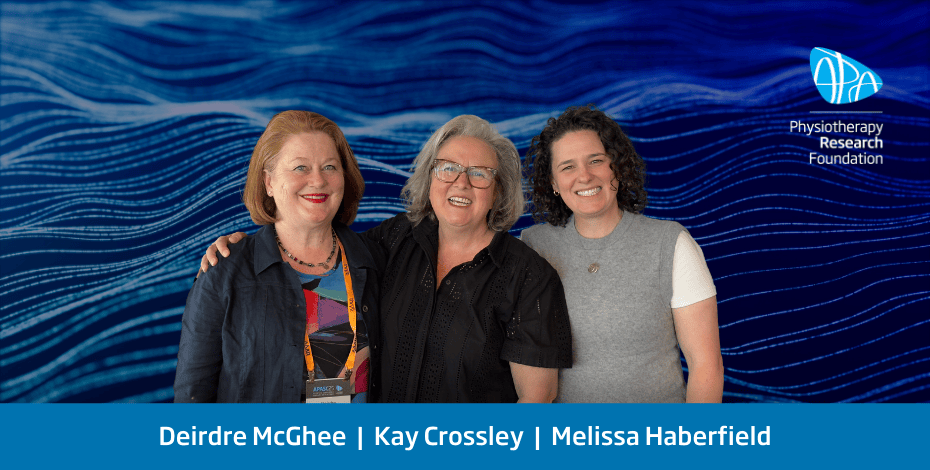
In this episode, Kay Crossley, Deirdre McGhee and Melissa Haberfield look at the factors influencing injury risk for females, women and girls in sport, from community to elite level. They also discuss gaps in research and clinical understanding, and what clinicians can do in their practices to improve injury outcomes.
This podcast is a Physiotherapy Research Foundation (PRF) initiative.
Watch the full podcast episode on YouTube.
Kay
My name’s Professor Kay Crossley, and I’m the director of the La Trobe Sport and Exercise Medicine Research Center. Today I'm joined by Professor Deirdre McGhee, who's the head of Breast Research Australia at the University of Wollongong, and Miss Melissa Haberfield who's a PhD candidate and an AFLW physiotherapist, and she's doing her PhD at La Trobe University. And today we're going to be talking about injuries in women's sport. And one of the first questions we get asked is, well why do women have injuries in sport and are they different to what we see in men and boys? And the answer is we really don't know. There really hasn't been enough research into why women do sustain more injuries and girls sustain more injuries playing sport, what types of injuries they sustain, and what are the factors that relate to it. Traditionally, we've thought that those factors might be related to some of the anatomical differences between men and women, such as the width of their pelvis, whether their knees are knocked together, the shape of their tibial plateaus, or perhaps their hormones. They're often factors that we consider, but there really isn't enough evidence to say that those factors are the reason why women do get more injuries. But also, it ignores all of the other many factors that could be related to why women and girls get injuries such as access to grounds, whether they've got access to gymnasiums, whether they're taught how to jump and land at the same ages that men are taught how to jump and land, whether they've got the same access to coaches, physiotherapists throughout their lifespan. So there's so many things we don't know about women and girls playing sport, and why they're likely to get injured, and so that's something that we really need to rectify. There needs to be more funding put towards women in sport. But today we're going to chat about what we do know and perhaps what we could do right now in our clinical practices to try and help women and girls stay as injury free and participating in sport for as long as possible. So, I'm going to first turn to Mel and ask her to put her clinical hat on first and think about are there differences for injuries, at a community level compared to at an elite level.
Melissa
Yeah, it's a really good question Kay, and I've been lucky enough in my career to work right from the community level to the elite sport level, same as yourself and a lot of other physios out there. And really there are a lot of commonalities across both, from community to elite, we see the same type of injuries, and we know women, for example, have more injuries than men like, ACL injury rates are much higher. As you said, the reasons are not straightforward and simple, it's multifactorial. But what I've noticed over my time working in elite sport is it is improving. We are getting more funding, more resources. But of course, it's never enough, we need more. And then in the community level, I think it's, bigger again, like women, have less access again, compared to men and boys. So for example, community level women are often training at odd times because they don't have access to the ground. They don't have the same coaching support or, physio support as the boys. And so they're always the second fiddle to the boys. And I think, we can do a lot in that space to try and improve things. That's definitely happening in the elite space, but we always need more.
Kay
Thank you. We're going to go now to Deirdre and talk specifically about breasts and bras and everything in that space. What do you see differences in say community sport compared to elite sport?
Deirdre
Well, as Mel was saying, the resources are definitely different. So in terms of education of understanding, say a supportive, correctly fitted bra that's very different in community because there just isn't the same infrastructure to spread education across that they all should be in a correctly fitted sports bra if they're playing any sport involving running, jumping or false alarm movements. But then that same access to medical care when they do get injured, where to go? What information? There isn’t that there. And then in terms of resources, like you're saying with equipment, there's you know, in terms of any type of GPS or GPS bras like the community girls are wearing the men's GPS tops, they don't fit. They move up and down and they cause friction injuries to their skin or they're wearing the men's old uniforms. They're not even wearing uniforms that fit them, you know, so not only that comfort affects their performance, you know. So I think there's, you know, definitely a difference in that skill level. In terms of safe we talk about breast injuries we know that they're associated with tackling in the football codes. But you know, the ones we've looked at in when we've done video analysis, a lot of them are poor tackle technique. So that training in terms of tackle technique or ball skills of catching the ball but not impacting your breast, definitely a difference in that resources at a community level to an elite level.
Kay
Thank you, and at the elite level sometimes uniforms, and you sort of alluded to this, are decided by not necessarily people who are worried about the health of the athlete. So things like volleyball, for example, where some of the uniforms or beach volleyball with some of the uniforms are really designed by the sport to look and feel a different way. How does that elite sport environment sometimes make it more difficult for women and girls to wear the best bras that they should be wearing?
Deirdre
Well, I think so. There’s sports where the top, the bra is decided by what the top is. So they may have a dress, say in netball and the scooped back shoulders, so then they can only wear a cross over design. And if they normally wear a vertical strap design and then they try and readjust the straps, they can be too tight and then they can press on their upper traps, and that upper traps is so important in controlling scapulohumeral rhythm, particularly as you're getting into these higher ranges of abduction and flexion. In terms of breast coverage, the whole breast has to be covered. So in terms of those beach volleyball sports where they have a low neckline, then the breast is not covered. So we're a jumping sport and we have far more breast movement than we need to. So then there's still that tendency of this double edge for a female of being, that whole sexual identity and that appearance of her as a woman. Whereas if she wants to be a high level athlete, that has to come first. So the uniform has to be designed for performance rather than aesthetics. And then in saying that, though, I've completely different views when it comes to adolescence. We know in adolescence that females are sensitive about the appearance of their breasts. So to be putting an adolescent girl as her breasts are developing in something that's tight and clingy, we are not doing anything for participation. So in adolescence, I think really think we need to go more the loose tops and not accenting the appearance of the breast so that we try to defer that drop off of girls in adolescence. And I think that appearance of that uniform is really important. Other bugbear I have, one more is that they'll purchase the uniforms before they've decided the team. And so then the team is fitting into what they've bought rather than what fits them. And you go comfort for the duration you're playing a sport. That uniform is really important. And then things like, you know, the light, the white colored pants in females, you know, when they’re menstruating particularly during adolescence, you go, come on. That's pretty simple fix. Can we go to dark pants please? Why is that an issue?
Melissa
I've definitely experienced that as a physio traveling with an elite junior team, and the players wearing white uniforms and saying to me during the game, can you just check that I don't have a spot on my shorts? So they worry, instead of worrying about their performance in their sport, they're worrying about making sure that they haven't bled through their uniform because they're on their period. And that is crazy to me. It's such an easy fix. Give the girls dark shorts. So easy. Kay
And some sports are doing that now, you do see that. And I also just want to come back to Deirdre. Some sports are doing quite well in the breast health area. So, World Tennis Association, WTA.
Deirdre
WTA
Kay
Do you want to just chat a little bit about what they're doing now?
Deirdre
So the WTA, because there's so much breast movement in tennis because of the false alarm movements, the running and the jumping, they've recognised that a sports bra is a piece of sporting equipment. And now in the annual physicals that occur in Miami, part of their screening stations that they go to, there's one on breast support and bra fit. It's a 15 minute station. The athletes get their bras checked and get educated on breast support. Those athletes at that level get their bras given to them as part of the uniform. And what they're doing is making those athletes more savvy to say, this company is designing the bra around the top and now they’re saying, sorry, I want my dress or my top to suit a higher support bra, because I'm an athlete. I'm an athlete, one. I'm a woman, two. So I think we need to keep pushing that performance.
Kay
Yeah. That's perfect. Thank you. I spoke at the beginning about the lack of knowledge around why women and girls get injured and what are the factors related to that. And so to try and sort of fill some of those evidence gaps, the International Olympic Committee, so the IOC, commissioned a big piece of work to put together all of the evidence that exists for female, women and girl injury prevention. And I was fortunate enough to work alongside, Professor Carolyn Emery at the University of Calgary on that piece of work. And one of the projects that we did alongside that was a project called a concept mapping project, and I co-led that with Melissa. And so she's going to just chat to us a little bit around what we did on what we found in there with relation to the sex and gender factors that are important to consider, for female, women and girl athlete injury risks.
Melissa
It was really important to find out from experts around the world what are those important factors to reduce injury risk for female, women and girls athletes? And so what we did, as Kay said, a concept mapping study, and that's where we gather the experts perspectives on that topic. And we had experts across the sporting spectrum, so from the athlete right through to the coach and the carer, and then the next level of the people at the clinical level, so physios, sport scientists, high performance, then thinking about the next level again, the organisation and policymakers. So we really tried to get experts from all levels of sport and from community through to elite as well. So a really broad range of perspectives and experts in the space. And, what we found was five overarching domains to answer the question of what do we need to consider for female women and girls to reduce injury risk? And so we've already talked about a couple this morning already, but number one was funding and resources. We need more funding. We need more resources. And where they do already exist, they need to be used more efficiently and communicated more effectively to both the athlete and the people working with the athlete. We need improved expertise and knowledge and that's mainly around the athlete themselves, but also the coaches and the support staff. One of the big messages that came across is that coaches and the support staff don't know much about working with female athletes or women, and they're coming from often a men's space into the women's space, and they bring those beliefs and practices with them. And often it doesn't fit into the female women and girls space. So yeah, the people working with the athlete need better education and knowledge around working with those athletes. The next domain, as you mentioned earlier Kay, was sex related factors. So, that's the things like you mentioned, the hormones, the hips, the things that we traditionally link with injury risk in female athletes. And maybe what we need to do there is where appropriate and supported by the evidence is actually bring that into our screening practices like you were talking Deirdre, women have breasts. So maybe part of the screening is we need to look at their bra and their equipment and make sure it's correct. Pelvic health is another one. So in the AFLW, we screen our players for pelvic health because one in three athletes have urinary leakage and they haven't even had babies. So that's crazy. So and we found that exactly 10 out of our 30 athletes had an issue with leakage, which is crazy and affects their performance. So we brought in a screening routine to try and address that. So simple things like that. Then the next domain is a big one. The gendered environment. And this is where we traditionally don't think in the injury prevention space. But I think for female women and girls, this is the key and perhaps where we can make a lot of change, thinking about the gendered environment. So I'm talking about things like the access to facilities, is it the same as the men and the boys? I'm talking about things like male dominated spaces, like gyms. Traditionally, gyms are male dominated and it's intimidating for women. Or things like, are the girls allowed to use the gym at the same time as the male athletes, or are they locked out? Because that is what still happens, even at the elite space, if the boys need the gym, the girls are out, or the grounds, the football ground or whatever sport you're working in. Another big factor in that gendered environment that we found or came out of our study was thinking about even things like interpersonal violence, something that you might not even think about or relate to injury prevention. But women face interpersonal violence and gendered harassment more than men and boys, and so I think that needs to be something we think about. How do we speak to women? How do we deal with them? Are there processes put in place to deal with this sort of interpersonal violence and harassment, and we need to eliminate that. Then the last factor was or domain, was the gendered communication. So again, like I mentioned before, when people are coming from a men's program and they use the same approaches with the women athletes, but maybe we actually need a different way to talk to our female athletes or our women athletes. And often what I found is the women want to know why. Why are we doing this? And that is different to the boys, and our coach, he has noticed that himself. He said, when I worked with the men, I’d just tell them we're doing this drill. And they'd say, okay. And when I work with the women, they go, but why? Why are we doing this? And so he found he had to really think about it and explain it and give them the why and link it to the game plan and link it to performance, and so his whole communication changed. And that's really intriguing actually. So yeah, that's what we found out of our study, really interesting and novel domains and factors to think about.
Kay
And just a couple of those again, maybe expanding in the physiotherapy space. And one is around perhaps the strength training. So we know that a lot of women in sport and outside of sport are intimidated by some of the male dominated spaces, but there are also some people, including physios who don't necessarily think about prioritising strength training. Not only prioritising strength training, but also thinking about how do we train women to be confident in the gym or to be confident with some of that work? So do you want to chat about that a little bit?
Melissa
Yep, I'll even take it a step back. It's how we interact with women patients in the first place. I think that's where we need to start. So I did a little bit of work as part of my PhD with my with a consumer advisory group, which was made up of women with lived experience of knee injury. So this is a bit knee centric but can be applied to any area of our clinical practice. And what they told us is they found their clinical interactions with physios and doctors too often be gendered, meaning, they would say, well, you're having a baby, so you don't need to get back to pivoting sports, so don't worry about it. And they were like, but wait, I want to go back to sport I'd like doesn't matter if I'm having a baby. Or they would say, you don't need to lift as heavy because you're a girl. And then their response was, well what would you expect a boy to lift in the rehab process of an ACL rehab? I want to do that. So often they found they were dismissed or undervalued, and I think we really need to challenge ourselves.
Kay
And our biases.
Melissa
our own biases and how we interact with our patients at the coalface. Start there. That’s where we need to start. And then yes, we need to take that extra step, so I think we need to acknowledge as physios that often women haven't traditionally been in the gym, especially in the community space. In the elite space, we're definitely getting better, the girls are in the gym all the time, they're really confident. But in the community space, no. We need to acknowledge that women don't have great self-efficacy in the gym. They might not know how to do the lifts, they might not know the basics, so we actually need to really support them and take them through that process as they need.
Kay
And I think we all remember the viral clip that came out during Covid of the women's.
Melissa
The NCAA.
Kay
Where they had like the big weight room for the men and then they had this one little stack of little teeny tiny dumbbells for the women. But I think as physios we need to not only challenge our beliefs, but also make sure that we have the skills to be teaching women how to do the work. And then the other piece I just want to come back to is in the interpersonal violence. As a physiotherapist, is that we aren't necessarily trained in that space, but if you are going to be working in sport and arguably in other workplaces as well, we do need to be aware of how to pick up the signs for interpersonal violence, who to go to, who to speak to, and make sure that we can provide that information accurately to our athletes. There is some great resources now available, mostly through the IOC. So just putting it out there when we are physios in this space, we do need to recognise that women and girls are much more affected by the men and boy athletes and that we have a role to play, even though that perhaps wasn't our training when we all went to university. I’m going to change now and go back to the breasts. And just thinking about what do physios need to know in this space around breast health, but also thinking about women's breast health across their athletic career. So obviously you already talked a little bit around adolescence and adulthood, but also into pregnancy and postpartum and perhaps some of the other sort of lifestyle, challenges for female athletes. Thanks, Deirdre.
Deirdre
I think physios can play a great leadership role in terms of breast health and injuries for women, for female patients. So I think physios need to understand what are the breast related issues that women commonly experience, you know, like breast pain, excessive breast movement, the effect of the breast on the upper torso, bra related chafing and breast injury. So they really need to have a general knowledge of all those topics. And because a correctly fitted supportive sports bra can alleviate many of those issues, even a breast injury like we've had a third of our athletes saying, if I wear a high supportive bra that compresses my breasts against a chest wall, that's all I want for breast protection in my contact football codes and things. So I think we need to be on top of it. Absolutely basic. How do we assess the sports bra for design fit and support? And that's very, very quick assessment that we can add to our treatment sessions. The sports bra app, bra.edu.au, very quickly and simply takes you through that. And I ran a session yesterday and, you know, it was like three minutes.
Melissa
Yep, we've done it at our AFLW club, thanks to your great resource. And what we found was a lot of the girls were wearing sports bras that they'd had since they were 18, and they were basically falling apart, crazy. And that was the biggest shock to me was, geez, they’re hanging onto these things for years.
Deirdre
They're like, you know, I've had high level international athletes who for competition, wear their lucky bra that they've worn for seven years. I mean, you might as well be bare breasted. I said you might as well were nothing. Can we keep it in your bag and just wear a decent bra? So I think that if these guys need to be on top of that. But I think in terms of what you're talking about, the lifespan, I think that's really important that breasts are dynamic and breasts change. So all breasts, you know, from puberty up to a mature breast, we don't have the anatomical breast supports to support breast movement. Just like our feet. We need to wear good shoes or boots for our feet. We need to be wearing a sports bra for a breast because that's the limit of our anatomy. But then you might have a woman who's, you know, reasonably small breasted, and then she gets pregnant and oh my God, you know, they get so much bigger and they're actually heavier because of the increase in glandular tissue, which is denser than fat, and that really increases, and blood volume doubles when you're pregnant and breastfeeding. And on top of that, when you're breastfeeding, the breast volume is fluctuating. So they have challenges finding a bra, a lot of women want a maternity bra in a sports bra. Unless you're willing to pay a lot of money, you probably need to have a maternity bra and a sports bra separate, but you need to know the bra you wore before you were pregnant is unlikely to support the mass of your breast when you're pregnant, and it's unlikely to fit you when you're lactating. And, so, you know, we really need to educate women that there needs to be invest in a new bra when you're pregnant and when you're breastfeeding. And on top of that, when they're breastfeeding, they have issues with cracked skin and you know, nipple chafing, and if a bra is digging into the sides of their breasts, definitely that can hedge away down engorgement and then mastitis, which is dreadfully unpleasant, and I'm really going to deter you from being physically active. Then after you finish breastfeeding, your breasts undergo what we call involution and your breasts will actually be softer than they were before you were pregnant. So relative before you were pregnant. Even now, your breasts may, you know, decrease in size and you could be similar to your pre-pregnancy size. They'll be softer, increasing the level of support you want. You'll go, thank you, thank you. You might look back, right, you'll be much more comfortable if you have a higher level of support than what you will pre-pregnancy. A lot of women, unfortunately, don't get their BMI back down and so their breasts are larger because of, you know, basically if you increase body weight, your breasts will get bigger, it's a fat storage system in your body. So, you know, then you'll need more support. Then when you hit menopause or perimenopause, your breast skin thickness decreases and your breasts will be softer again. And again, increasing that level of support can really make you more comfortable and keep you active. Because we know in each of those stages, when breasts change, so at puberty, then at pregnancy and breastfeeding, and then at menopause, women drop, drop, drop in physical activity levels relative to males, and overall we're less physically active than males. So breasts are a factor, a contributing factor to those declines throughout the woman's lifespan. But it's such an easy fix. You go, you know, so the analogy I use is that, you know, your breasts when you're young are like a jelly that set and your bra is a mould, a jelly mould. And as you age and your breasts become softer, that you're like now a jelly that's not fully set, but that mould can make you like an adolescent. You can look as good if we put you in a, you know, correctly fitted bra. The other thing briefly I wanted to talk about was after surgery. So, you know, breast cancer surgery, women really have far more challenges with bras after that because the surgery to the upper torso or radiotherapy really affects where the bra’s sitting, often the drainage holes are right underneath the band of the bra. So there's far more challenges they have with that. And oncology physios I’ve been training as well to guide women about breast support and bra fit, and I've also trained McGrath nurses, so there's simple strategies women can use of what to look for in a bra that'll help them to be more comfortable. And our research has found that bras are actually the third highest barrier to women being physically active, and we had about 20% of the women, who were the youngest cohort, which we looked at women who had breast conserving surgery, a lumpectomy, mastectomy and reconstruction. So the reconstruction group was about 20% of them, two years down the track, who could not wear a bra. And if you can't wear a bra you’re not exercising. So we really need to help those women and 50% of them had not returned to their sport. And you go, what a shame. What a shame. And we can fix this, we just need to guide you in proper breast support and that's one of those barriers that we can easily wipe away.
Kay
Thanks, and I just want to build on that as well. So as physios we see people coming in with a variety of different pain and conditions. And you've spoken before about if someone comes in with neck or thoracic pain, the importance of checking their bra, but some of them might come in with back pain and part of your treatment might be to say, okay, look, let's try and get you more physically active. So as physiotherapists, it's important that they also say look, we're going to get you more physically active but before we do that, do you have the right equipment to help yourself get there? So it might be shoes, but it might be bras. So you want to just talk about maybe making physiotherapists more confident to have those conversations, even if someone didn't come in with like a breast pain problem to begin with?
Deirdre
I think the first thing you would look at is bra size and get an idea of bra size, because we've done research measuring breast volume via scanning and say, what's the size of a breast? And then how much force that will have, flexion torque that will create on your thoracic spine. So once you start getting to the large and extra large sizes, then you go, you got a decent amount of flexion torque on the thoracic spine. So those women who are more your, and if we just grossly this is a gross, you know, relation, but A and B is basically small breast volume, C-D medium, DD-E large and then anything bigger than that extra large. So once you start getting to that DD-E size and saying to the woman just in one of your criteria, what's the most common bra size you currently wear? Then getting that down, that should be a red flag to you already going, and most women are very comfortable telling you their bra size and you can easily look when you take off their top to look at the back, you can easily look at their bra. So looking at their bra and thinking what type of state is that in and is it lifting the breast? Okay, so if the breasts are hanging down then you know you're getting that flexion torque and we know the vertical columns interconnected. So if you've got an increased thoracic kyphosis then we know that's going to change the lumbar spine posture anyhow. And also it's going to change the way they walk because they don't tend to stand with such an upright posture, and if you're in more flexed thoracic then that changes the rotation of your thorax when you walk or when you run, and that changes then the rotation of your pelvis, which then changes your lower limb. So again, it's all an interconnected chain. But also to ask a question about how comfortable are you when you exercise or what type of exercise you're doing? So, you know, women with larger breasts, they’re not going to be so comfortable running unless they're in, you know, a really decent breast support. So diverting women to forms of exercise that are more comfortable for women with large breasts, so, you know, cycling, rowing, less vertical movement of the trunk is definitely more comfortable for these women, or putting them in the pool, anything in the pool, because the breasts float, so they're much more comfortable. But these women are often more self-conscious about their figure so putting them into classes, finding out local classes where they're doing like aqua aerobics with the jogging belts is so good for them because it doesn't muck up the hair, they can have the hair and makeup done, and so they're more likely to get in and out. But directing them about swimwear that does good breast coverage because often they're sensitive about their breasts. And I find a really nice place to buy swimmers for women with large breasts are the post breast cancer surgery shops they sell beautiful swimmers for women who have larger breasts, so they want that good coverage because their breasts float up. So it's about making women more comfortable to exercise. Now that can be through proper breast support, or that can be through diverting them to exercises that are more suitable where there's less breast movement for those women.
Kay
Thank you. And look, we are all about trying to keep women and girls active for as long as possible, so all of this information is brilliant and I think physio should be able to take that all on board. Mel, we're also doing some research in in runners, female runners as well. Do you want to just give us a little insight into some of that work?
Mel
Yeah, we're really lucky to be conducting a really large cohort study in runners, regular runners, and something that was really important to us, and Kay, you can back me up here, was we wanted to have equal number of men and women because we know that women make up 10% or less of participants in sports and exercise medicine research. So we don't research women, so that's why we don't know anything about them. So it was very important to us that we actually had equal number of men and women in our study. So happy to say that we do, we have half men, half women. And then it got us thinking, well, what don't we normally ask and what can we ask? And so we decided to create what we're calling Trail W’s. So Trail W is asking those extra questions that we don't know anything about our women runners. So bra use and knowledge, pelvic health, so anything to do with female health factors, so menstrual health. We're asking them about social gendered factors, so things like what motivates you to run, but what are your barriers to running? Things like safety, toilet use, things like that that we don't often think about and maybe do influence their ability to participate in running or physical activity. So watch this space, that is coming.
Kay
It's a really exciting study, and yeah, we can't wait to share the results with everyone. And we've been lucky to have Deirdre as part of that as well. I feel like we have already, but just, are there other sort of research gaps other than everything? Maybe specific research gaps, perhaps Deirdre, where you would like to see some funding for us to be able to improve our understanding of breast health and support?
Deidre
I think at an elite level, I'd really like funding to get surveillance done of breast injuries because the problem we have with breast injuries is they don't normally fit a criteria to be measured as an injury. So we're not doing surveillance because there's no time loss, these women are warriors, they get a blow to their breast, results in pain, bruising and swelling and they keep playing. But we know that they don’t play as well. We know that for 60% they don't run as well, it limits their ability to run, makes them more reluctant to tackle because they're afraid of getting another blow to their breast, and the pain of it, they go, yes, it is distracting from the game. But the other problem we have is that athletes don't report injuries, and there's many factors involved in that. Some of it is that they don't have trust and confidence in their clinicians that they would know what to do with them, to expose their breasts to someone. There's not the environment to private space where they would be able to take off their top and, and have someone, you know, look at their breasts after an injury. There's also a lack of knowledge, like we really want to get the word out to athletes that a bruise to your breast is not the same as a bruise to your muscle. There are potential long-term consequences, we need to treat these differently. So, you know, we're really under resourced in terms of surveillance and education for these women. And unless we do surveillance, it's our first step in management and prevention of any sports injury. A breast injury is a female-specific sports injury, we need to treat it with the same respect we'd have any sports injury. So I'd love to see more research in that area. I think the other area that I'd like to see research in is breast-protective equipment, and really looking at the efficacy of it. I think athletes really want education and guidelines, and I know World Rugby are being quite proactive about doing research in this area, and they’re funding us to do research in this area. But I think more needs to be done on the efficacy of it and developing guidelines on it, because at the moment it's sort of all open and anyone can do anything they want. And athletes are wasting money on guards that then are uncomfortable or don't fit or they're too hot to wear.
Kay
Is there anything else we haven't really discussed from a research point of view? We obviously need to do a lot in this space, we need a lot more women as participants, we need a lot more women doing the research, we need the research to be informed by what we know about sex and gender. Are there any other sort of key things for you, Mel?
Mel
Yeah, I think the only one we haven't really spoken about today is the influence of the hidden load or caring responsibilities, competing demands. So, yeah, we know that women often carry that invisible load and that can impact how they engage with clinicians or health care and how they do their physical activity or their rehabilitation as well. So often they might put their caring responsibilities for their kids first above their ACL rehab or going for a run. And yeah, I wonder if that's different between men and women. We don't know. So that's part of hopefully what we can answer with Trail W. But yeah, that would be the other big gap for me.
Kay
Yep. Perfect. And that does lead me on to my last question about what advice would you give to physios. What do we know about differences in rehabilitation at a sort of clinical practice level, for men versus women, perhaps after an ACL injury, for example?
Mel
Yeah, I think the big rocks of rehab at the same for men and women. Like we need to get people moving, we need to get people strong, we need to get them doing sport-specific skills to return them to the level of activity that they want to be doing. That's the same no matter who you are. But I think the way we go about it is maybe different for women, and that is obviously emerging in the literature. But we need to I think some simple things that clinicians can do, again, we've already spoken about, but just start by checking your biases, like how do you interact with your women patients? What are the assumptions that you're making about them? What aren’t you asking them? So things like, do you have kids that you're caring for? Do I need to think about when I set your appointments? Do we need to do a hybrid model of your rehab? Do you need flexibility in how we're going about your rehab? So ask those questions, maybe explore that a bit more. The big one for me in the clinic is the self-efficacy around the gym stuff, so I think a simple one for physios is get confident yourself. Number one, we need to start to own that space, which we know, so really get confident yourself, but then help the women to get confident and maybe challenge your assumptions again about just giving them a list of exercises or saying this is your gym program, but where are they doing it? How are they accessing a gym? Do they know how to do the lift that you've given them? All of those simple things. So I think that's like a great place to start for clinicians.
Kay
Thank you. So I think we've had a really good chat today about the injuries that women and girls experience in sport and the challenges for them to stay physically active over their lifespan. And then really some key things for physiotherapists about how to assess and manage female, women and girl athletes specific to their needs. And I think that's the really critical thing is looking at every element of them when you're seeing them as a patient and really trying to work out how can we integrate everything we know to try and give them the best outcomes to keep them physically active or participating in their sport at the level that they want to for as long as possible. So thank you Deirdre, for your time and we encourage people to go to:
Deidre
Bra - dot edu dot au
Kay
Say that again
Deidre
bra.edu.au
Kay
Thank you and I’ll thank Melissa for the fantastic work she's doing as a clinician, keeping our female athletes participating at the level they want to, but in her work as a PhD student as well. So thank you very much.
Get to know our interviewees
Professor Kay Crossley FACP
Professor Kay Crossley FACP is the Director of the La Trobe Sport and Exercise Medicine Research Centre. Kay’s main research focus is on preventing and managing knee and hip pain and injuries, and early-onset osteoarthritis after sports-related injuries. She became a Specialist Research Physiotherapist as awarded by the Australian College of Physiotherapists in 2025 and was also named an APA Honoured Member in 2025. Kay is a physiotherapist with many years of experience in clinical sports physiotherapy. She has contributed to a number of sports medicine and physiotherapy texts, including every edition of Brukner and Khan's Clinical Sports Medicine. Kay maintains a strong research interest in enhancing treatments for knee conditions (injuries, pain and osteoarthritis). She also focuses on preventing osteoarthritis following sports-related injuries, with fields in patellofemoral osteoarthritis following patellofemoral pain, knee osteoarthritis following ACL reconstruction, and hip OA following hip-related injuries (including FAI and labral tears). She is passionate about promoting the health of women and girls participating in sport and physical activity (including injury prevention) and the careers and opportunities for women working in sport and exercise physiotherapy/medicine.
Professor Deirdre McGhee FACP
Professor Deirdre McGhee FACP directs Breast Research Australia, a research group dedicated to advancing physical activity and athletic performance in females by optimizing breast health. As a Sport and Exercise Physiotherapist and Fellow of the Australian College of Physiotherapy and Sports Medicine Australia, Deirdre is recognized for her expertise in breast health, sports bra design, and breast protective equipment for women in sport. Over 20 years, she has researched breast health biomechanics and created educational resources for athletes and clinicians, now used internationally. At the University of Wollongong, Professor McGhee coordinates the Musculoskeletal Block for Postgraduate Medicine and Musculoskeletal Anatomy for undergraduate Pre-Med, Exercise Science, and Med/Health Science courses.
Melissa Haberfield APAM
Melissa Haberfield APAM is a physiotherapist with over 16 years of clinical experience, and a current PhD candidate at La Trobe University's Sport and Exercise Medicine Research Centre. Melissa’s PhD is exploring sex/gender differences following ACL injury, and how to optimise outcomes for women. In 2025, she won the Wendy E Award for best paper—Women in Sport at the SMA Conference. As a clinical physiotherapist, she has worked across all facets of the profession, most notably in the elite female sporting space. She has been team physio at a national and state level in basketball and gymnastics, as well as an AFLW physiotherapist for North Melbourne Football Club—winning the 2024 AFLW premiership. Her particular interests are knee injury, women’s health in sport, and women working in sport.