Swimming for back pain
A recipient of a 2024 Seeding Grant has recently published her research into how swimming can reduce disability from chronic low back pain.
Deb Wareham APAM is a researcher and postdoctoral fellow in the Spinal Pain Research Centre at Macquarie University, Sydney, and the recipient of a 2024 PRF Seeding Grant for her research exploring the effectiveness of swimming for combating chronic low back pain.
‘For a long time there has been a preconception held by the general public that swimming is good for low back pain,’ said Deb in 2025.
‘Many patients and their friends and family – even fellow clinicians – mention it.
'But surprisingly, there is almost no research on the topic.’
The research, ‘Effectiveness of an individualised swimming and education programme for chronic low back pain (EduSwim): a randomised controlled trial’, was published in July 2026 in the British Journal of Sports Medicine.
Seventy-six adults were randomised into an intervention group (n=39) and a control group (n=37), ranging in age from 26 to 74 years (average 41 years), who had all experienced some disability due to persistent low back pain.
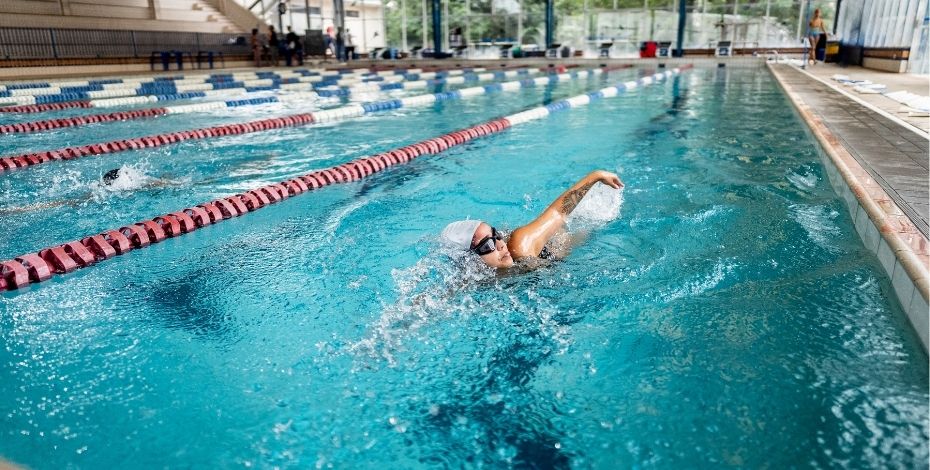
Over eight weeks, the intervention group received an individualised swimming program and access to a local swimming pool, supported by four telehealth sessions with a physiotherapist.
The intervention group was encouraged to continue swimming beyond the eight-week period of support.
Both groups received pain education for low back pain.
The control group received the education with up to two telehealth sessions with a physiotherapist.
After eight weeks, the primary outcome (disability) was measured using the Roland-Morris Disability Questionnaire, which uses self-assessment to rate physical disability due to low back pain.
The researchers found that swimming and education were more effective on disability than education alone, with a mean difference of −2.5 (95% CI −4.5 to −0.5) on the Roland-Morris Disability Questionnaire.
For pain intensity, one of the secondary outcomes, there was only a small benefit at eight weeks.
For the other secondary outcomes (patient-specific functional limitation, pain self-efficacy, fear of movement and patient-perceived global improvement), the intervention group saw better outcomes, although this reduced over time.
The PRF Seeding Grant provided funding to help the team perform follow-ups with participants at 52 weeks.
The between-group difference for the primary outcome of disability that was seen at eight weeks was smaller at 52 weeks, although other factors were explored in additional research.
‘We also published a qualitative paper talking to some of the people who did the swimming and education program, asking them about their experience.
'While the primary outcome, disability, got a bit smaller between the eight- and 52-week follow-ups, we found that self-efficacy improved quite substantially in the swimming and education group and maintained its improvement.
'Participants reported that the swimming program helped them feel more confident in their bodies, that they could try things a bit more.
'They had built up confidence that they could then transfer to other exercises that were important to them or other activities that were more accessible.’
The research outcomes help to give physiotherapists options for patients who are experiencing low back pain, with some data to back up the effectiveness of swimming on pain.
‘I think this trial does provide some clinical relevance for physios.
'Essentially, the reason why we did it was because there was no trial evidence to say whether or not swimming would be effective for low back pain, so now we have another tool in our toolkit.
'It helps to open up the conversation with patients, to find a practical exercise they enjoy doing, build up their confidence and help address their low back pain.’
To read the research paper, click here.
© Copyright 2026 by Australian Physiotherapy Association. All rights reserved.