
Building stronger foundations for stroke care and rehabilitation
The recent launch of the updated Stroke Clinical Care Standard, coupled with the Stroke Foundation’s Living Clinical Guidelines for Stroke Management, provides Australian physiotherapists with a comprehensive, evidence-based framework for best practice care. Here, the two sets of recommendations are examined to understand how they work together and what physiotherapists should know about them.
In June 2026, the Australian Commission on Safety and Quality in Health Care launched the Stroke Clinical Care Standard (Stroke CCS), an update to the previous Acute Stroke Clinical Care Standard published in 2019.
The update expands the standard’s reach to cover more aspects of stroke care and management, from the acute phase to rehabilitation and planning for ongoing care after release from hospital.
The new Stroke CCS consists of eight quality statements describing best-practice care, with accompanying indicators to allow monitoring and quality assurance (see below).
However, for clinicians, a more useful document is arguably the Australian and New Zealand Living Clinical Guidelines for Stroke Management (see below).
Developed by the Stroke Foundation, the guidelines are continually reviewed and updated in response to new evidence and are currently the only living clinical guidelines for stroke that have been developed worldwide.
The evidence contained within the guidelines is a key part of the evidence used to develop the Stroke CCS, so the two documents are closely linked.
The Australian Commission on Safety and Quality in Health Care’s Stroke CCS provides a systems-level, measurable framework for the standard of stroke care and management in Australia and can be used by every hospital and health service in Australia to ensure they are providing the best stroke care possible to patients.
The guidelines, on the other hand, provide an up-to-date, evidence-based guide to every aspect of care and management, from the acute phase to rehabilitation in and out of hospital and ongoing management for stroke survivors.
Clinicians can use the guidelines as a resource, knowing that the most recent evidence is at their fingertips.
A high standard for hospital care
The Stroke CCS aims to improve the assessment, management and transitions of care for patients with stroke to increase their likelihood of survival and recovery while reducing their risk of another stroke.
The eight quality statements outline the care that should be given to patients, encompassing timely assessment and early treatment, early assessment to determine rehabilitation needs and the development of an individualised plan to support the patient after discharge from the hospital, including measures to prevent another stroke, ongoing rehabilitation needs and support for the patient and their families (see breakout).
The quality statements are supported by measurable quality indicators, allowing hospitals and health systems to monitor how well they are implementing the care described in the Stroke CCS.
These can be quite broad and don’t set a benchmark for care but allow services to assess their own performance against the standard.
One of the indicators for quality statement 4, for example, which outlines the requirements for rehabilitation, measures the ‘proportion of patients with a stroke seen by a physiotherapist within 48 hours of admission to hospital’ and there are similar indicators for other allied health services including speech pathology and occupational therapy.

Natalie Fini believes the update to the Stroke CCS is a win for stroke survivors.
Associate Professor Natalie Fini MACP, an APA Titled Neurological Physiotherapist, an APA Titled Research Physiotherapist and an associate professor in physiotherapy and stroke recovery and rehabilitation at the University of Melbourne, says it’s a positive step that the Australian Commission on Safety and Quality in Health Care has moved past focusing on acute care only, largely within the hospital setting, for stroke care and management.
‘They’re recognising that we need to think beyond that very acute phase to rehabilitation and life after stroke.
‘That’s a big win for stroke survivors – it’s a great start – but we still have a way to go.
‘We have provided them with some feedback about what we’d like to highlight as areas for future improvement,’ Natalie says.
Of most interest to physiotherapists, especially those working in hospitals, are quality statements 4, 7 and 8, which cover rehabilitation, the development of an individualised care plan and the need to implement a follow-up assessment and review within six months of discharge.
Natalie says that quality statement 4’s emphasis on ensuring that patients are assessed for and commence rehabilitation by a multidisciplinary team within 48 hours of admission is a big positive.
Another big win for allied health is the requirement for a follow-up assessment and review within six months, Natalie says.
Patients leaving the hospital’s stroke unit often require months of rehabilitation, which can be undertaken as an outpatient in a specialised rehabilitation facility or at home.
‘Eventually, we’d like the standard to go further.
‘We wanted it to have more of a focus on the post-acute phase for rehabilitation and the years of life after stroke.
‘Not to downplay that early medical management, which is key to a better outcome, but we need to also think beyond that.
‘And we know that people who get appropriate rehabilitation get better outcomes,’ she says.
Beyond the Stroke CCS
While the Stroke CCS is a useful framework for hospitals and health services, from a practical perspective, the Stroke Foundation’s Living Clinical Guidelines for Stroke Management are of immense benefit to any clinician working with stroke survivors – from the neurological physiotherapist working in hospitals and rehabilitation clinics to the musculoskeletal physiotherapist working with a client who is a stroke survivor.
Initially developed by the Stroke Foundation and Cochrane Australia as a three-year pilot program, starting in 2018 with funding from the Medical Research Future Fund, the guidelines provide a comprehensive evidence base spanning the entire continuum of stroke care.
It is continuously reviewed and updated by a panel of experts in response to new evidence.
Across eight chapters broken down into dozens of topics and sub-topics, the guidelines provide recommendations based on evidence that has been rigorously reviewed by experts (see breakout).

Associate Professor Elizabeth Lynch says the Living Guidelines lay out all of the evidence for best practice stroke care.
‘The guidelines are huge.
‘There are eight chapters and hundreds of recommendations.
‘In comparison, the clinical standards are much more pared down,’ says Associate Professor Elizabeth Lynch, who leads stroke rehabilitation research at Flinders University and is currently the co-chair of the content steering committee overseeing the guidelines’ sections involving rehabilitation.
‘The guidelines lay out all the evidence there is on how to deliver best-practice care to people who’ve had a stroke.’
A unique aspect of the guidelines, which sets them apart from all the other stroke guidelines that have been developed worldwide, is the frequency of updates.
New evidence is regularly identified and reviewed and if necessary the guidelines are updated in response.
In practice, says Elizabeth, that means the information in the guidelines is no more than 12 months old.
In contrast, the National Health and Medical Research Council requires that clinical guidelines be updated at least every five years.
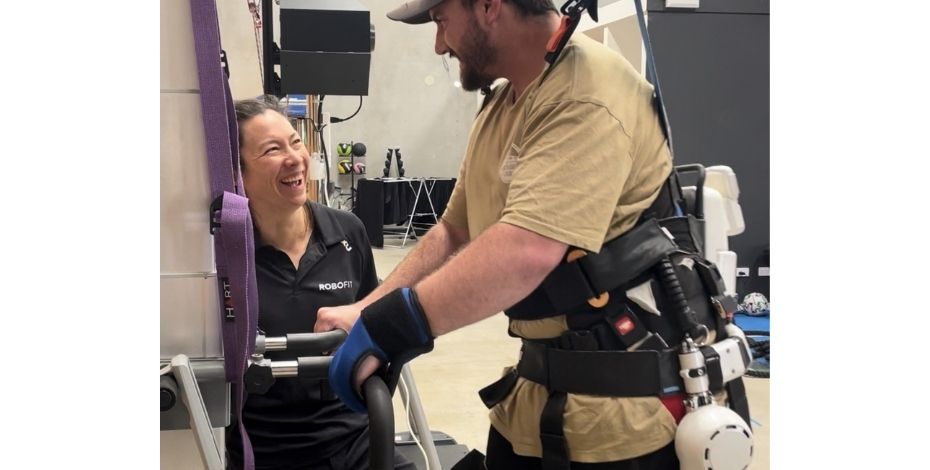
Matt Wingfield APAM (right) is a neurological physiotherapist at Melbourne’s Epworth Healthcare and also teaches at the University of Melbourne, where he is completing a PhD.
As one of the many reviewers in the guidelines’ physiotherapy content working group, he says the short turnaround means that new evidence reaches the clinic quickly.
‘The whole purpose of these guidelines being living guidelines is that as the evidence comes out, it is reflected in the guidelines statement, so that we start to close the gap between what happens in the research world and what happens in the clinical world,’ Matt says.
He notes that it is a more efficient way to manage guidelines because the whole evidence base doesn’t need to be re-reviewed every time a new version of the guidelines is required.
Previous guidelines were reviewed and rewritten every five years.
‘These living guidelines allow us to avoid that waste of resources in going back and reviewing the literature again for the past five years to see if anything’s changed.
The Stroke Foundation does a wonderful job of managing that influx of research and getting it out to its reviewers to determine whether or not something belongs in the guidelines, requires a change to a guideline recommendation or supports a current recommendation.’
A user’s guide to stroke care and management
While the Stroke CCS provides a baseline standard for hospitals and health systems, the Living Clinical Guidelines for Stroke Management are a user’s guide to stroke care and management and an invaluable resource for clinicians involved in rehabilitation.
Rather than providing a care pathway for a patient, they provide the rationale for each component of the pathway that a clinician might consider including.
And it’s not just for physiotherapists.
The guidelines cover medical care, physiotherapy, speech pathology, occupational therapy, mental health and more and encourage a multidisciplinary approach to patient care.

Matt Wingfield says the Living Guidelines give clinicians the flexibility to understand treatment options.
Matt says the guidelines can assist a clinician to develop an individualised care pathway targeting the impairments and the activity limitations of a specific patient.
‘Having a stroke patient present with whatever combination of impairments and activity limitations they have requires you to be able to understand what the best practice treatment is for that particular impairment or impairment profile as well as the activity that you’re looking at.
‘There’s no one problem that everyone presents with; everyone presents differently.
‘The guidelines provide the flexibility to understand the best option for the patient in front of you right now.
‘Going back and forth between the guidelines and the patient is a good way to make sure that we have as much individualised, personalised care as possible,’ he says.
While experienced clinicians may not need to look at the guidelines for regularly used interventions, those with less experience will find them invaluable, not just for understanding what the patient needs but also for developing their clinical skills.
Matt notes that junior clinicians may initially need to consult the guidelines for every aspect of a patient’s care and management but over time, they will learn to recognise the more common activity limitations and impairments and know what to do without having to go to the guidelines as frequently.
‘We are evidence-based practitioners.
‘If we want to take ourselves seriously as a scientific application or a scientific discipline, then physiotherapy needs to be based on the best evidence.
‘And that means that if you come across a problem you haven’t faced before, you should be using the guidelines because they are the one-stop shop providing you with the most up-to-date evidence for what to do in that circumstance,’ Matt says.
An important aspect of the guidelines is the breadth of information they provide to the clinician, from links to the research papers to the rationale used by the panel to decide on a recommendation through the MAGICapp platform, which was developed specifically for hosting evidence-based guidelines.
Each chapter provides a list of the clinical questions answered as well as an overview of the chapter topic.
Then each topic and sub-topic is listed and each recommendation accompanied by links to the evidence – including decision information, rationale, references and practical information – allowing users to dig as deeply as they want into a particular intervention or treatment.
‘My favourite tab is the practical info tab – that can give you some good information as a clinician about what you need to do,’ says Natalie.
The practical information tab sets out considerations such as the kinds of approaches or tasks that can be used, what a particular patient may or may not be able to do and whether a particular exercise is suitable for a patient as well as tips for motivating patients and ensuring safety.
‘These practice points include considerations that the senior clinicians on the panels think are the right things to do but don’t have the data to support.
‘For the junior physiotherapists and students, that’s going to be very valuable, helping them to understand what those recommendations mean and how to apply them to their local context,’ Matt says.
While most clinicians will opt for the strong recommendations when deciding what to put into a rehabilitation plan, Natalie points out that it’s worth looking at the weaker recommendations too.
What works for one patient may not work or be suitable for another.
No two stroke survivors have the same collection of impairments and activity limitations and each person has their individual personal and environmental factors that impact their recovery and quality of life.
‘They give you options.
‘As a physio, you know what you’re seeing in the patient in front of you and something that is a strong recommendation may not be working for that patient.
‘That’s when it’s up to you to do your clinical decision-making and say, “Oh, this isn’t quite right. How can I tweak it or do I need to go to something else?”
‘Don’t forget to back yourself and constantly assess and reassess to make sure that what you’re doing is working,’ she says.
Continuous updating of the guidelines means that clinicians should regularly check for updates to ensure they aren’t moving away from current best practice.
There are some limitations to the guidelines that clinicians should be aware of.
Elizabeth says wellbeing and mental health are not covered in much depth.
Fatigue is another area where the evidence base is thin.
‘It’s because we don’t know a lot about these areas.
‘For example, people who have had a stroke have a lot of trouble with fatigue but we don’t know much about how to manage it.
‘The academic sector and the healthcare sector need to keep doing the research to boost what we know.’
Are the guidelines just for neurological physiotherapists?
While the Living Clinical Guidelines for Stroke Management are mostly used by clinicians in neurorehabilitation, it’s worth noting that as a freely available resource, they can be accessed by any physiotherapist.
Given the number of people surviving stroke and returning to their lives, some with more significant impairments than others, physiotherapists working in a general musculoskeletal setting are likely to see more stroke survivors – although not necessarily for stroke-related issues – and the guidelines may provide insight into approaches that assist stroke survivors to lead their best lives.
It’s a particularly useful tool for practitioners in regional and rural areas, where there are a lot fewer services available and people may have to travel long distances to access acute stroke care, rehabilitation and ongoing services.
Forty-three per cent of stroke survivors live outside Australia’s metropolitan centres and living regionally increases the likelihood of having a stroke, so it’s very likely that a physiotherapist working at a small regional hospital or in the community in these areas will encounter patients who have survived a stroke.
‘If someone’s coming in to see you, whether it’s for a stroke-related issue or a musculoskeletal issue, and they have a coexisting stroke diagnosis, I think it’s good practice to go back and make sure your understanding is up to date with the current evidence base.
‘We’re reflective practitioners; we need to learn and grow and continue to develop.
‘I don’t think there’s any shame in saying, “Actually, I don’t know for certain so I’m going to go somewhere that does inform me for certain what the best management is here”,’ Matt says.
Elizabeth says the guidelines can remove some of the uncertainty for clinicians who might not see many patients after stroke.
A lot of the time, she says, the process is similar – a patient with a weak muscle due to stroke will be treated in a similar way to a patient with a weak muscle after injury.
‘General clinical reasoning as a physiotherapist should see you through what to do with someone who’s had a stroke.
‘It might not be exactly the same but the guidelines can take away some of that feeling of “Oh my gosh, I’ve never seen it before. What do I do?”
‘The guidelines are good.
‘They say do strength training, do cardiorespiratory training.
‘Those sorts of things are good physio skills regardless of what the patient presents with.’
The Stroke Clinical Care Standard
The updated Stroke Clinical Care Standard was launched by the Australian Commission on Safety and Quality in Health Care in June 2026.
Unlike previous versions of the standard, which focused on acute care and management of stroke, the current version encompasses care and management beyond the acute and subacute phases, with a greater emphasis on rehabilitation and support for the patient and their family beyond the hospital via an individualised care plan.
Quality statement 1. Early assessment and urgent transport to hospital
A person with suspected stroke is assessed at first clinical contact using a validated stroke screening tool, such as the FAST (Face, Arms, Speech and Time) test. When acute stroke is suspected, the person is transported immediately to a hospital capable of providing appropriate time-critical therapy. The hospital is pre-notified to enable rapid access to care.
Quality statement 2. Time-critical therapy
A patient with acute stroke receives time-critical therapy urgently and in accordance with the Living Clinical Guidelines for Stroke Management. A patient with ischaemic stroke suitable for reperfusion therapy receives timely thrombolysis and/or endovascular thrombectomy. A patient with intracerebral haemorrhage receives urgent blood-pressure-lowering therapy and/or anticoagulation reversal where appropriate.
Quality statement 3. Stroke unit care
A patient with stroke is promptly transferred to a stroke unit, as defined in the National Acute Stroke Services Framework. The patient receives early, protocolised care to prevent complications and maximise recovery.
Quality statement 4. Rehabilitation
A patient’s initial rehabilitation needs are assessed by a multidisciplinary team as early as possible and within 48 hours of hospital admission for stroke. Individualised, guideline-recommended rehabilitation begins as soon as clinically appropriate during the admission. Rehabilitation needs are continually assessed and documented. Arrangements for ongoing rehabilitation are made before discharge.
Quality statement 5. Minimising risk of another stroke
While in hospital, a patient undergoes a comprehensive assessment to determine the probable cause of their stroke. This assessment informs their ongoing care, including individualised treatment and education to promote healthy living and reduce their risk of another stroke.
Quality statement 6. Practical assistance for families and support people
The family and support people of a patient with stroke are provided with information and practical assistance so that they can safely and confidently support the patient to manage their daily needs.
Quality statement 7. Individualised care plan
Before leaving hospital, a patient with stroke and their family or support people are involved in the development of an individualised care plan that describes the ongoing care required. This care plan is given to the patient, their general practice and their ongoing rehabilitation team at the time of discharge.
Quality statement 8. Follow-up assessment and review
A patient who has had a stroke receives a follow-up assessment and review, with appropriate multidisciplinary team input, within six months of their stroke diagnosis. This is arranged before discharge.
Click here to read more about the Stroke CCS
Living Clinical Guidelines for Stroke Management
The Living Clinical Guidelines for Stroke Management have been developed by the Stroke Foundation since 2018 and are the world’s only living guidelines for stroke care and management.
The guidelines are published in eight separate chapters:
- Pre-hospital care
- Early assessment and diagnosis
- Acute medical and surgical management
- Secondary prevention
- Rehabilitation
- Managing complications
- Discharge planning and transfer of care
- Community participation and long-term care.
Each chapter contains a number of clinical questions and these are broken down into topics and sub-topics.
For each topic or sub-topic, graded recommendations (strong or weak, for or against) are provided along with practice points.
These recommendations have been developed using the GRADE (Grading of Recommendations Assessment, Development and Evaluation) approach.
For topics that lack high-quality evidence, a consensus statement has been provided by the expert panel reviewing the evidence.
Practice points provide considerations and context for the clinician to put the recommendation into practice.
Users of the guidelines can dig deeper to read about the research evidence behind a recommendation, the rationale used and practical information to take into account when designing a program for a patient.
Click here to access the Living Clinical Guidelines for Stroke Management
© Copyright 2026 by Australian Physiotherapy Association. All rights reserved.