High-quality care for low back pain given a nudge
Reducing low-value care for low back pain remains one of the biggest challenges facing hospital emergency departments. A team of researchers including physiotherapist Associate Professor Adrian Traeger is offering important insights into why changing clinician and patient behaviour is more complex than it first appears.
Low back pain has never been simply another musculoskeletal presentation for Associate Professor Adrian Traeger APAM.
It is one of the most common reasons people seek healthcare and an area where community beliefs diverge from the best available evidence.
That combination, Adrian says, makes it as much a public health issue as a clinical one.
Those beliefs formed the foundation of the Behavioural Nudges to Reduce Low-value Care for Low Back Pain in the Emergency Department (NUDG-ED) trial, recently published in the Canadian Medical Association Journal.
Conducted across eight public hospital emergency departments in Sydney and involving 3770 patients with low back pain, the NHMRC-funded randomised controlled trial tested whether relatively simple behavioural interventions could reduce low-value care, specifically unnecessary lumbar imaging and opioid prescribing at discharge.
Despite the scale of the study and carefully designed interventions targeting both clinicians and patients, the behavioural ‘nudges’ did not significantly reduce the delivery of low-value care.
‘In our trial, around 40 per cent of people got an imaging test, an opioid at discharge or both.
'That’s nearly half of everyone coming through getting non-recommended interventions.’
At first glance, the findings could be viewed as disappointing. However, Adrian sees them differently.
‘We were really surprised. We had to recheck the results.
'Maybe it’s this mismatch between the public perception of what’s needed and what the evidence shows and I think we still haven’t adequately addressed that.’
High-quality care in focus
The interventions in the trial were anything but invisible.
The research team – which included Adrian and Specialist Research Physiotherapist (as awarded by the Australian College of Physiotherapists in 2012) Professor Chris Maher as well as emergency physicians, psychologists, sociologists and behavioural economists – approached an advertising firm known for creating campaigns for fast food and asked it to come up with images to persuade people with low back pain to opt for better care.
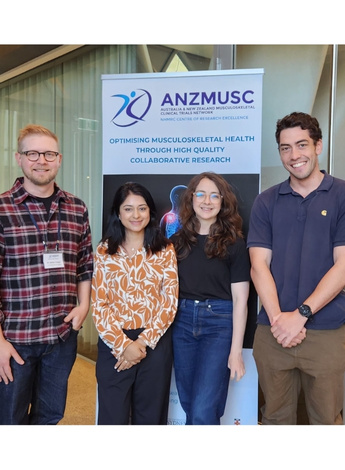
Some of the NUDG-ED study team. Left to right: Associate Professor Adrian Traeger, Dr Sweekriti Sharma, Dr Gemma Altinger, Aidan van Wyk. Photo courtesy of the NUDG-ED study team
‘We used fairly strong imagery and techniques that have worked in the past in public health campaigns to stop smoking and promote healthy behaviours.
'But we just didn’t see an effect. I think it is that belief that opioids and imaging are helpful aspects of care that we need to change on a large scale if we are going to see a reduction in this sort of low-value care.’
As part of the trial, clinicians received electronic health record prompts reminding them of evidence-based imaging indictors and encouraging alternatives to opioid prescribing whenever they managed patients with low back pain.
‘We’re talking about interventions that were in the clinician’s face.
'Every single time they saw someone with back pain, they were getting a reminder about best practice care.’
Meanwhile, patients sitting in emergency department waiting rooms were exposed to the ad-company-designed public health-style advertisements discouraging unnecessary imaging and opioid use while simultaneously promoting evidence-based management strategies.
The multilingual posters were developed with input from the advertising agency, behavioural economists, clinicians and patients before being piloted with community members and refined.
A QR code link was displayed to offer patients more information about effective care for low back pain.
‘We had the patient-facing intervention in the waiting room – those sorts of advertising screens that you see in shopping centres.
'You’ve got people sitting there for up to four hours. We thought putting that information in front of patients and having the automated prompts for clinicians would have an effect.’
It did not. In many ways, the absence of effect provides a more valuable insight than a positive result might have, Adrian says.
Traditional implementation strategies, including guideline dissemination and education, have only had modest success in reducing unnecessary imaging and opioid prescribing for low back pain.
He says that behavioural economics appeared to offer a fresh approach by subtly changing the decision-making environment without removing clinician autonomy or increasing workload.
The field has successfully influenced other behaviours, from vaccination uptake to financial decision-making.
Applying similar principles to musculoskeletal care seemed an attractive proposition, he says.
Deeply entrenched beliefs
The ‘nudges’ approach originated within behavioural economics decades ago and has been popularised through books, public policy and even Nobel Prize-winning work examining how small changes in the way choices are presented can influence decision-making.
‘We didn’t come up with the term “nudge” but we looked at what was going on in other fields and thought, could we apply this approach to back pain, to this highly prevalent issue?
'Can we take what seems to have worked in economics and other human decision-making and apply it to this issue of low-value care?’
The answer, at least in emergency departments, appears to be no.
Yet Adrian believes the findings expose something much more fundamental about healthcare behaviour.
‘I have been reflecting on the trial and why we didn’t see an effect.
'We did see fairly entrenched beliefs in patients and clinicians about the necessity of these low-value practices.’
Those beliefs are remarkably persistent despite years of high-quality evidence and clinical practice guideline development.
Adrian says imaging continues to be perceived by many patients as essential for diagnosis, while opioids retain a reputation as powerful pain relievers despite evidence that harms can outweigh benefits for non-specific low back pain.
‘When we measure people’s beliefs, people still believe opioids are strong pain relievers for back pain.
'There’s a cultural approach to treating pain that stronger pain drugs should be better at pain relief but actually the evidence doesn’t show that.’

Associate Professor Adrian Traegar.
The challenge is magnified in the emergency department, where diagnostic uncertainty shapes almost every clinical encounter.
Unlike community physiotherapy practice, emergency clinicians work in an environment where serious pathology, including fracture and infection, is more prevalent.
Missing one of these diagnoses carries substantial consequences, making clinicians understandably cautious.
‘We think the reluctance to let any uncertainty go past without having a scan was a stronger driver than these prompts.
'The clinician has the patient’s best interests at heart and they just did not want to take any risk of missing something.’
That observation has particular relevance for physiotherapists working across public health settings.
The profession has long embraced evidence-informed management of non-specific low back pain, emphasising clinical reasoning, movement, self-management and avoidance of unnecessary investigations.
However, Adrian believes the trial reinforces how challenging it remains to balance appropriate vigilance with avoiding low-value care.
Contemporary practice relies on recognising clusters of clinical features that meaningfully increase suspicion of serious pathology rather than responding to isolated findings.
The NUDG-ED trial used evidence-based criteria for appropriate imaging that included documented suspicion of fracture, infection, malignancy or cauda equina syndrome, alongside combinations of recognised clinical indicators.
Even within an emergency department cohort, around 98 per cent of participants ultimately had non-serious low back pain that did not require imaging.
‘The challenge is making sure you don’t miss the two per cent.
'That’s where your clinical reasoning and having awareness of the clusters of clinical features that increase risk of serious pathology will help you avoid over-imaging.’
Physiotherapists also brought an important perspective to the multidisciplinary research team.
Adrian’s background in primary care shaped how the intervention was designed, particularly its emphasis on guideline-concordant conservative management.
‘My background is in primary care; I was a family physiotherapist.
'As physios, we are frontline practitioners for back pain and we really are specialists in the assessment of back pain.’
The trial highlighted the expanding role physiotherapists continue to play within emergency departments, where advanced musculoskeletal assessment and early conservative management are increasingly recognised as valuable components of patient care.
For Adrian, one of the strongest messages emerging from the trial was that meaningful behaviour change probably requires something more than a single prompt or poster.
Unlike emergency clinicians managing patients during a single acute presentation, physiotherapists often develop therapeutic relationships over multiple consultations.
Those repeated interactions create opportunities to address misconceptions, build confidence in self-management and reshape unhelpful beliefs about pain, imaging and medication over time.
‘It might take several sessions over time and a relationship with your patient to be able to persuade them that low-value care may not be necessary.
'That’s the unique position physios are in.’
Conducted across culturally and socio-economically diverse health districts in Sydney, the NUDG-ED trial also highlighted important equity considerations.
The research team translated patient materials into the most commonly spoken community languages at each participating hospital and undertook extensive community consultation during intervention development.
Adrian believes understanding how different cultural communities perceive low back pain and healthcare remains an important research priority.
‘We know some under-represented groups miss out on high-value care anyway and can be more susceptible to low-value care.
'The drivers are going to be complex with different groups and different individuals, so I think this is a big area for future research.’
Looking ahead
While behavioural nudges alone might not have transformed emergency department practice, Adrian remains optimistic that broader systems-level changes could produce better outcomes.
Rather than relying solely on information campaigns or electronic reminders, future research is exploring new models of care that integrate physiotherapists more directly into emergency department workflows.
‘There’s more research emerging on putting physios in the workflow and having physios as the first line in the emergency department. I think that’s an exciting area for further testing.’
Supporting clinicians at the point of decision-making, strengthening interdisciplinary collaboration and improving access to specialist musculoskeletal assessment may prove more effective than simply reminding clinicians what the guidelines recommend, Adrian says.
Perhaps one of the greatest values of the NUDG-ED trial for Adrian has been its demonstration of the importance of publishing rigorous negative findings.
Large pragmatic trials that fail to confirm a hypothesis still move the profession forward by challenging assumptions and refining future research directions.
‘I think there’s a lot of work to do to understand how we can better deliver high-value physio care in Australia and internationally.’
Read the paper here.
© Copyright 2026 by Australian Physiotherapy Association. All rights reserved.