
Exercise unlocks the pharmacy inside
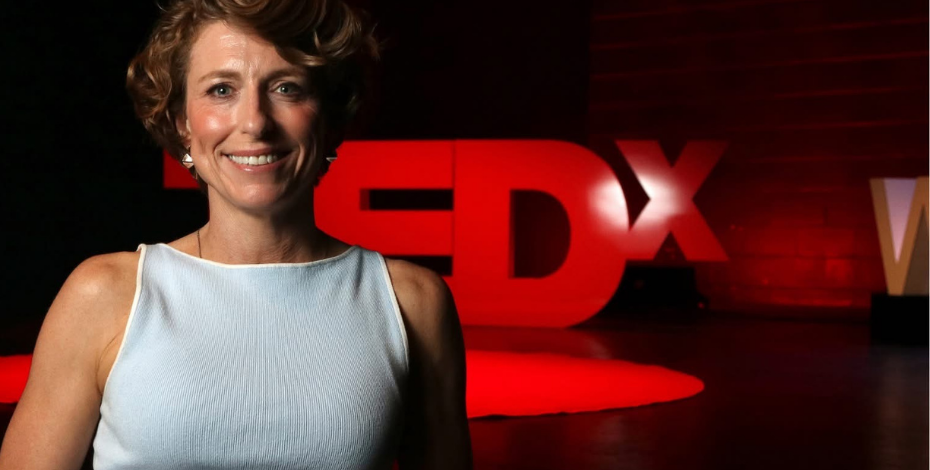
Exercise is increasingly recognised as an essential component of cancer care but translating evidence into an appropriately dosed, individualised intervention remains a challenge. Physiotherapist Kylie Moffitt has spent the past decade developing a model of care that places exercise, rehabilitation and the therapeutic relationship at the centre of the cancer journey.
Kylie Moffitt APAM’s pathway into cancer rehabilitation began with a lecture.
Already working as a physiotherapist and exercise physiologist, and having established her PhysioHealth Corrimal private practice north of Wollongong in New South Wales, Kylie attended a conference in 2016 and heard a presentation about the physiological changes that occur at a cellular level when people with cancer exercise.
It changed the direction of her clinical practice.
‘I listened to the oncology lecture and it was presenting exercise oncology concepts about what exercise was doing inside the body at a cellular level – when people with cancer were exercising.
‘I was blown away and I immediately started mapping out what a service could look like, saying, “Oh my god, I need to take this back to the Illawarra and give this to the people.”’
Her response has evolved into a career-long focus on bringing exercise into routine cancer rehabilitation.
Kylie is a principal physiotherapist, lymphoedema practitioner and accredited exercise physiologist but it is her physiotherapy background that provides an important part of the clinical framework she brings to oncology care.
Kylie’s work encompasses assessment, functional rehabilitation, musculoskeletal management, lymphoedema, scar and tissue management, postoperative rehabilitation and exercise prescription, alongside the complex physiological effects of cancer and its treatment.
At PhysioHealth, Kylie works with patients across the cancer continuum rather than seeing rehabilitation as something that begins once active treatment has finished.
Prehabilitation can be used to build strength, aerobic capacity and physical reserve before surgery, chemotherapy or radiotherapy, while ongoing physiotherapy can address treatment-related impairments, loss of function, fatigue, reduced mobility, joint and soft tissue restrictions and lymphoedema.
The emphasis is on maintaining function and physical capacity while the person is undergoing treatment instead of waiting until deconditioning has already occurred.
Kylie is interested in the physiological stimulus created by exercise and the way clinicians communicate its purpose.
Exercise, she says, can produce systemic responses involving skeletal muscle, circulation, immune function and metabolic pathways, including the release of myokines, which remain present in the body as long as 30 minutes after exercising.
Kylie describes this as a ‘pharmacy within the body’, a carefully dosed physiological stimulus capable of producing adaptations across multiple systems.
‘The medicine or the pharmacy inside us, all these chemicals that are released… our immune cells are activated; we have improved circulation; exercise is a multi-system stimulus and when we give the body the right stimulus, it adapts.
‘Exercise primes the body before someone goes into chemo or radiation and that oxygen circulating around changes the tumour micro-environment and the way the cancer cell responds to the treatment.’
That concept has particular relevance to physiotherapists because it shifts exercise prescription away from being a health recommendation and towards being an active treatment intervention.
Frequency, intensity, time and type need to be considered alongside the person’s cancer diagnosis, treatment protocol, symptoms, comorbidities, treatment-related toxicities and current physical capacity.
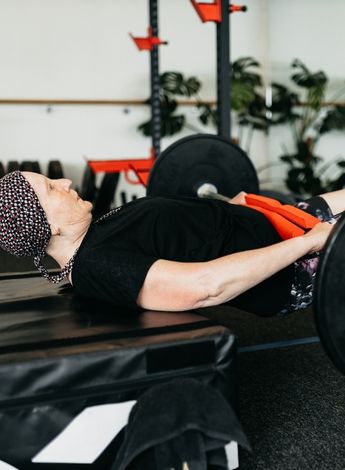
A patient works out at PhysioHealth Corrimal while undergoing treatment for cancer. Photo Dylan Crandell Photography.
The program may need to be modified in response to chemotherapy cycles, surgery, radiotherapy or other changes in clinical status, with monitoring and progression just as important as they are in any other complex rehabilitation presentation, Kylie adds.
She is particularly interested in what happens between an evidence-based recommendation and the patient actually carrying it out.
Someone receiving a new cancer diagnosis may never have exercised, may associate a gym with a completely different identity or may be experiencing profound fatigue, distress and uncertainty.
Asking that person simply to ‘exercise more’, Kylie says, can be a poor translation of the evidence into clinical practice.
‘If you prescribe exercise, more than likely they’re not going to do it at the intensity where they will get the outcome that you think they’re going to get.’
Her solution is partly based on language: she prefers to talk about a physiological ‘stimulus’ rather than exercise per se, helping patients understand why a particular intensity, load or modality has been selected.
That distinction is evident in Kylie’s private practice work, where physiotherapy, exercise oncology and lymphoedema management operate alongside one another.
Having multiple disciplines and areas of expertise within the same clinic allows clinicians to discuss complex cases and maintain continuity as a patient moves between different aspects of rehabilitation.
For patients, Kylie says, one of the greatest benefits is trust and a sense of safety.
Kylie points to one patient, Madolyn Ryan, who was diagnosed with breast cancer when she was 10 weeks pregnant.
As Madolyn underwent chemotherapy and her pregnancy progressed, Kylie and her team had to account for changing cardiovascular responses, the physiological demands of pregnancy and the effects of chemotherapy while continuing to provide an appropriate exercise stimulus.
‘It’s not only a physiological stimulus and training session.
‘It’s a safe place, a support network and a cheer squad for someone going through really hard things.’
CanConquer grew out of the same evidence-based approach.
Established by Kylie after that pivotal 2016 conference, the service provides specialised exercise oncology and cancer rehabilitation across the cancer continuum, including prehabilitation, active treatment and recovery.
Its current model combines physiotherapy, exercise oncology and lymphatic therapy, allowing exercise prescription to sit alongside management of treatment-related impairments and postoperative rehabilitation.
The program also reflects Kylie’s emphasis on individualising the dose.
CanConquer’s approach includes assessment of strength and physical capacity, education about the physiological rationale for exercise and programs adapted to the person’s treatment and symptoms, including chemotherapy cycles.
The aim is not simply to keep patients moving but to use movement deliberately to preserve muscle mass and function, manage treatment-related effects and maintain physical capacity.
For physiotherapists considering exercise oncology, Kylie sees considerable scope to build on existing clinical skills.
‘Physiotherapists have a huge role in covering all of these things,’ Kylie says, pointing to prehabilitation, exercise prescription, postoperative rehabilitation, radiation-related tissue and joint restrictions, scar management, lymphoedema and musculoskeletal consequences of cancer treatment.
Those skills can be developed through further education while retaining the core physiotherapy principles of assessment, clinical reasoning, graded loading, functional restoration and patient-centred care.
Kylie took her message beyond the clinic in her recent TEDx Wollongong talk (see below), using a different narrative to communicate the science of exercise oncology.
She sees communication as an important part of changing how exercise is understood by patients and health professionals, particularly when the evidence is already strong but implementation remains inconsistent.
Kylie’s bigger ambition is for exercise oncology to become part of standard cancer treatment rather than an additional service that patients have to discover for themselves.
She believes that physiotherapists have an important role in making that change happen, through clinical practice as well as educating patients, colleagues and the wider community.
‘We’ve got to help the people who want it and go and ask for it.
‘That’s the big change that needs to happen.’
Moving talk tackles a change in thinking
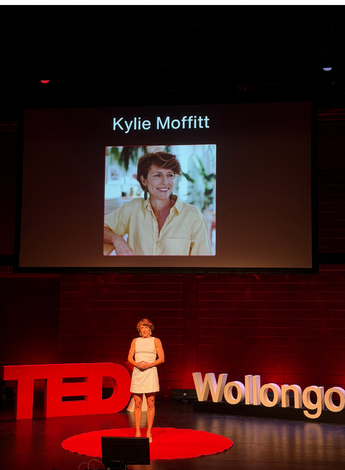
Physiotherapist Kylie Moffitt's TEDx talk grew out of her frustration that exercise is not routinely embedded in cancer care.
Kylie Moffitt’s TEDx Wollongong talk, ‘Change your perspective: how exercise supports cancer treatment’, challenges physiotherapists to rethink how they talk about exercise.
Drawing on the science of exercise oncology, Kylie makes the case for seeing movement as more than healthy behaviour.
Rather, she argues it is a physiological intervention that can have powerful effects throughout the body.
The talk – given at the first ever TEDx event in Wollongong – grew out of Kylie’s frustration that despite increasingly compelling evidence, exercise oncology was still not reaching enough people or becoming embedded in routine cancer care.
‘The research evidence is mind-blowing but it’s not working.
‘It’s not getting into the people in the community; it’s not in the system.’
Her aim with the TEDx format was to communicate the science differently so audiences could understand and feel its potential impact rather than simply being presented with research findings.
For physiotherapists, one of the most useful messages is Kylie’s challenge to reframe the word ‘exercise’.
She argues that clinicians need to think about it in the same way they think about other therapeutic interventions – considering the physiological response they are trying to create and the appropriate dose.
Her talk, given in March this year, also explores why prescribing exercise is only part of the job.
A patient may understand that exercise is beneficial but still struggle to undertake it, particularly during cancer treatment.
Kylie encourages physiotherapists to explain the reasons behind the intervention and consider how language can influence behaviour.
Watch Kylie's TEDx Wollongong talk.
Read more about the importance of exercise in cancer rehabilitation.
© Copyright 2026 by Australian Physiotherapy Association. All rights reserved.