

Compensation and work-related pain
It’s time to re-establish the reputation of physiotherapy in compensation arenas, say Dr Darren Beales, Dr Tim Mitchell and Craig Elliott as they consider some fundamental principles for physiotherapists managing people with work-related pain.
Too often we come across physiotherapists lamenting, berating or being perplexed by the way our profession is viewed in compensation arenas (workers compensation or motor vehicle insurance).
Certainly, it is the perception of some that physiotherapy has been devalued in compensation systems over time, with the role siloed to acute management only.
‘Role creep’ (other health professions providing similar services) is often cited, by physiotherapists, as a problem for the physiotherapy profession.
We can assure you that other professions are not worried about ‘role creep’.
Neither are third-party payers. And is ‘role creep’ even a real issue?
Are other professions just doing a better job of navigating and adapting within evolving compensation arenas than physiotherapists?
We propose that to optimise our role within compensation arenas, the physiotherapy profession should first look inward.
Having firstclass competencies in understanding pathology and pain, applying person-centred approaches to care and being experts on functional restoration via exercise are key, but by themselves they are not enough.
Here we outline fundamental principles of operating within compensation arenas that physiotherapists would do well to apply if they want to optimise and expand their role in work-related pain.
Understand who else is involved
You are part of a system that extends beyond the patient– physiotherapist–GP triad; there are a lot of stakeholders in the management of a person with work-related pain (see Table 1).
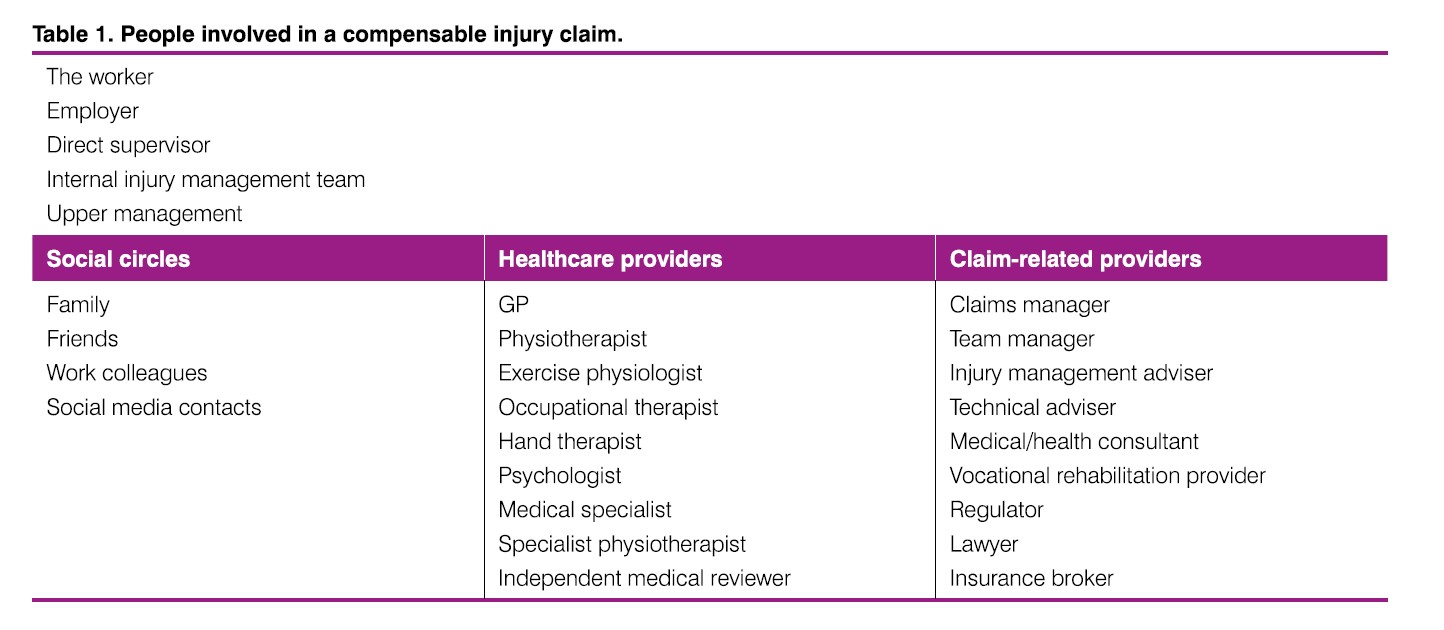
Rightly or wrongly, these stakeholders have influence over the care and outcomes of a worker.
It is not enough to communicate only with the GP or worse—not communicate at all.
This is an area where other professions have surpassed physiotherapists.
Practice point: think about the key parties whom you should involve in correspondence beyond the GP.
Typically, this would be the insurer, the patient and frequently the vocational rehabilitation provider.
It is not difficult to ‘cc’ these people into written communications.
This simple measure will show that you are a team player.
Prioritise guideline-based care
The point here is not to debate the pros and cons of guideline-based care.
Third-party payers know about guideline-based care and use the information to make decisions.
There are probably two layers to this in compensation arenas.
The first is the Clinical Framework for the Delivery of Health Services (here), which is recognised as a national guideline for the management of people with work-related pain.
If you do not adhere to this framework, you have no business practising in compensable arenas.
The framework is underpinned by the fact that good work is good for your health.
In alignment with this framework, physiotherapists should be helping people to engage in work in some form as soon as possible, not be a barrier to this.
The second layer is an understanding of condition-specific clinical practice guidelines.
Practice point: know the appropriate guidelines for the condition you are managing and align your communication with the primary elements of these guidelines.
Communicate appropriately and widely
Yes, this is repeating elements of the first two principles and communication will be seen again within other principles.
You must communicate. If you don’t want to engage in communication, then don’t practise in compensation arenas. It is not an excuse to say that you are too busy to communicate.
If you opt to engage in managing people with a compensable injury, then it is incumbent upon you to communicate appropriately.
Practice point: in states where you can bill for communication, bill for it. Every other provider does.
And if you can bill for it, then there is no excuse not to engage in it.
Remember to be mindful of confidentiality, however.
Minimise passive treatments
Bear in mind that there is minimal love for passive treatments, therapeutic modalities and maintenance therapy in compensation arenas.
This is not a debate on the efficacy of some interventions, nor is it a call to abandon tools that may have utility.
This is a recommendation to use passive treatments and modalities judiciously, in a manner consistent with guidelines, for defined periods of time and with explicit aims.
Self-management is critical in a worker’s recovery and often passive treatments are seen as part of maintenance treatment.
Compensation is broadly built around ‘restoration’, not maintenance, and third-party payers will make decisions based on this premise.
Just having someone say passive treatment is helpful is insufficient.
If you are continuing this beyond six weeks of symptom onset, you should be able to demonstrate meaningful benefit in the form of function or work capacity.
You need to ask yourself, ‘Is this passive treatment or maintenance therapy going to help the worker in the long run?’
If you don’t know, perhaps revisit the principle of guideline-based care for guidance.
Practice point: de-emphasise passive treatments and modalities in communication.
We bet you will be using other management strategies, like exercise and activity pacing.
Emphasise these areas in communication.
Put active management strategies up-front, not the passive treatments or modalities.
Practice point: if your management is maintenance, be up-front about it.
Then the third-party payer can decide whether they will fund it or not.
Use billing codes wisely
Unfortunately, when third-party payers see a billing code for ‘physiotherapy’, they frequently equate this with passive treatment and non-active therapeutic modalities.
Insurers will infer what you are doing from your billing code and then facilitate a change of providers if guidelines suggest to them that another form of intervention is more appropriate.
Practice point: use exercise codes if this is the majority of what you are doing (another form of communication in this instance).
The pre-approval of exercise should not be a hassle if you are already communicating well.
Prioritise functional, work-relevant exercise
You need to understand what the person’s work demands are and make sure that your intervention is functional and relevant to that work.
The worker may be able to describe this to you and/or provide a job description through communication with other team members.
Third-party payers may well consider this—eg, how does Pilates relate to being a long-haul truck driver?
A reasonable question indeed.
Practice point: if precursor exercise is needed to build up to a functional task, be clear about this in your communication.
Explain the plan to progress from this to more work-related functional rehabilitation.
Practice point: make recommendations in relation to return to work based on functional tolerances.
Do not make recommendations based on the perceived availability of duties.
Our role is functional capacity, not the availability of duties.
Take a biopsychosocial approach
All of this aligns with adopting a person-centred, biopsychosocial approach to managing people with work-related pain.
Our role might include flagging psychosocial risk.
We may be providing information on specific barriers like unhelpful pain beliefs, fear avoidance and mood issues.
We would then provide targeted education and other interventions related to these issues.
And we would work as part of a team to address them when the input of a broader team is indicated.
Practice point: be specific in communication.
What exactly are the psychosocial issues that are important for a particular individual?
How are you managing this?
What exact strategies have you put in place?
Practice point: there is still a lot of variability in how secondary psychological sequelae after a physical injury are handled in compensation arenas, ranging from almost excessive support options to no support being provided.
Be very specific in communication about this, then let the third-party payer decide how they will deal with the information.
Encourage independence
Enough said.
Practice point: there may be legitimate reasons for a high level of physiotherapist involvement in managing a person with work-related pain.
If there is, communicate this effectively.
Unacceptable reasons include ‘the patient just keeps booking in’ or ‘the doctor referred the patient’.
Management must be justified.
Have a prognosis and report outcomes regularly
Insurance businesses are built on estimating.
Providing a prognosis is very useful to insurers for estimating purposes.
It is also very useful to physiotherapists as a way of checking on the effectiveness of a management program.
Clear goals and timelines are necessary for a useful prognosis.
Practice point: communicate your prognosis.
Everyone understands that this is an estimation.
Don’t worry if you get it wrong.
Instead, worry if you don’t have strategies for people who are not meeting expected goals in appropriate timeframes.
Third-party payers want detailed tracking of outcomes.
We talk about this in three levels.
Level 1 is return to work. This is the highest level and most important metric that third-party payers will be concerned with.
It should always be front of mind for all providers.
Level 2 is hard outcome measures. Use region-specific disability questionnaires, symptom-specific questionnaires or risk profiling tools here.
You must have these in place.
Level 3 is improvement in specific impairments.
There are times when specific impairments might be improving but this doesn’t register on a questionnaire.
Pick impairments that are key to the worker’s functional demands at work.
For example, choosing ‘unable to run’ as the functional impairment for a desk worker will raise eyebrows.
If the goals stretch beyond work-related duties to prior recreational activities, be clear about this.
Practice point: Sometimes physiotherapy may not be helping someone at a particular point in time.
It is okay to acknowledge this and cease involvement.
Perhaps at another time, physiotherapy will again be indicated for that person.
Refer
As a profession, we are good at referral for diagnostic testing and referral to additional health providers.
What we are not good at is intra-professional referral.
The APA career pathway provides a clear structure for seeking second opinions within the profession.
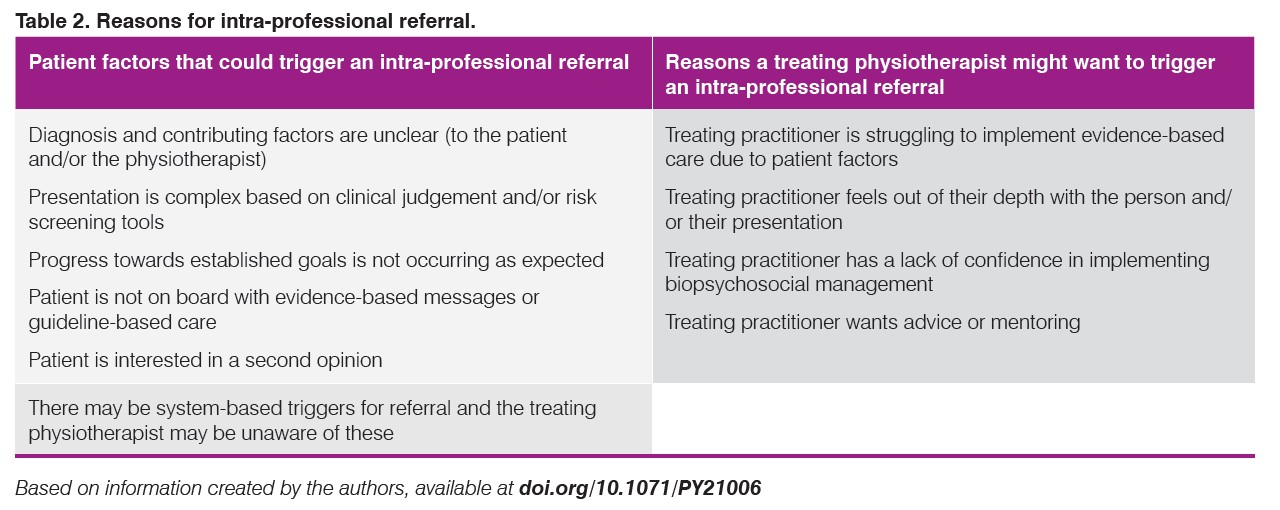
This might be someone more senior in your clinic or an external person.
Our research suggests that the worker will respect you for doing this, you will get a lot out of it for your own personal development and the third-party payers often support additional input when there is complexity or things aren’t progressing as expected.
See Table 2 for examples of reasons for intra-professional referral. Practice point: referring to someone with more experience is not a judgement on you.
Its primary focus is on helping the worker as well as collaboration and education to upskill the treating physiotherapist.
You will get out of this what you put into it.
Spread the word
If you are an educator, it is your responsibility to produce graduands who can operate effectively in work environments.
It is up to you to teach these principles, given that many graduands will dive (or be thrown) straight into working in compensation arenas upon graduation.
If you are an employer, it is your responsibility to mentor your physiotherapy staff in the practical application of these principles.
We would strongly suggest that investment by a business in their application will provide a healthy return.
If you are a physiotherapist and you are working in compensation arenas, it is your responsibility to do so in a manner that is acceptable to the community.
The breadth of this community is indicated in Table 1.
Expectations of physiotherapists have changed over time.
The principles described here give you the greatest chance of being a valuable team player within compensation arenas.
If you are a professional body (such as the APA), it is your responsibility to promote these principles to members.
Guide us to look inwardly rather than flagellating external players whom we might feel inclined to blame for not understanding our value.
Help us prove our value. Facilitating a cultural shift in the delivery of physiotherapy services within compensation arenas must be the responsibility of professional bodies.
Conclusion
Physiotherapists play an important role in the management of people with a compensable claim.
Many times, this is done well.
Far too often, though, it is not.
While physiotherapists have the skills and knowledge to very effectively help people with compensable injuries, this is not enough.
If we as a profession and as individual practitioners look inward, we can greatly improve our value (perceived or otherwise) within compensation arenas.
>>Dr Darren Beales FACP is a Specialist Musculoskeletal Physiotherapist (as awarded by the Australian College of Physiotherapists in 2008), a director of Pain Options in Perth, Western Australia, and a senior research fellow at Curtin University.
>>Dr Tim Mitchell FACP is a Specialist Musculoskeletal Physiotherapist (as awarded by the Australian College of Physiotherapists in 2007) and a director of Pain Options.
>>Craig Elliott FACP is a Specialist Musculoskeletal Physiotherapist (as awarded by the Australian College of Physiotherapists in 2019) and a physiotherapist at Pain Options.
© Copyright 2026 by Australian Physiotherapy Association. All rights reserved.