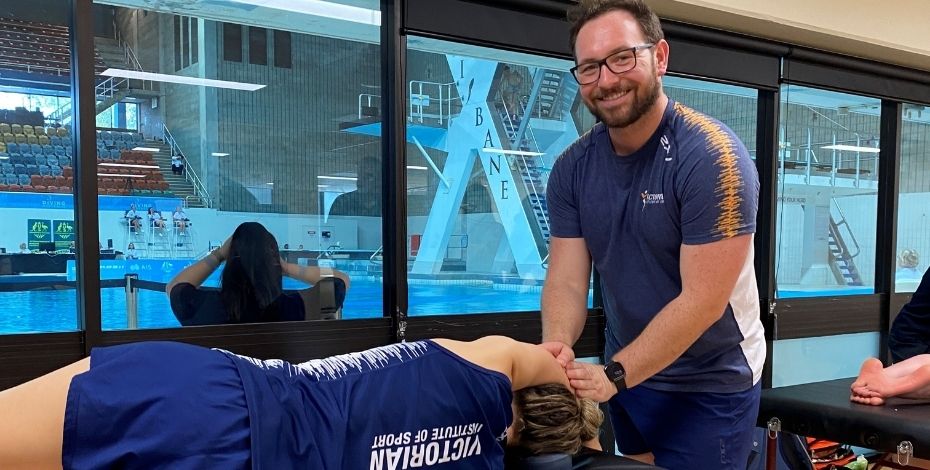

Andrew Cameron treats diver Laura Hingston at the 2023 Australian Diving Grand Prix in Brisbane.
INMOTION 02 Feb, 2026

Out, open and on the field

Physiotherapist Andrew Cameron has built a career in high-performance sport while proudly and visibly identifying as a gay man, in a field where such visibility is still rare. His story is one of resilience, authenticity and the power of lived experience to shape more inclusive, emotionally intelligent physiotherapy practice.

Andrew Cameron MACP has always been driven by two instincts—to help others and to stay connected to sport. 

A graphic of people exercising while wearing rainbows
INMOTION 26 Nov, 2025

The power of inclusive language in sport

When physiotherapists use inclusive language, sporting environments are safer and more welcoming for LGBTQIA+ people, explains Andrew Cameron.

In Australia, sport is more than just a game—it is a cultural cornerstone that unites communities, builds friendships and fosters belonging. 

Yet for athletes who identify as LGBTQIA+, sporting environments can feel exclusionary rather than inclusive. 

Experiences of discrimination and fear of judgement remain powerful barriers to participation. 

A physiotherapist smiling and holding an exercise ball
INMOTION 01 Oct, 2025

Mental health for LGBTQIA+ physiotherapists

LGBTQIA+ Holly Shuttleworth considers the intersection of LGBTQIA+ identity, being a healthcare professional and mental health.

October is Australia’s Mental Health Month and an opportunity to bring the country together to raise awareness about mental illness and to promote better mental health. 

One in five Australians will experience mental illness in any given year. 

The image is a zebra pattern across the spectrum of colours
INMOTION 27 Jun, 2025

The rainbow zebras

Holly Shuttleworth considers the higher prevalence of connective tissue disorders in members of the LGBTQIA+ community.

Ehlers-Danlos Syndromes (EDS) are a group of hereditary connective tissue disorders (HCTD) that affect all systems of the body. 

The most common type of EDS is hypermobile EDS, which is characterised by increased mobility in the joints as per the Beighton score, systemic features including skin problems and widespread pain. 

A rainbow crossing over a pair of hands
INMOTION 29 Nov, 2024

Physiotherapy students’ perspectives on LGBTQIA+ care

Calum Neish and Dr Megan Ross from the University of Queensland recently surveyed more than 300 physiotherapy students about their beliefs and education on LGBTQIA+ healthcare. Lead author Calum Neish answered some questions about their study.

What specific question did your study seek to answer?

In this study, we investigated two research questions:

What are physiotherapy students’ attitudes and beliefs towards providing care for LGBTQIA+ individuals?

An individual waving the trans flag
INMOTION 29 Nov, 2024

Gender euphoria and the role of physiotherapy

LGBTQIA+ Kate Gallo talks about trans body image, the importance of gender euphoria and how physiotherapists can support and enable it.

Acceptance and awareness play a vital role in determining health outcomes for the LGBTQIA+ community. 

For many transgender and gender-diverse individuals, positive body image and alignment of identity and gender can be life-changing and life-saving.

Many of us find affirmation when we look in the mirror and feel confident about ourselves and how the world will perceive
us.