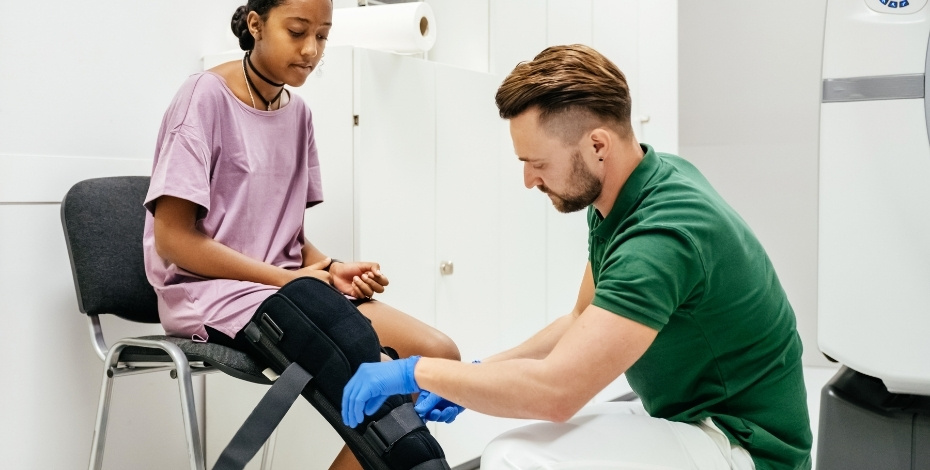
The image shows a patient about to undergo an imaging scan on his leg. A technician is holding a cover.
INMOTION 25 Feb, 2026

Smoothing the path for referrals

A digital platform that streamlines and speeds up the process of referrals for scans and specialist care won the 2025 Physiotherapy Research Foundation Physio Pitchfest People’s Choice Award at the APASC25 conference last year.

When sports physiotherapist Daniel Patterson APAM worked in pro sport as a young physiotherapist, the multidisciplinary team that surrounded him included medical staff who were always on hand to write prescriptions and referrals for imaging or for specialist care when needed. 

A person typing at their computer
INMOTION 23 Feb, 2026

The ghost in the consultation room

Barry Nguyen explains the pitfalls of patients relying on AI for diagnosis and how to navigate the ChatGPT era as a clinician.

The patient arrives with an MRI report in one hand and a smartphone in the other. Before you’ve even performed a single provocation test, they present you with a neatly bulleted ‘recovery road map’. 

This isn’t a collection of disparate Google searches. 

The image is of Plasticise co-founder and physiotherapist Sarah Turner presenting at Physio Pitchfest
INMOTION 30 Jan, 2026

Exercise prescription wins Physio Pitchfest

PHYSIO PITCHFEST An app that allows clinicians to film the exercise they want their patients to do at home took out the 2025 Physiotherapy Research Foundation Physio Pitchfest Judges’ Award at the APASC25 conference last year.

Compliance with exercise programs is something that most physiotherapists and their patients struggle with. 

the image is of Associate Professor Mark Meroli speaking at APASC25
INMOTION 01 Dec, 2025

APASC25: Adapting for the future

Attendees were literally spilling into the aisles at the mini keynote session about the power and potential of digital health technology. 

Speaking in the context of workforce capability, Associate Professor Mark Merolli MACP, a clinician and digital health and informatics researcher from the University of Melbourne, emphasised that digital technologies are becoming paramount to physiotherapy practice. 

‘We’ve entered into that age where technology literacy, technology skills are changing the very DNA of what it means to practise in healthcare.’ 

Associate Professor Elizabeth Lynch talking at APASC2025
INMOTION 01 Dec, 2025

APASC25: Co-design and lived experience

Co-design is an important aspect of physiotherapy research and affects all stages of the research process. In a mini keynote session at APASC25, a panel of physiotherapy researchers and their co-investigators with lived experience discussed how co-design can and should be implemented and its impact on research.

Steve Sammartino talked technology and AI during the closing keynote. Photo: Michael Blyde
INMOTION 01 Dec, 2025

APASC25: A technological turning point

In a high-energy and often hilarious closing keynote at APASC25 in Adelaide, futurist and technology commentator Steve Sammartino challenged physiotherapists to grasp the scale of the technological revolution unfolding now—one he believes will reshape every aspect of healthcare.

In Steve’s presentation, ‘The future of health’, he explored the accelerating pace of change and placed physiotherapists at the centre of the opportunities that lay ahead.

A robot conducting music alongside a human conductor
INMOTION 28 Nov, 2025

AI and accountability in physiotherapy

A recent decision by the Administrative Review Tribunal has highlighted the serious professional risks of using artificial intelligence (AI) in clinical documentation without appropriate oversight.

According to The Australian Financial Review, an NDIS participant’s bid to increase her $202,000 support package was rejected in part because two physiotherapists had used AI tools to help draft reports submitted as evidence. 

Image of translucent panels with writing and graphics showing tech-related topics
INMOTION 25 Aug, 2025

Bridging the AI divide in physiotherapy

Barry Nguyen examines how physiotherapists are adopting artificial intelligence and highlights the benefits of embracing technology, the costs of avoidance, the risks of uninformed implementation and what lies ahead for the profession.

Artificial intelligence (AI) isn’t coming to physiotherapy—it’s already here. 

AI is embedded in how we communicate, automate workflows and, increasingly, deliver patient care. 

A group of people bringing their hands together
INMOTION 30 May, 2025

Strength in numbers

I am excited to be developing the APA’s next strategic plan so early in my tenure. In my view, strategic development is as much about the process as it is about the outcome. 

The pathway to our 2025 strategic plan has relied on diverse voices both within and beyond our organisation, encompassing feedback from our staff, board members, membership base and key stakeholders. 

The image shows a pregnant woman lying on a rug on her side. A physiotherapist has her hands on the woman's hip and belly.
INMOTION 28 May, 2025

Machine learning helps predict pelvic girdle pain

PREGNANCY Machine learning approaches have been used to identify the main risk factors for developing pregnancy-related pelvic girdle pain, which may lead to a screening tool.

Pregnancy-related pelvic girdle pain (PPGP) is a common complication of pregnancy affecting between 23 and 65 per cent of pregnant women worldwide. 

Distinct from low back pain, it affects the pelvic joints—in particular, the pubic symphysis and sacroiliac joints.